
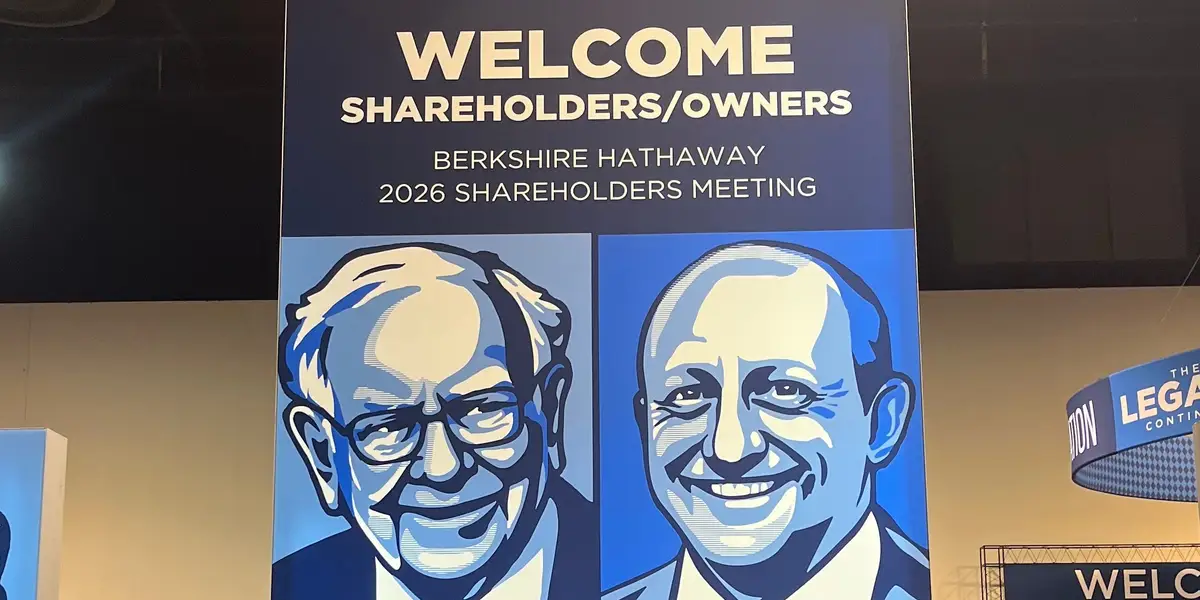
Warren Buffett did not sit at the center of Berkshire Hathaway annual shareholder meeting as chief executive. That distinction now belongs to Greg Abel, who took over as CEO in January and faced his first major public test in Omaha, Nebraska, in front of thousands of investors who had traveled from across the world. By most accounts, Abel performed competently, demonstrating deep operational knowledge and steady leadership. But for many shareholders who had grown accustomed to the unique experience that Buffett and the late Charlie Munger created over many years, something felt noticeably different.
The weekend drew noticeably smaller crowds than in previous years, with Reuters reporters and photographers estimating that around 12,000 of the arena's approximately 18,000 seats were occupied when Abel formally opened the annual meeting. Lines to enter the arena before its 7 a.m. opening were shorter than in prior years. The shopping exhibition hall, which typically buzzes with activity around Berkshire-owned businesses, saw fewer visitors and left vendors with unsold merchandise by the close of Saturday, including hundreds of boxes of commemorative See's Candies chocolates and leftover Dairy Queen ice cream bars.
Despite the thinner attendance, those who stayed for the full meeting came away with a largely positive impression of Abel's command of Berkshire's sprawling operations across insurance, railroads, energy, manufacturing, and retail. The debate among shareholders, however, was not really about Abel's competence. It was about whether Berkshire's legendary annual gathering can retain its cultural and intellectual magnetism in the post-Buffett era, and whether a conglomerate built so deeply around one person's philosophy can sustain the same emotional pull for investors worldwide.
Warren Buffett and Charlie Munger Built a Culture That Extended Far Beyond Stock Performance
In the years when Buffett and Munger shared the stage, the Berkshire annual meeting was as much a philosophical experience as it was a corporate event. Shareholders did not just come to hear quarterly results or capital allocation updates. They came to absorb decades of accumulated wisdom about investing, business, human nature, and life itself. Buffett and Munger had a rare gift for translating complex financial principles into plain language that resonated across generations, professions, and cultures. That combination of intellect, humor, and authenticity was the unofficial product being sold each May in Omaha.
Charlie Munger, who passed away in November 2023, brought his own brand of unfiltered candor to the proceedings that shareholders deeply admired. His willingness to challenge conventional wisdom, deliver uncomfortable truths, and pepper his insights with references to psychology and philosophy gave the meetings a texture that went far beyond investor relations. Together, Buffett and Munger created what many longtime attendees described as a kind of intellectual pilgrimage, an annual ritual that had no real equivalent anywhere else in the corporate world. That era is now closed, and its absence is being felt.
Xiao Zhang, a private investor from Boston, captured the sentiment that several shareholders expressed during the weekend. He noted that in previous years, Buffett and Munger shared not just investing strategies but genuine life experiences and broader philosophies that left attendees thinking long after they returned home. This year, he said, that dimension was largely missing from the proceedings. His disappointment was not a criticism of Abel personally, but a recognition that the meeting had shifted in character, moving closer to a traditional corporate conference and further from the uniquely human experience that generations of shareholders had come to treasure.
Greg Abel Demonstrates Operational Mastery But Faces the Challenge of Building His Own Identity
Greg Abel entered this year's annual meeting carrying an enormous amount of institutional weight. As the chosen successor of arguably the most celebrated investor in modern history, every word, gesture, and answer he gave on stage was being measured against a standard that no incoming CEO could reasonably be expected to match immediately. What Abel did deliver, however, impressed the investors who were paying close attention to the substance of his remarks. His knowledge of Berkshire's operations was detailed, specific, and clearly hard-won through years of hands-on involvement across the company's diverse business units.
Alexandra Cook, an accounting and finance professor at Palm Beach Atlantic University in Florida who attended the meeting with four students, said Abel did what he needed to do in this transitional moment. She observed that he visibly understood the operations with genuine depth, not just surface familiarity, and that his performance served its primary purpose of reassuring shareholders that Berkshire's leadership transition was in capable hands. That reassurance matters considerably given the size of Berkshire's shareholder base and the degree to which investor confidence in the company has historically been tied to confidence in its leadership.
Where Abel faces a longer road is in developing the kind of personal connection with shareholders that Buffett built over more than half a century. Sophia Deng, who runs an artificial intelligence startup in San Francisco, noted that the meeting felt more like an operational excellence conference than the investing and life philosophy forum that drew her to Berkshire in the first place. She said she plans to hold her existing shares but is not looking to add to her position, a sentiment that reflects a subtle but important shift in how some investors are reassessing their emotional relationship with the company under its new leadership.
Smaller Crowds and Quieter Exhibition Halls Signal a Transition Period for the Berkshire Experience
The physical atmosphere at the shareholder weekend told its own story about where Berkshire stands in this transitional moment. The Geico booth, typically surrounded by visitors eager to interact with the brand's gecko mascot, had staff audibly calling out for attendees with no line in sight. See's Candies, one of Buffett's most beloved Berkshire holdings and a perennial sellout at the annual event, had hundreds of unsold commemorative chocolate boxes remaining when sales closed on Saturday. These are not catastrophic indicators, but they are meaningful signals that the magnetic pull of the Berkshire brand is currently undergoing recalibration.
Some shareholders pointed to practical factors that may have contributed to lower attendance. The cost of international travel, along with reported hesitancy among some foreign visitors about traveling to the United States in the current geopolitical climate, was cited by multiple attendees as a likely contributor to the thinner crowds. Chandler Thien, a freelance writer from Beijing who made the trip specifically to experience Berkshire's meeting culture in person, said the face-to-face dimension of attending was still worth the investment for him, even if the overall energy of the weekend felt different from what he had anticipated based on prior years.
Others chose to view the lower attendance as a transitional phenomenon rather than a permanent decline. John Wichita, a utility systems analyst from Omaha, expressed confidence that Buffett and Munger built something with structural durability that does not depend on any individual's physical presence to sustain itself. He argued that the ideas and principles the two men embedded into Berkshire's culture over decades are ultimately more powerful than the personalities that articulated them, and that the company is built to outlast any single leader, including its most iconic one.
Berkshire's Future Under Abel Hinges on Value, Stability, and Long-Term Shareholder Trust
Despite the mixed emotional signals from the weekend, there is a substantial cohort of Berkshire shareholders who remain firmly committed to the company's long-term trajectory under Abel's leadership. For investors focused primarily on fundamentals, Berkshire's balance sheet strength, its diversified business portfolio, and its disciplined approach to capital allocation continue to make it one of the most compelling long-term holdings available in public markets. Abel's emphasis on operational excellence, rather than personal philosophy, may actually suit this segment of the shareholder base quite well.
Julie Vargas, a healthcare logistics manager from Omaha, reflected on why she found the meeting's focus on the future genuinely reassuring rather than disappointing. In a period of considerable global uncertainty, geopolitical volatility, and market anxiety, she valued the sense of direction and forward-looking perspective that Abel and his fellow executives communicated throughout the weekend. She described it as a positive step to have leadership articulating where the company is going at a time when clarity is in short supply elsewhere. That perspective represents an important constituency within Berkshire's broad and diverse investor base.
Abel is 63 years old and has indicated clearly that he intends to lead Berkshire for many years, possibly decades. He has the institutional knowledge, the management credentials, and the backing of Buffett himself, who selected him carefully over a long period of succession planning. What remains to be seen is whether Abel will develop a distinctive public persona that gives shareholders a new reason to feel the same emotional investment in Berkshire's annual gathering that Buffett's presence reliably inspired. As Richard Callahan, a retail banker from Omaha, put it plainly: Abel may grow into the role over time, but the homespun wit and personal magnetism that made the Berkshire weekend genuinely irreplaceable is something that cannot simply be transferred through succession.