
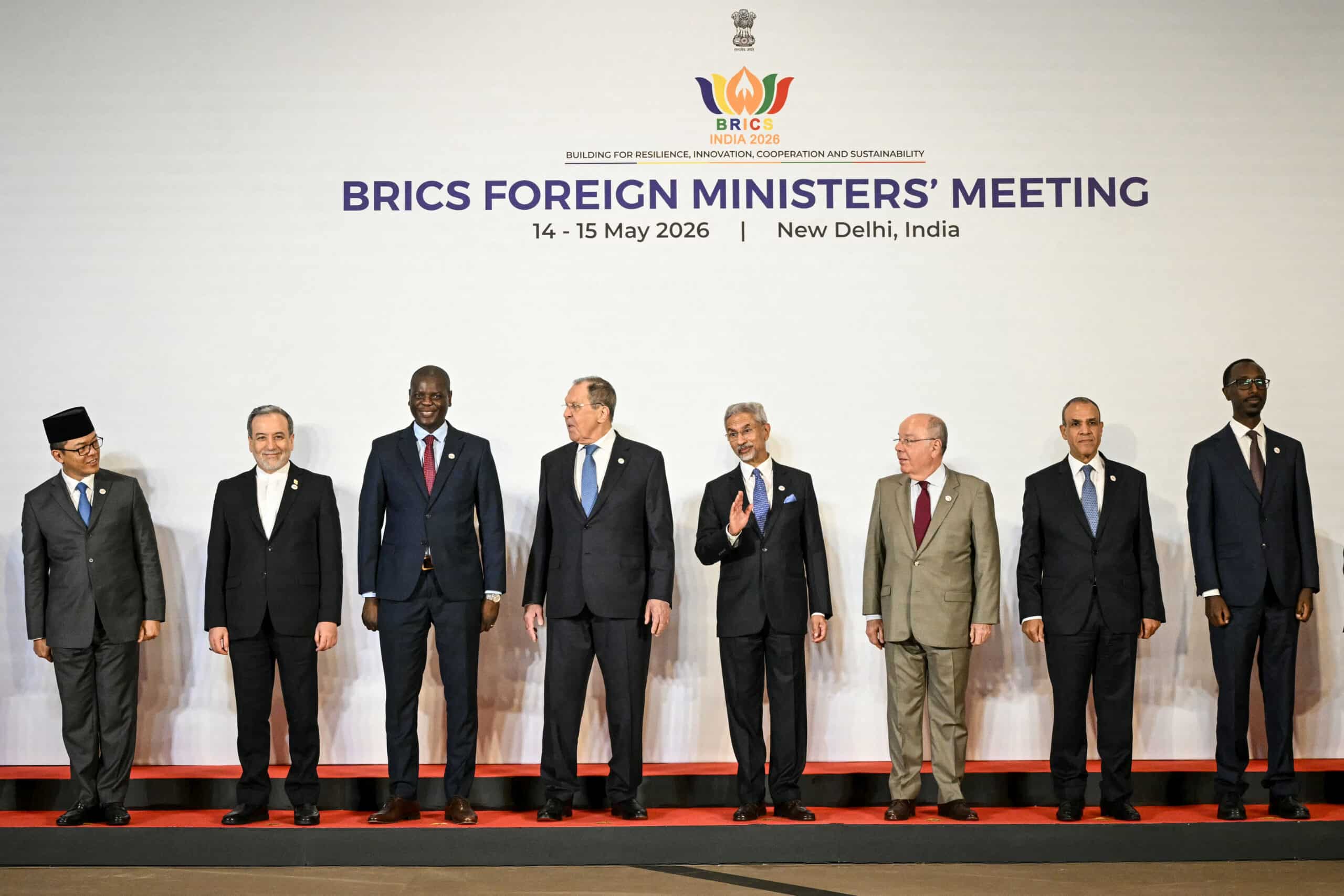
India Jaishankar UN Security Council reform BRICS 2026 demand has been placed at the centre of the BRICS foreign ministers' meeting in New Delhi, with Indian Foreign Minister Subrahmanyam Jaishankar telling assembled ministers on Friday that reform of the United Nations and its subsidiary bodies remains central to the international agenda because key UN structures, particularly the Security Council, continue to reflect an earlier era that does not represent the current distribution of global power, population, or economic weight. Jaishankar argued that representation of Asia, Africa, and Latin America is essential in the UN's principal bodies, making the case that the world's most populous and fastest-growing regions remain structurally underrepresented in the international institution most responsible for maintaining peace and security at exactly the moment when the legitimacy and effectiveness of that institution are being tested by the Iran war, the Ukraine conflict, and the broader fracturing of the post-Cold War international order. The New Delhi setting gave the call for UN reform a specific geographical and symbolic resonance, with India using its BRICS foreign ministers' hosting role to advance the UN reform agenda that has been a consistent priority of Indian foreign policy across multiple administrations and that connects directly to India's longstanding aspiration for a permanent Security Council seat.
The speech reflects a moment in which the argument for UN Security Council reform has gained new urgency from the demonstrated inadequacy of existing UN structures to manage the conflicts that the international system is currently generating. The Security Council's design, with five permanent members holding veto power, was established in 1945 to reflect the distribution of power among the victorious allied nations of the Second World War and has remained unchanged in its core structure for eight decades despite the transformation of the international system that has occurred across that period. The emergence of India, Brazil, South Africa, and the broader Global South as major economic and political actors, the decolonisation that created more than a hundred new UN member states, and the dramatic shift in global economic weight toward Asia have not been reflected in Security Council membership, creating the legitimacy gap that Jaishankar characterised as a reflection of an earlier era that no longer matches the world as it exists.
The BRICS grouping itself, encompassing Brazil, Russia, India, China, South Africa, and the new members that recent expansion rounds have added, represents a collective diplomatic platform through which the reform agenda can be advanced with a broader coalition than any single country's unilateral advocacy could assemble. The fact that China and Russia, two of the five permanent Security Council members, are part of BRICS creates a specific complexity in the forum's advocacy for Security Council reform, because both countries have used their veto power in ways that have protected their own interests and those of their allies, and neither has shown consistent enthusiasm for structural reforms that would dilute the P5's collective power even if they have occasionally expressed rhetorical support for broader representation. Jaishankar's choice of the BRICS forum to advance the UN reform agenda reflects both the genuine multilateral character of the issue and the diplomatic calculation that building Global South consensus behind the reform demand creates pressure that is harder to dismiss than a single country's advocacy.
How the UN Security Council's Structure Became Outdated and Why Reform Has Failed
The United Nations Security Council's five permanent member structure, established at San Francisco in 1945, was designed to give the major powers of the post-war international order the institutional authority and the commitment through the veto to maintain their engagement with the new collective security system that the UN was intended to provide. The United States, the United Kingdom, France, the Soviet Union, and China were the victorious powers whose cooperation was considered essential for any collective security arrangement to have practical effect, and the veto power was the political price that the drafters of the UN Charter paid to secure the participation of states that would otherwise have been unwilling to subject their own security decisions to multilateral constraint. The arrangement made political sense in 1945 given the power distribution of that specific historical moment, but it has become progressively less representative as the international system has transformed across eight decades of decolonisation, economic development, and shifting power distributions.
The case for Security Council reform rests on multiple dimensions of representational inadequacy that have grown more pronounced with each decade of unchanged structure. Africa, the continent with the most UN member states, has no permanent Security Council seat despite having the world's fastest-growing population and some of the most active UN peacekeeping operations on its territory. Latin America, home to Brazil as the world's sixth-largest economy and the largest country in the Western Hemisphere by most measures, similarly lacks permanent representation. Asia's permanent representation consists of China alone, leaving India with 1.4 billion people, Japan with the world's third-largest economy, and other major Asian nations without the structural influence that their international weight would suggest they deserve. The regional imbalances are not subtle or marginal but fundamental, reflecting the colonial-era power distribution that 1945 captured rather than the multipolar reality that the twenty-first century has produced.
Reform efforts have repeatedly failed across the decades because the veto power that the current P5 holds can be used to block any Security Council reform that requires Charter amendment, and no P5 member has considered its own interests to be served by reforms that would add new permanent members with or without veto power. The G4 group of countries seeking permanent seats, India, Germany, Japan, and Brazil, has been advocating for Security Council expansion since the 1990s without achieving the Charter amendment that their proposal requires, blocked repeatedly by the impossibility of assembling the two-thirds General Assembly majority and P5 unanimous consent that Charter amendment demands. The Uniting for Consensus group, led by Italy and Pakistan, has opposed expansion with new permanent seats, preferring more elected seats with longer terms, further dividing the reform coalition and preventing the consensus that reform requires from forming.
India's Specific Security Council Ambitions and Their Diplomatic Context
India's case for permanent Security Council membership is among the most compelling available in objective terms, combining the world's largest population, the fifth-largest economy, the world's largest democracy, a nuclear-armed state with significant regional and global security responsibilities, and a consistent record of UN peacekeeping contributions that makes India one of the largest providers of UN peacekeeping troops across multiple decades. The combination of scale, democratic credentials, peacekeeping engagement, and regional and global significance creates a factual basis for permanent membership that is difficult to dispute on the merits, even if the diplomatic obstacles to achieving it through the Charter amendment process remain formidable. India has been a non-permanent Security Council member on multiple occasions, most recently in 2021 and 2022, providing it with direct experience of the Council's workings and the frustrations of participating without permanent voice and veto.
The Iran war's demonstration of the Security Council's limitations in managing major international conflicts has given the reform argument renewed practical urgency, because the Council's inability to take meaningful collective action on the conflict, reflecting the divisions among permanent members and the use or threatened use of veto power to block resolutions that any permanent member finds unacceptable, is precisely the dysfunction that reform advocates argue structural change could address. A Security Council that included India, Brazil, South Africa, and other major Global South countries as permanent members would bring different perspectives and different relationships with the parties to major conflicts, potentially providing mediation and dialogue channels that the current P5 composition does not offer. Whether a more representative Council would be more effective at managing conflicts or simply more complex to achieve consensus within is a genuine policy debate, but the representation argument retains its force regardless of how the effectiveness question is resolved.
The BRICS Forum, India's Hosting Role, and the Reform Coalition
India's hosting of the BRICS foreign ministers' meeting in New Delhi provides the diplomatic platform and the international media visibility that allows the UN reform message to reach an audience beyond the normal circles of multilateral diplomacy, creating the kind of public record of positions and pressures that builds the long-term consensus that reform eventually requires. The foreign ministers of the BRICS grouping represent a substantial portion of the world's population, economic output, and geopolitical influence, and their collective engagement with the UN reform agenda in New Delhi creates a multilateral statement whose weight exceeds what bilateral meetings or regional groupings could generate. Jaishankar's choice to use the hosting role to advance the UN reform message reflects a deliberate diplomatic strategy of building the BRICS platform's relevance to issues beyond economics and trade toward the governance questions that India considers central to the reconfiguration of the international order that the current global disruption is accelerating.
The challenge for the BRICS forum's UN reform advocacy is that the grouping includes China and Russia, both permanent Security Council members, whose interests in reform depend on what specific proposals are on the table. China has generally been cautious about Security Council expansion that would include Japan or other countries it considers regional rivals, and has supported India's aspirations more in rhetoric than in concrete diplomatic action when Charter amendment proposals have been advanced in the General Assembly. Russia's position has similarly been more rhetorically supportive than practically enabling, with both countries understanding that the existing P5 structure gives them structural advantages in global governance that reform would dilute. Jaishankar's ability to use the BRICS forum to advance genuine reform momentum therefore depends on navigating the tension between the grouping's collective interest in a more representative international order and the individual interests of its P5 members in the specific structure that reform would change.
The Global South solidarity argument that Jaishankar employed, emphasising the essential nature of Asian, African, and Latin American representation in UN bodies, is the most politically compelling framing available for the reform agenda because it connects the institutional question to the broader narrative of post-colonial redress and contemporary multipolarity that resonates across the developing world and that China and Russia cannot openly oppose without undermining their own positioning as champions of the non-Western world against Western dominance. The framing creates political pressure that is difficult to absorb through rhetorical support while blocking practical progress, and India's consistent and increasingly sophisticated advocacy for UN reform at multilateral forums like BRICS is a long-term diplomatic investment in the normative case whose payoff may be measured in decades rather than election cycles.