
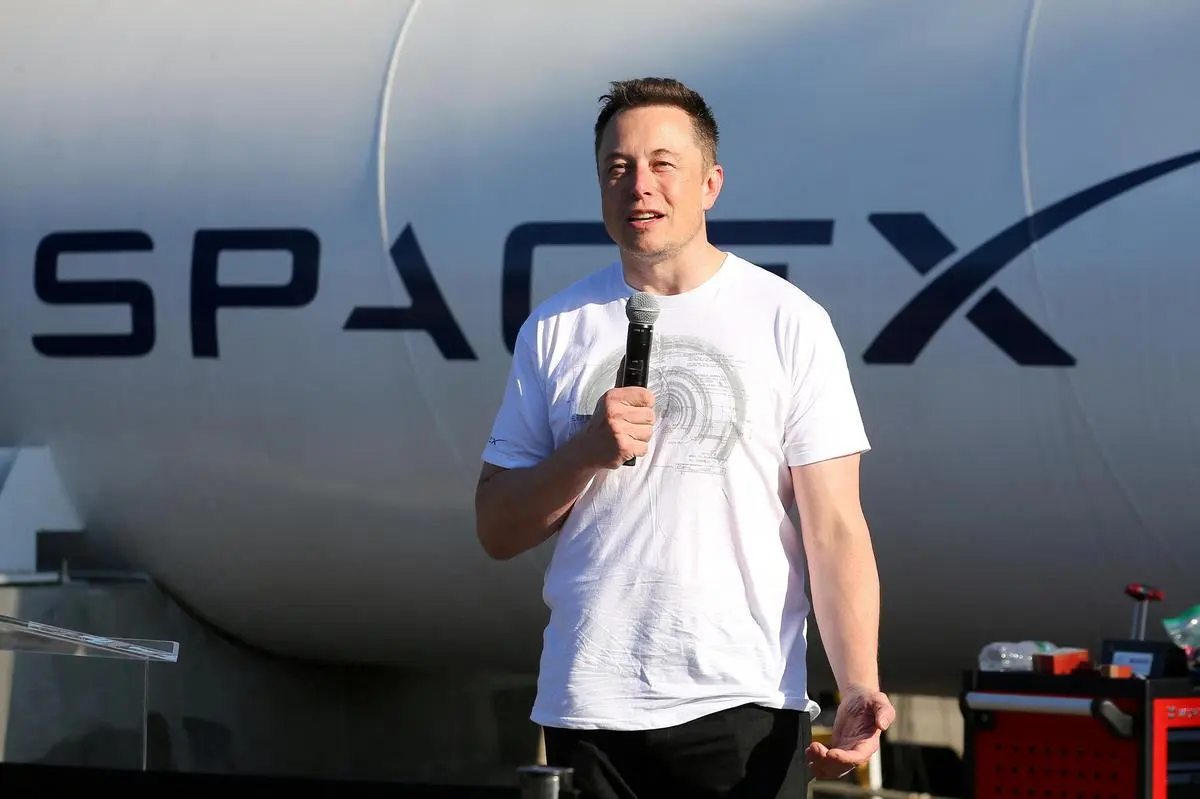
SpaceX has filed confidentially for an initial public offering that would be the largest in stock market history, with excerpts of the prospectus reviewed by revealing that founder Elon Musk and a small group of company insiders will retain overwhelming voting control of the rocket and satellite internet company through a dual-class share structure that grants them ten votes per share compared to the single vote attached to each Class A share sold to public investors, a governance arrangement that ensures Musk's strategic vision for SpaceX will remain effectively unchallenged by outside shareholders regardless of how large a proportion of the company's equity eventually passes into public hands through the listing process. The company is targeting a listing valuation of approximately $1.75 trillion with a fundraising target of $75 billion, figures that would shatter previous records for initial public offerings and would place SpaceX among the most valuable publicly traded companies on earth from the moment of its market debut, reflecting the extraordinary combination of commercial success in satellite internet through its Starlink business, its dominant position in global launch services, and the massive artificial intelligence infrastructure investment it has undertaken through its combination with Musk's xAI company this year. The confidential filing, made this month, provides the first detailed public look at SpaceX's financial position and corporate governance structure, and Wall Street analysts are scheduled to receive three days of briefings and presentations beginning this week with a tour of SpaceX's Starbase launch facility in Boca Chica, Texas, as the company begins the formal process of building the investor understanding and institutional demand that a listing of this unprecedented scale will require to price successfully and maintain strong aftermarket performance.
The dual-class equity structure that SpaceX has chosen for its public listing places it within a well-established tradition among founder-led technology companies, joining Google, Meta, and numerous other major technology platform businesses that have used differential voting rights to preserve founder control through and after the transition to public ownership, but the specific implementation and the scale of SpaceX's listing give the governance questions particular importance and visibility at a moment when institutional investors and governance advocates have become increasingly vocal about the long-term risks that super-voting share structures create for minority shareholders who bear economic risk without proportionate influence over the decisions that affect their investment. Under the structure described in the filing excerpts, Class B shareholders will receive ten votes for each share they hold, concentrating effective decision-making power with Musk and a handful of other insiders who will together command a majority of total voting power even as public shareholders collectively own a substantial portion of the company's economic value. The filing also outlines provisions that restrict shareholders' ability to influence board elections and pursue certain legal claims against the company, channeling disputes into arbitration processes and limiting where legal challenges can be brought, creating a governance environment in which public investors have significantly less recourse than they would in a company with conventional single-class share structures and standard shareholder rights provisions.
Musk will retain his roles as chief executive officer, chief technical officer, and chairman of SpaceX's nine-member board of directors following the completion of the offering, a combination of executive and governance roles that gives him simultaneous control over the company's strategic direction, its technical decision-making, and the board oversight function that in conventional corporate governance structures is intended to provide independent scrutiny of management performance and accountability. His compensation last year was recorded at just $54,080, a nominal figure that reflects the same approach to founder compensation that characterizes Musk's arrangements at his other companies and that is entirely beside the point economically given that he stands to gain billions in equity value following the company's stock market debut at the targeted $1.75 trillion valuation. The contrast between his minimal salary and the astronomical equity value he is positioned to capture through the IPO illustrates the way in which modern founder compensation at the largest technology and space companies has moved almost entirely away from salary and cash compensation toward equity-based wealth creation that is measured not in millions but in hundreds of billions of dollars across Musk's various corporate interests.
How SpaceX Built the Financial Foundation That Makes a $1.75 Trillion Valuation Plausible
SpaceX's journey to the point where a $1.75 trillion listing valuation is being seriously proposed and actively marketed to institutional investors is a story of building commercial dominance in the global launch market through relentless technical innovation and cost reduction, transforming a government-dependent contractor into a commercially self-sustaining business through the Starlink satellite internet service, and then making a dramatic and financially costly pivot into artificial intelligence infrastructure through the combination with xAI that has fundamentally changed the company's financial profile in ways that the IPO filing's first detailed financial disclosures are now making visible to potential investors for the first time. The combined company ended 2025 with approximately $24.8 billion in cash on hand, a liquidity position that reflects both the revenue-generating power of Starlink and the fundraising that SpaceX has conducted through private capital markets over recent years, and carried total assets of $92 billion against total liabilities of $50.8 billion, producing a net asset position that provides a substantial balance sheet foundation for a company that is simultaneously managing the capital requirements of rocket development, satellite constellation expansion, and now massive AI infrastructure investment.
The financial trajectory revealed in the filing excerpts tells a story of a company that was moving from loss to profitability in its core space and satellite internet businesses before the xAI combination fundamentally altered the picture. SpaceX generated a $791 million profit on revenue of $14.02 billion in 2024, a genuine profitability milestone for a company that had spent its early years burning through capital at rates that would have ended most private ventures before they achieved commercial scale, demonstrating that the Starlink business model was not only technically viable but genuinely commercially powerful as a generator of operating cash flow at scale. The company had previously recorded a $4.63 billion loss on $10.4 billion in revenue in 2023, reflecting the heavy investment phase of Starlink's constellation buildout and the continuing capital requirements of Falcon 9 and Starship development, making the 2024 swing to profitability a significant validation of the business model that underpins the IPO's valuation proposition.
The 2025 financial results, which show SpaceX swinging back to a $4.94 billion consolidated loss on revenue of $18.67 billion, need to be understood primarily as the financial reflection of the decision to combine with xAI and accelerate investment in artificial intelligence infrastructure rather than as evidence of deterioration in the underlying space and satellite internet businesses that remain the core of what makes SpaceX commercially valuable. Revenue grew by approximately $4.65 billion between 2024 and 2025, demonstrating continued strong commercial momentum in the Starlink subscriber base and launch services market, while the loss reflects the absorption of xAI's financial profile and the dramatic acceleration of capital expenditure on AI infrastructure that Musk has determined is necessary for the combined company to compete effectively in what he views as the most consequential technology race of the current era. The filing's disclosure of these numbers for the first time gives institutional investors the raw material they need to assess whether the investment in AI infrastructure represents a value-creating strategic decision or a dilution of the focused space and satellite internet business model that had brought SpaceX to profitability before the xAI combination.
Starlink's Profitability Subsidizing Massive AI Infrastructure Investment
The Starlink satellite internet business has emerged from the IPO filing's financial disclosures as the commercial engine whose profitability is effectively subsidizing the company's enormous and rapidly growing investment in artificial intelligence infrastructure, a financial relationship that is both the key to understanding SpaceX's current financial profile and one of the most important questions that potential IPO investors will need to assess in determining whether the company's capital allocation strategy is likely to create or destroy long-term shareholder value at the unprecedented valuation being targeted for the listing. Starlink generated $4.42 billion in operating profit last year, a figure that represents genuine and substantial commercial success for a satellite internet constellation that has grown from a speculative and technically ambitious concept into one of the world's most widely used broadband internet services with subscribers in countries across every inhabited continent and a particular strategic importance in underserved and remote areas where terrestrial broadband infrastructure cannot economically reach. That $4.42 billion of Starlink operating profit is however accounting for less than a quarter of SpaceX's total capital expenditures, meaning that the profitable satellite internet business is generating cash flow at a rate that covers only a fraction of the total investment the combined company is making across its various business segments.
The scale of the AI infrastructure investment that is driving SpaceX's overall capital expenditure to levels that dramatically exceed Starlink's operating profit generation is made concrete by specific numbers that the filing excerpts reveal. Capital expenditure at the AI segment surged to $12.7 billion last year from $5.6 billion the prior year, an increase of more than $7 billion in a single year that reflects the acceleration of data center construction, compute infrastructure acquisition, and the other physical investments required to build the AI training and inference capacity that xAI needs to compete with OpenAI, Google DeepMind, Anthropic, and other well-capitalized rivals in the large language model and artificial intelligence services market. This $12.7 billion of AI capital expenditure alone substantially exceeds the $4.42 billion of Starlink operating profit, and when combined with the capital requirements of the space and launch businesses, pushes SpaceX's total capital expenditure to $20.74 billion for the year, more than double the prior year's total and representing an almost fivefold increase over two years that illustrates the pace at which the company has redirected capital toward AI infrastructure since the xAI combination was completed.
The comparison that the filing context invites between SpaceX's AI infrastructure spending and that of the largest technology companies provides important scale perspective for investors trying to assess whether the company's AI investment is adequate to the competitive challenge it faces or represents an unsustainable drain on the capital that the core space and satellite internet businesses require for their own continued development and growth. Meta, which operates at a comparable overall market capitalization of approximately $1.7 trillion and which is investing in AI infrastructure at the scale required to maintain its competitive position in social media and develop next-generation AI products, recorded capital expenditure of $72 billion in 2025, a figure that puts SpaceX's $12.7 billion of AI-specific capital expenditure in stark perspective as a fraction of what the most aggressive AI infrastructure investors are spending. Whether SpaceX can build a competitively meaningful AI business at a spending level that is less than one-fifth of what Meta is deploying is one of the most important and genuinely uncertain strategic questions that the IPO filing raises without definitively answering, and it will be central to the investor conversations that the three-day analyst briefing program beginning this week is designed to address.
What the IPO Structure and Governance Terms Mean for Public Investors
The specific governance provisions that the SpaceX IPO filing describes create an investment proposition that is genuinely unusual even by the standards of founder-controlled technology company listings, combining the dual-class voting structure that has become relatively standard in the technology sector with additional provisions restricting shareholder legal rights and board election influence in ways that limit public investors' recourse more comprehensively than most comparable listings have done. The arbitration provisions and forum selection restrictions outlined in the filing mean that public shareholders who believe they have been harmed by decisions made by SpaceX's management or board will face significant practical obstacles in pursuing legal remedies, since mandatory arbitration processes are generally less favorable to plaintiffs than litigation in state courts and restrict the ability to pursue class action claims that aggregate many individual shareholders' harm into legally efficient collective proceedings. These provisions reflect a deliberate choice by SpaceX's legal architects to minimize the governance and litigation risks associated with public ownership while capturing the capital market benefits of a listed equity, a choice that is legally permissible in the jurisdictions where SpaceX is incorporated but that institutional investors and governance-focused activist funds will assess carefully before committing capital at the valuation levels being targeted.
President and Chief Operating Officer Gwynne Shotwell's total compensation of $85.8 million last year and Chief Financial Officer Bret Johnsen's $9.8 million package provide context for understanding the human capital costs of maintaining the executive leadership that has built SpaceX into its current position, with Shotwell's compensation reflecting her decade-plus role as the operational architect of a company that has grown from a small launch startup into the dominant force in global commercial launch services and the operator of the world's largest satellite internet constellation. The contrast between Shotwell's market-rate executive compensation and Musk's nominal $54,080 salary reflects their very different relationships to SpaceX's equity value, with Musk's compensation being entirely indexed to the equity appreciation that a successful IPO at the targeted valuation would crystallize into the kind of personal wealth increment that is difficult to express in conventional financial terms. The question for public investors is not whether these compensation arrangements are appropriate for the individuals involved but whether the governance structure being established through the IPO terms will ensure that the interests of the executives who will continue to control SpaceX after listing remain sufficiently aligned with the interests of the public shareholders whose capital will fund the continued development of the AI infrastructure, launch capabilities, and Starlink expansion that the company's growth ambitions require.
The three-day analyst briefing program beginning with the Starbase facility tour in Boca Chica represents SpaceX's opportunity to translate the raw financial and governance data in the IPO filing into a compelling narrative about why the company deserves a $1.75 trillion valuation and why the governance structure being established, for all its limitations on public shareholder rights, is appropriate for a company whose success has been built on the founder's willingness to make long-term capital allocation decisions that conventional short-term-focused public market shareholders might not have supported. The comparison to other founder-controlled technology companies that have successfully built long-term shareholder value while maintaining founder voting control provides some historical support for the governance model being proposed, but SpaceX's specific combination of space infrastructure, satellite internet, and AI ambitions, and the financial profile that the xAI combination has created, make direct comparisons to previous technology IPOs imperfect guides to how public markets will assess and value the company once it begins trading.