
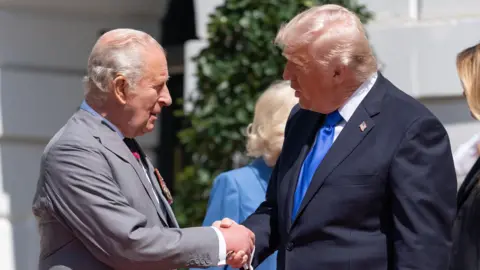
The United States has lifted all tariffs on Scotch whisky and Irish whiskey imports following a landmark state visit by King Charles and Queen Camilla. President Donald Trump announced the decision personally, calling it a gesture of respect and gratitude toward the British monarchs who spent four transformative days in the country. The move has been widely celebrated across Scotland, Ireland, and the broader whisky Tariffs removal trade as a turning point for an industry that had endured months of mounting financial pressure.
The announcement came on Thursday as the King and Queen prepared to depart the United States after visiting Washington DC, New York, and Virginia. Trump made it clear that the royal visit served as the catalyst for a deal that trade negotiators had been working toward for many months. For distillers, exporters, and farming communities tied to the Scotch whisky industry, the news brought an immediate sense of relief.
Industry figures quickly welcomed the announcement. The Scotch Whisky Association confirmed that exports to the United States had suffered losses of around 4 million pounds every week since tariffs were introduced, amounting to approximately 150 million pounds over the past year. With the tariffs now removed, businesses can begin rebuilding their most valuable export market with renewed confidence.
What Were the Whisky Tariffs and Why Did They Matter?
The tariffs in question were part of a broader set of trade measures introduced under the Trump administration, which added a 10 percent levy to whisky importers' costs in the United States. This directly impacted the competitiveness of Scottish single malt whiskies, which are premium products commanding higher prices in international markets. American buyers were absorbing part of that cost, and sales volumes in the US had been declining as a result.
The situation was set to worsen. Single malt tariffs that had previously been suspended were on course to return this spring with an additional 25 percent charge, unless a deal could be reached between the UK and the US. That prospect alarmed distillers across Scotland, particularly smaller independent producers who rely heavily on US export revenue. The stakes for the industry were extremely high heading into the spring season.
Beyond Scotland, the tariffs also disrupted a deeply interconnected trade relationship between Scottish distillers and American bourbon producers in Kentucky. Scotch whisky maturation traditionally depends on used Kentucky bourbon barrels, with Scotland importing roughly 200 million pounds worth of those barrels each year. The tariff environment had created friction across that supply chain, affecting both sides of the Atlantic.
Trump Credits King Charles Visit as the Reason for the Deal
In a post on his Truth Social platform, Trump described the tariff removal as a direct tribute to King Charles and Queen Camilla. He wrote that the royal visit had prompted him to take action that nobody else had been able to achieve, noting that the King and Queen had barely even needed to ask. The phrasing suggested that the personal rapport developed during the state visit played a decisive role in accelerating an outcome that trade officials had been seeking for a long time.
Trump also highlighted the historical and commercial connection between Scotland and Kentucky, pointing to the wooden barrel trade as a symbol of genuine economic interdependence between the two regions. He framed the policy change not just as a trade decision but as a celebration of the friendship between the United Kingdom and the United States. That framing helped position the announcement as both a diplomatic win and a practical one.
At a press conference later the same day, Trump reiterated his reasoning. He confirmed that all restrictions on Scotland's ability to work with Kentucky in the whisky and bourbon sectors had been lifted, effective immediately. The directness of his language left little ambiguity about the scope of the change and its connection to the royal occasion.
Buckingham Palace and Scottish Government React With Gratitude
Buckingham Palace responded to the announcement with warmth and a touch of humor. A spokesperson confirmed that King Charles had sent his sincere gratitude to President Trump and added that the King would be raising a dram in honour of the President's thoughtfulness. The lighthearted comment resonated with people on both sides of the Atlantic and underlined the genuine goodwill that had developed between the two leaders during the visit.
Scotland's First Minister John Swinney described the news as tremendous for Scotland and acknowledged the key role played by King Charles in helping bring the deal to fruition. Swinney noted that the Scottish economy had been losing millions of pounds every month while the tariffs were in place, and expressed relief that the financial bleeding had now stopped. For a country where whisky is not just an industry but a cultural institution, the announcement carried significant emotional weight alongside its economic value.
UK Business and Trade Secretary Peter Kyle also welcomed the development, pointing out that the Scotch whisky industry is worth close to one billion pounds in exports and supports thousands of jobs across the United Kingdom. He positioned the outcome as a concrete example of British trade diplomacy delivering real results for workers and businesses at home. The cross-party and cross-border unity of the response underlined just how broadly the decision was welcomed.
What This Means for the Future of Scotch Whisky Exports
The lifting of tariffs opens a significant commercial opportunity for distilleries of all sizes across Scotland. The United States is the single largest export market for Scotch whisky, and even modest improvements in price competitiveness can translate into meaningful volume gains. With the 10 percent tariff removed and the threatened additional 25 percent charge now off the table, producers can price their products more attractively for American consumers.
Graeme Littlejohn, Director of Strategy at the Scotch Whisky Association, called the announcement a real boost for the entire sector. He credited months of senior-level negotiation for laying the groundwork, while acknowledging that the state visit may well have provided the final push to get the deal over the line. His reference to a touch of royal sparkle captured the mood within the industry, which had been under sustained pressure since the tariffs were first introduced.
For Kentucky bourbon producers, the removal of restrictions on barrel trade also brings commercial benefits. The mutual dependency between Scotch and bourbon through the barrel exchange has long been a quiet but economically significant link between the two industries. Restoring that relationship to its full potential benefits workers and businesses in both the American South and rural Scotland.