
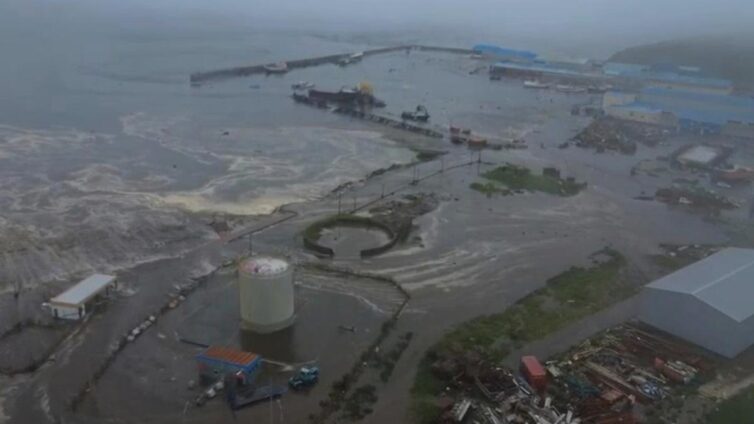
Japan earthquake tsunami warning 2026 magnitude 7.7 struck off the northeastern coast at 4:53 pm local time on Monday, prompting authorities to immediately issue evacuation orders for thousands of coastal residents and warn of tsunami waves of up to 3 metres expected along the shoreline. Two hours after the tremor, the maximum detected tsunami wave height had reached 80 centimetres, and the Japan Meteorological Agency subsequently downgraded the initial tsunami warning to a tsunami advisory as the threat assessment was revised in light of observed wave data. Japan's top government spokesperson Minoru Kihara confirmed at a press conference as night fell in Tokyo that there were no immediate reports of casualties or major damage, providing the initial reassurance that emergency response authorities had been hoping for given the quake's significant magnitude and its occurrence along one of the most seismically active coastlines in the world.
The earthquake's epicentre was located in the Pacific Ocean at a depth of 20 kilometres, and it registered an upper 5 on Japan's seismic intensity scale, a level strong enough to make it difficult for people to move around and capable of causing un-reinforced concrete-block walls to collapse. Port towns including Otsuchi and Kamaishi, both communities devastated by the catastrophic 2011 earthquake and tsunami, were among those that issued evacuation orders, activating the community disaster response systems that those towns rebuilt specifically with the lessons of 2011 in mind. Bullet train services were halted and several motorways were closed as a precautionary response to the tremors, disrupting travel and commerce across the northeastern region while emergency services assessed the earthquake's impact on infrastructure and coastal communities.
The government issued a warning of heightened megaquake risk following Monday's tremor, with a government official explaining at a press conference that the normally approximately 0.1 percent weekly probability of a magnitude 8 or stronger earthquake striking along the Japan Trench and Kuril Trench would be elevated to approximately 1 percent in the week following Monday's quake. That tenfold increase in megaquake probability, while still a relatively low absolute number, represents the kind of elevated seismic risk that requires public communication and preparedness reinforcement. The absence of nuclear power plants currently in operation in the affected areas provided one significant source of reassurance, with Hokkaido Electric Power and Tohoku Electric Power both reporting no abnormalities at their idled facilities in the region.
Japan's Earthquake History and Why the 2011 Memory Shapes Every Response
Japan's status as one of the world's most earthquake-prone countries is not a geological misfortune but a direct consequence of its position at the convergence of multiple tectonic plates in the Ring of Fire, the zone of volcanoes and oceanic trenches that partly encircles the Pacific Basin and accounts for the majority of the world's seismic activity. Japan accounts for approximately 20 percent of the world's earthquakes of magnitude 6.0 or more, an extraordinary concentration of seismic energy release in a country of 125 million people whose modern industrial economy has been built in a landscape of near-constant geological activity. The Japan Meteorological Agency estimates that a tremor of some magnitude occurs in Japan at least every five minutes, making earthquakes not exceptional events but a continuous background feature of life that Japanese infrastructure standards, public education, and emergency management systems have been specifically designed to accommodate.
The Japan Trench, located off the northeastern Pacific coast of Honshu, is one of the world's most seismically active submarine geological features, where the Pacific Plate subducts beneath the North American Plate at a rate that generates the accumulated stress whose release produces the region's most powerful earthquakes. The trench and the subduction zone that it represents are the geological parent of the 2011 Tohoku earthquake, the 2003 Tokachi earthquake, and a long historical record of major seismic events that have shaped northeastern Japan's geography, urban planning, and cultural relationship with natural disaster. Monday's magnitude 7.7 event occurred within the same geological system that produced those previous earthquakes, and its epicentre's location in the Pacific Ocean off the northeastern coast places it in the same general seismic zone whose characteristics Japanese seismologists track most closely given its demonstrated capacity for catastrophic events.
The Kuril Trench, mentioned alongside the Japan Trench in the government's megaquake probability statement, extends northward from the Japan Trench along the Kuril Islands chain, creating a continuous subduction zone of enormous length whose total accumulated stress represents one of the highest concentrations of unreleased seismic energy in the world. Seismological research has identified the potential for magnitude 8 or greater earthquakes along multiple segments of both trenches, and the probability elevation that the government cited following Monday's tremor reflects the well-established seismological principle that large earthquakes can trigger or be followed by additional large events in the same seismic zone as stress is redistributed along the fault system. The 1 percent weekly probability that the government cited is ten times the background rate but still means that a megaquake remains unlikely in any given week, while representing a level of elevated risk that justifies the public warning.
The 2011 Tohoku Disaster and Its Lasting Legacy for Otsuchi and Kamaishi
The 2011 Tohoku earthquake and tsunami, which struck at magnitude 9.0 on March 11, 2011, remains the defining catastrophe in modern Japanese disaster history and the event against which every subsequent northeastern coastal earthquake is immediately measured. The 2011 tsunami waves, which reached heights of up to 40 metres in some locations and swept several kilometres inland across the Sanriku coast, killed approximately 20,000 people, destroyed entire communities, and triggered the Fukushima Daiichi nuclear plant meltdowns that became the world's most serious nuclear accident since Chernobyl. The physical destruction of coastal infrastructure, fishing industries, and residential communities across the Sanriku region was of a scale that Japan's modern society had not previously experienced, and the recovery and rebuilding process that followed has continued for more than a decade and is still not fully complete.
Otsuchi and Kamaishi, both of which issued evacuation orders following Monday's earthquake, were among the communities most severely affected by the 2011 tsunami. Otsuchi lost approximately ten percent of its population in the disaster and its town hall was destroyed, leaving the community's administrative functions unable to operate during the critical immediate post-disaster period. Kamaishi, a former steel manufacturing city whose population had been declining even before 2011, lost significant portions of its waterfront district and its fishing port infrastructure. Both towns have rebuilt their coastal defences with massive seawall construction programmes that have changed the physical appearance of their waterfronts, and both have invested heavily in community-based disaster preparedness systems that include regular evacuation drills, warning system maintenance, and the cultural reinforcement of the instinct to evacuate immediately when a tsunami warning is issued rather than waiting to observe whether waves actually materialise.
The evacuation orders issued in these communities on Monday activated the emergency protocols that 2011 made mandatory and that both towns have practised repeatedly since then. The community memory of 2011 functions as a powerful and self-reinforcing motivator for evacuation compliance in a way that official warnings alone cannot produce in communities without that direct trauma in their recent history. Residents of Otsuchi and Kamaishi who evacuated when Monday's warning was issued were following both official instruction and the deepest kind of community learning, the collective memory of what happens when people do not evacuate quickly enough and the determination that that experience will not be repeated on their watch regardless of how uncertain the threat may appear in its early minutes.
The Nuclear Question and Why Plant Status Matters Immediately After Any Major Quake
The immediate disclosure that there were no nuclear power plants currently in operation in the affected areas, and that Hokkaido Electric Power and Tohoku Electric Power reported no abnormalities at their idled facilities, reflects the structural change in Japan's nuclear energy landscape that the 2011 Fukushima disaster produced. Before March 2011, Japan operated more than fifty nuclear reactors that collectively provided a significant share of the country's electricity supply, and the pre-Fukushima assumption was that Japan's nuclear plants had been engineered to survive major earthquakes and tsunamis without losing the cooling systems that prevent fuel meltdown. The Fukushima disaster demonstrated that those engineering assumptions had underestimated both the scale of the possible tsunami and the multiple simultaneous system failures that an extreme event could produce, triggering a comprehensive reassessment of nuclear safety standards that led to the shutdown of all Japanese reactors and a long process of regulatory review before selective restarts have been permitted under new safety standards.
The idled status of the Hokkaido and Tohoku Electric facilities in the affected region means that the nuclear dimension of Monday's earthquake is limited to the question of whether the physical structures of the idled plants suffered any damage from the seismic shaking, a much more tractable question than the operational safety questions that would arise if those plants were generating power. Idled nuclear facilities still contain spent fuel and other radioactive materials that require management and monitoring, but the absence of active nuclear reactions means that the cooling system failure scenarios that produced Fukushima's meltdowns are not applicable to facilities that are not generating heat. Both utilities' reports of no abnormalities at their facilities provide the initial assurance that the earthquake's physical impact on nuclear infrastructure in the region was within the tolerance that the facilities' seismic design standards were intended to accommodate.
The Downgraded Warning, the Megaquake Risk, and What Comes Next
The downgrading of the initial tsunami warning to a tsunami advisory two hours after the earthquake represents the standard emergency management process of adjusting the threat assessment as actual observational data replaces the initial model-based projections. The Japan Meteorological Agency's initial 3-metre tsunami warning was based on rapid seismological analysis of the earthquake's magnitude, depth, and location, using computer models that estimate potential tsunami wave heights from those parameters before any actual wave measurements are available. As tide gauges, ocean sensors, and coastal monitoring stations began reporting actual wave heights, the maximum observed value of 80 centimetres provided a specific empirical basis for revising the threat assessment downward from the 3-metre warning level.
The distinction between a tsunami warning and a tsunami advisory carries specific operational meaning in Japan's emergency management system. A tsunami warning requires immediate evacuation of coastal areas and prohibits approach to the coast, while a tsunami advisory allows people who have already evacuated to remain away from the shoreline while permitting emergency services to begin assessment activities in the coastal zone. The downgrade from warning to advisory does not signal that the event is over or that return to coastal areas is safe, but it reflects the available wave data's indication that the most severe tsunami scenarios are no longer considered likely based on observed conditions. Residents and local authorities who received the advisory would be expected to maintain caution and continue monitoring official communications for further updates about when coastal return would be considered safe.
The absence of reports of casualties or major damage as of Kihara's evening press conference reflects both the effectiveness of the evacuation orders and the actual wave heights that materialised rather than the worst-case projections. Japanese coastal communities' investment in warning systems, evacuation infrastructure, and public education since 2011 has demonstrably improved evacuation rates and reduced the exposure of coastal residents during the critical minutes between warning issuance and potential wave arrival. The 80-centimetre maximum observed wave height, while requiring continued caution, is significantly lower than the 3-metre projection that triggered the initial evacuations, and a coastal population that responded appropriately to the warning by moving to higher ground would have been well clear of any flooding that even the higher projected wave heights would have produced.
The Megaquake Probability Elevation and What It Means for Public Preparedness
The government's communication that the weekly probability of a magnitude 8 or stronger earthquake along the Japan Trench and Kuril Trench had risen from approximately 0.1 percent to approximately 1 percent represents the application of seismological research findings about earthquake clustering and stress transfer to real-time public communication. The mechanism behind this probability elevation is the transfer of stress along fault systems that occurs when a large earthquake releases energy in one segment, potentially loading adjacent segments closer to their own failure threshold. Seismological research following the 2011 Tohoku earthquake documented this stress transfer effect across multiple fault segments, contributing to a period of elevated seismic activity in northeastern Japan in the months following that disaster.
The 1 percent weekly megaquake probability that the government cited should be understood in both its relative and absolute contexts simultaneously. Relative to the background rate of 0.1 percent, it represents a tenfold increase that the scientific evidence justifies communicating to the public. In absolute terms, a 1 percent weekly probability means a 99 percent probability that a megaquake will not occur in that specific week, and the appropriate public response is heightened preparedness rather than the kind of alarm that would justify economic disruption or mass evacuation absent more specific warning. Japan's emergency management authorities have become increasingly sophisticated in communicating probabilistic risk information after 2011, attempting to provide accurate information about elevated risk without triggering either complacent dismissal or disproportionate alarm.
The suspension of bullet train services and motorway closures that followed Monday's earthquake illustrates the automatic and comprehensive nature of Japan's infrastructure protection response to significant seismic events. Japan's Shinkansen high-speed rail network is equipped with early warning sensors that can trigger automatic braking before seismic waves reach the train's location, and the manual halt of services following a magnitude 7.7 event reflects the additional human safety decision layer that operates above the automated systems to ensure that services do not resume before the infrastructure has been inspected and cleared. The resumption of rail and road services following such events typically occurs within hours once physical inspections confirm no structural damage, but the temporary disruption to the movement of people and goods across the northeastern region represents one of the most immediate economic impacts of major seismic events even when physical damage to the infrastructure is minimal.