
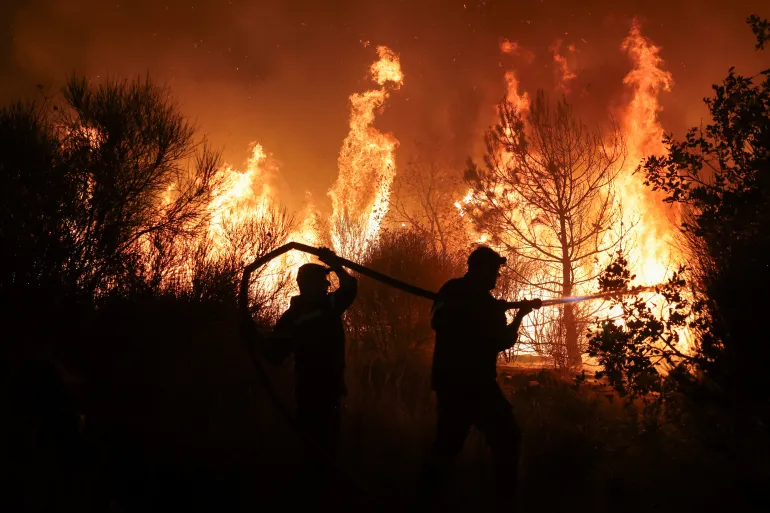
Europe wildfire crisis has reached a level of severity that is outpacing the continent's capacity to respond, and a major new report released ahead of the Aerial Fire Fighting Conference in Rome is making that gap impossible to ignore. Commissioned by Avincis, a Portugal-based company that leases firefighting aircraft and helicopters across Europe, and compiled by consulting firm Lead by Thought, the report concludes that the continent is dangerously unprepared to tackle a wildfire threat that is growing larger, starting earlier, ending later, and spreading into countries that have never historically dealt with serious fire risk. The findings arrive as the European Commission prepares to propose a new fire prevention and risk reduction strategy on Wednesday.
The numbers behind the warning are stark and specific. Wildfires destroyed 1.03 million hectares of forest across the European Union in 2025 the highest level since records began. Spain alone suffered 393,079 hectares burned, followed by Portugal, Romania, Italy, Greece, and France in descending order of damage. Sweden recorded 1,100 hectares burned last year, a rise of more than 120 percent above its recent average. Finland and Denmark also exceeded their long-term baselines. These are not southern European problems anymore they are continental ones, and the infrastructure built to fight them was designed for a different climate than the one Europe now inhabits.
Three structural forces are driving the crisis simultaneously and reinforcing each other in ways that make each individual factor worse. Climate change is raising temperatures and extending drought conditions across a continent whose fire management systems were calibrated for a cooler, wetter baseline. Falling rural populations are leaving vast stretches of countryside unmanaged, allowing burnable vegetation to accumulate across landscapes that farming communities once kept cleared. And the global firefighting aircraft fleet is shrinking in effective terms just as demand for it is rising squeezed by longer fire seasons, bureaucratic barriers to pilot licensing, red tape slowing aircraft production, and a shrinking window for moving planes between hemispheres to match fire seasons. Europe is facing a bigger fire problem with fewer functional tools to fight it.
How Europe's Wildfire Problem Was Built Over Decades
Europe's wildfire crisis did not arrive without warning it was constructed gradually across decades through the intersection of climate trends and demographic shifts that individually seemed manageable but together created conditions for catastrophic fire seasons. Average temperatures across southern Europe have risen consistently over the past fifty years, with summer heat extremes becoming more frequent, more intense, and more prolonged. Drought periods that once lasted weeks now stretch into months across Spain, Portugal, Greece, and Italy, drying out the vegetation that covers millions of hectares of countryside and turning it into fuel waiting for an ignition source.
The rural depopulation trend that has reshaped European demographics since the mid-twentieth century compounded the climate risk in ways that land managers and policymakers underestimated for too long. When farming communities maintained active presence across the countryside grazing livestock, clearing brush, managing forest edges, and burning controlled small fires they inadvertently performed the vegetation management that reduces catastrophic fire risk. As those communities emptied over generations, drawn to urban employment and city services, the landscape they left behind began accumulating decades of unmanaged biomass. The forests and scrublands of southern Europe are carrying far more burnable material per hectare today than they were fifty years ago, and climate change is making that material drier and more combustible with each passing year.
The combination of these two trends hotter, drier conditions and denser, more flammable vegetation has produced a fire risk environment that the firefighting systems built in the twentieth century were simply not designed to handle. Those systems assumed fire seasons of roughly defined duration, fires of broadly predictable intensity, and geographic containment within historically fire-prone zones. All three of those assumptions are now wrong, and the gap between the system Europe has and the system Europe needs has been widening every year while institutional responses have moved slowly.
How the Firefighting Fleet Fell Behind the Fire Risk
Europe's aerial firefighting capability the aircraft and helicopters that are the front line of response to large, fast-moving wildfires has not kept pace with the growth in fire risk, and the report commissioned by Avincis documents that gap with precision. The global aerial firefighting fleet is effectively shrinking in available terms just as demand for it grows, caught in a structural squeeze created by longer fire seasons that reduce the window for moving aircraft between the northern and southern hemispheres. Historically, firefighting aircraft could be rotated from Europe after the northern summer fire season to Australia or South America for the southern summer, maximising the utilisation of a limited global fleet. That rotation window is closing as fire seasons extend at both ends.
The EU committed 600 million euros in 2024 to purchase twelve DHC-515 amphibious firefighting aircraft across six member states, with deliveries scheduled between 2027 and 2030. The DHC-515, manufactured by De Havilland Canada, is a purpose-built aerial firefighting platform capable of scooping water from lakes and coastlines and dropping it precisely on active fire fronts exactly the kind of specialised capability that large wildfires demand. The commitment represents a serious investment, but the delivery timeline stretches years into a future where fires are burning today, this summer, and next summer before a single new aircraft arrives.
Brian Chafe, CEO of De Havilland Canada, acknowledged in the report that scaling up production to meet growing European demand is being slowed by bureaucratic obstacles that cross national and institutional boundaries. Government procurement processes, certification requirements, and regulatory approvals create friction that extends delivery timelines regardless of manufacturer capacity or political urgency. Chafe's statement that government bureaucracies are very slow applied not just to his aircraft but to any firefighting asset a systemic observation that points to an institutional culture of process over urgency that is poorly matched to the pace at which Europe's fire risk is escalating.
The Skilled Worker Shortage That Nobody Planned For
Behind every firefighting aircraft is a trained pilot, and the report identifies a serious and underappreciated shortage of qualified aircrew as one of the structural constraints limiting Europe's firefighting capacity. The problem has a specific and measurable cause: a foreign pilot seeking employment within the EU must complete more than a dozen examinations to obtain a European Union Aviation Safety Agency licence, compared with one or two examinations required in the United States or Australia. The licensing barrier is not designed to exclude qualified pilots it reflects the EU's comprehensive approach to aviation safety standards but its practical effect is to significantly restrict the pool of experienced firefighting pilots available to European operators during periods of peak demand.
This licensing gap matters most precisely when it matters most during major fire events when multiple countries are simultaneously deploying aircraft and the demand for qualified aircrew spikes dramatically. An experienced Canadian or Australian water-bomber pilot who has spent a career fighting fires cannot quickly convert their expertise into European employment when a fire season emergency creates an urgent need for additional capacity. The twelve-plus examination requirement creates a delay measured in months between identifying a qualified pilot and deploying them operationally, a timeline that is incompatible with the seasonal urgency of wildfire response.
The skilled worker shortage extends beyond pilots to the broader technical and operational workforce supporting aerial firefighting operations maintenance engineers, load masters, operations coordinators, and the specialists who manage the logistics of deploying aircraft to rapidly changing fire fronts. These are not roles that can be filled from general aviation labour pools on short notice, and Europe has not invested in training pipelines capable of producing qualified personnel at the rate the expanding fire risk demands. The workforce gap and the aircraft gap reinforce each other more aircraft without qualified crews to fly them does not solve the operational problem.
Record Destruction, Northward Spread, and an Inadequate Response
The 2025 wildfire season produced destruction at a scale Europe had never previously recorded, with 1.03 million hectares of forest destroyed across the EU a figure that represents not just a bad year but a new baseline of severity that future seasons will be measured against. Spain bore the greatest share of that destruction with 393,079 hectares burned, a figure that encompasses entire ecosystems, biodiversity habitats, carbon stores, and watershed protection systems that took generations to develop and will take generations to recover. Portugal, Romania, Italy, Greece, and France all recorded significant damage, continuing the pattern of southern European countries absorbing the heaviest fire burden while their northern neighbours begin to confront a threat they previously considered someone else's problem.
The geographic spread of the fire risk is one of the most significant findings in the Avincis report and represents a fundamental change in how European fire management must be organised and resourced. Sweden recording a 120 percent increase above its recent average, with Finland and Denmark also exceeding long-term baselines, means that the institutional assumption that northern Europe can serve as a relatively safe reserve of firefighting resources to be deployed southward during emergencies is becoming less reliable. When Sweden needs its own aircraft to fight its own fires, those aircraft are not available for mutual aid deployment to Spain or Greece reducing the effective pooled capacity of the entire European response system at the moment when the system is under maximum strain.
Independent EU advisers echoed the concerns raised in the Avincis report the previous month, adding institutional validation to findings that might otherwise be characterised as the advocacy of a commercial firefighting company with financial interests in increased government spending on aerial assets. The European Commission's decision to propose a new fire prevention and risk reduction strategy on the same day the report is presented at the Rome conference suggests that at least some elements of EU institutional machinery are registering the urgency, though the distance between a proposed strategy and deployed operational capacity involves years of budget negotiations, procurement processes, and implementation timelines that fire seasons do not wait for.
Fire Seasons Are Getting Longer and the Response Window Is Shrinking
John Boag, Group CEO of Avincis, put the operational consequence of lengthening fire seasons in direct and specific terms: the window for transporting aircraft from one hemisphere to another is getting smaller, forcing the available global aerial firefighting fleet into effective decline even without any reduction in the absolute number of aircraft. This is a systems-level observation about how the global firefighting resource works that goes beyond Europe's domestic capacity challenges. The northern and southern hemisphere fire seasons were historically offset enough to allow shared utilisation of a limited global fleet the same aircraft fighting Australian fires in January could be fighting Portuguese fires in July. That offset is narrowing as seasons extend, and the global fleet is becoming less efficiently deployed as a result.
The timing of the European Commission's proposed new strategy is significant but its content will determine whether it represents genuine progress or institutional gesture. A strategy that accelerates the DHC-515 delivery timeline, streamlines the EASA pilot licensing process, funds rural vegetation management programmes, and creates rapid-deployment mutual aid frameworks across member states would address the specific structural failures the report identifies. A strategy that sets targets for 2030 and beyond, creates new reporting requirements, and establishes committees to study implementation options would add bureaucratic weight to a system already criticised for being too slow to respond to operational urgency.
The wildfire crisis in Europe is not a future threat being prepared for it is a present reality being inadequately managed. The 1.03 million hectares that burned in 2025 were real forests, real habitats, and real communities. The fires burning in the coming summer will arrive before new aircraft are delivered, before licensing reforms take effect, and before rural vegetation management programmes can meaningfully reduce the fuel load accumulated across decades of depopulation. Europe's wildfire crisis demands responses measured in months and years, not in the decade-long timelines that institutional processes naturally produce when urgency is not legislatively mandated.
The Bureaucratic Barriers That Are Making Everything Slower
The red tape critique running through the Avincis report is not a generic complaint about government inefficiency it is a specific operational diagnosis of how regulatory and procurement processes are creating dangerous delays in capability that fire seasons are not waiting for. Brian Chafe's observation that starting a second DHC-515 production line is being slowed by government bureaucracies applies across the entire ecosystem of firefighting asset procurement from aircraft to helicopters to ground vehicles to the protective equipment worn by the people fighting fires on the ground. Every month of delay in procurement is a month in which the gap between Europe's fire risk and Europe's fire response capacity widens further.
The EASA pilot licensing barrier illustrates how well-intentioned regulatory frameworks can produce unintended operational consequences that need to be corrected without compromising the underlying safety standards they protect. The goal of ensuring that pilots operating in European airspace meet European safety standards is legitimate and important but achieving that goal through twelve-plus examinations when the United States and Australia achieve equivalent outcomes through one or two suggests that the process has accumulated bureaucratic complexity that is not serving its core safety purpose. A streamlined pathway that maintains rigorous safety validation while reducing the time and administrative burden required to convert qualified international experience into European certification would expand the available pilot pool without compromising airspace safety.
The report's presentation at the Aerial Fire Fighting Conference in Rome, combined with the European Commission's simultaneous strategy proposal, creates a moment of institutional attention that advocates for genuine reform will need to convert into specific policy commitments with binding timelines. The wildfire crisis has the evidence base, the political visibility, and the public concern required to drive meaningful change in European fire management policy. What it has historically lacked is the institutional urgency to translate that evidence into operational capability at a pace that matches the rate at which the fire risk is growing. Whether this moment is different from previous moments of concern will be determined not by the strategy proposed on Wednesday but by what European governments actually fund, procure, and deploy in the fire seasons immediately ahead.