
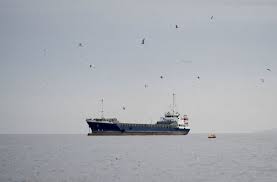
The United States military has officially announced a comprehensive U.S. Launches Naval blockade targeting all Iranian ports and coastal waters, set to take effect on Monday at 10 a.m. Eastern Time. This dramatic military escalation came after high-stakes peace negotiations held over the weekend in Islamabad, Pakistan, ended without any meaningful agreement between the two nations. The blockade covers all maritime traffic, meaning every vessel attempting to enter or exit Iranian ports along the Arabian Gulf and the Gulf of Oman will now face interception by U.S. naval forces. What was already a deeply volatile situation in the Middle East has now entered a far more dangerous and unpredictable phase that is sending shockwaves across diplomatic circles, energy markets, and military commands around the world.
The conflict that triggered these negotiations had already been burning for six weeks before a fragile ceasefire was established on a Tuesday just two weeks prior. During those six weeks of active fighting, thousands of people lost their lives across the Gulf region, vital energy supplies were severely disrupted, and fears of a much wider regional war began to grow with each passing day. The ceasefire offered a brief window of hope, and the Islamabad talks were seen as the best opportunity yet to convert that pause in fighting into a lasting peace agreement. That window has now closed, at least for the moment, and the path forward looks considerably more dangerous than it did just days ago.
The talks in Islamabad represented something genuinely historic in modern diplomacy. They marked the first direct face-to-face negotiations between American and Iranian officials in more than a decade. Even more significantly, they were the highest-level diplomatic discussions the two countries had engaged in since Iran's 1979 Islamic Revolution fundamentally transformed the relationship between Tehran and Washington. The fact that both sides agreed to sit down at all was considered a significant development by regional analysts and foreign policy observers. But sitting down and reaching an agreement turned out to be two very different things, and the gap between the two sides proved far too wide to bridge over the course of a single weekend.
How the Islamabad Talks Fell Apart Over Nuclear and Proxy Demands
The United States arrived in Islamabad carrying a list of demands that were, by any realistic diplomatic standard, extremely ambitious. American negotiators insisted that Iran agree to a complete and permanent halt to all uranium enrichment activities across the country. Beyond simply stopping enrichment, Washington also demanded the physical dismantling of all major enrichment facilities that Iran had spent years and billions of dollars building. To go even further, the U.S. called for Iran to physically transfer its stockpile of highly enriched uranium out of Iranian territory and out of Iranian control entirely. For a country that views its nuclear program as both a matter of national sovereignty and a strategic deterrent, these demands were seen as an attempt to strip Iran of one of its most significant sources of geopolitical leverage in a single negotiating session.
The nuclear demands were not the only sticking point that brought the talks to a halt. Washington also insisted that Iran immediately and permanently stop providing financial support, weapons, training, and logistical assistance to a range of armed proxy groups operating across the broader Middle East region. Specifically, the U.S. demanded that Iran sever its ties with Hamas in Gaza, Hezbollah in Lebanon, and the Houthi movement in Yemen. These groups form a central pillar of what Iranian strategists call the "Axis of Resistance," and cutting funding to all of them simultaneously would represent a fundamental restructuring of Iran's entire regional security strategy. American negotiators also pushed for Iran to formally commit to keeping the Strait of Hormuz fully open to international shipping without the imposition of any transit tolls or restrictions.
Iranian Foreign Minister Abbas Araqchi gave a pointed public account of how the final hours of the talks unfolded. He said Iran had come within inches of signing what he described as an Islamabad Memorandum of Understanding, only to encounter what he characterized as "maximalism" and "shifting goalposts" from the American side at the very last moment. His frustration was evident and his language was direct. "Good will begets good will," he said publicly after the talks concluded without a deal. "Enmity begets enmity." Iranian state media acknowledged that the two delegations had actually managed to find common ground on a number of secondary and procedural issues during the discussions, but confirmed that the nuclear program and the question of the Strait of Hormuz had proven to be completely insurmountable obstacles that neither side was willing to compromise on at this stage.
Global Energy Markets Thrown Into Chaos by the Blockade Announcement
The reaction from global energy markets was swift, severe, and entirely predictable given the strategic importance of the waters now caught in the middle of this standoff. Benchmark crude oil prices surged by more than 7 percent during early Monday morning trading sessions in Asia, pushing past the psychologically and economically significant threshold of $100 per barrel for the first time in recent memory. The jump in oil prices triggered a cascade of related market movements, with the U.S. dollar strengthening against most major global currencies while American stock futures declined sharply as investors began recalculating the economic risks of a prolonged military standoff in the world's most important energy corridor.
Commercial shipping operators began responding to the threat even before the blockade formally began. Shipping data confirmed that while three supertankers fully loaded with crude oil had managed to transit the Strait of Hormuz on Saturday before the announcement, commercial tankers were already steering well clear of the waterway by the time Monday arrived. The U.S. Central Command attempted to limit the disruption to global trade by clarifying that vessels traveling through the Strait to reach ports in countries other than Iran would not be stopped or searched. However, the ambiguity surrounding the situation and the fear of being caught in a potential military confrontation proved sufficient to push most commercial operators toward alternative and much longer routes around the region.
President Trump addressed the domestic economic consequences of the blockade directly and with unusual candor during an appearance on the Fox News program "Sunday Briefing." He acknowledged that gasoline prices could remain elevated not just for weeks but potentially through November's midterm elections, which was a remarkably straightforward admission of the political cost his administration was accepting by pursuing this military strategy. Iranian Parliament Speaker Mohammad Baqer Qalibaf seized on that admission immediately, posting a map showing current Washington-area gasoline prices on social media and mockingly telling Americans to enjoy the numbers they were seeing now because things were going to get significantly worse before they got better.
Iran Warns of Military Consequences as Ceasefire Teeters on the Edge
Iran's Islamic Revolutionary Guards Corps wasted no time issuing a formal and forceful warning in response to Trump's Sunday announcements. The Guards stated clearly and publicly that any military vessels attempting to approach or enter the Strait of Hormuz would be considered a direct breach of the existing ceasefire agreement and would be confronted with what they described as a harsh and decisive response. This statement elevated the risk of an unplanned armed confrontation between U.S. Navy ships and Iranian military forces to a level that has military analysts and regional security experts genuinely alarmed. The Strait of Hormuz is an extraordinarily narrow waterway where the proximity of opposing forces makes miscalculation and accidental escalation a constant and serious danger.
Iranian President Masoud Pezeshkian chose to communicate his government's position through a diplomatic phone call with Russian President Vladimir Putin shortly after the talks concluded. He told Putin that Iran remained genuinely open to reaching a negotiated settlement but that any agreement would need to operate within the established framework of international law and reflect a balanced and fair outcome for both parties involved. He made clear that if the United States was willing to return to that framework, a deal was not beyond reach. Iranian state media reported the conversation and used it to signal to the international community that Tehran was not abandoning diplomacy entirely, even as the military situation on the ground continued to deteriorate rapidly.
Trump, despite ordering the blockade, maintained that he believed Iran would ultimately choose to return to the negotiating table rather than face the full economic and military consequences of prolonged isolation. Speaking to reporters late Sunday night after returning to the Washington area from Florida, he described the Islamabad discussions as "very friendly" in tone and expressed confidence that no rational government could continue to hold out indefinitely. However, in the same conversation, he also made it unmistakably clear that he was entirely comfortable continuing the current course of action if Iran chose not to re-engage. "If they don't come back, I'm fine," he told reporters, a statement that captured both the confidence and the calculated risk at the heart of Washington's current strategy.