
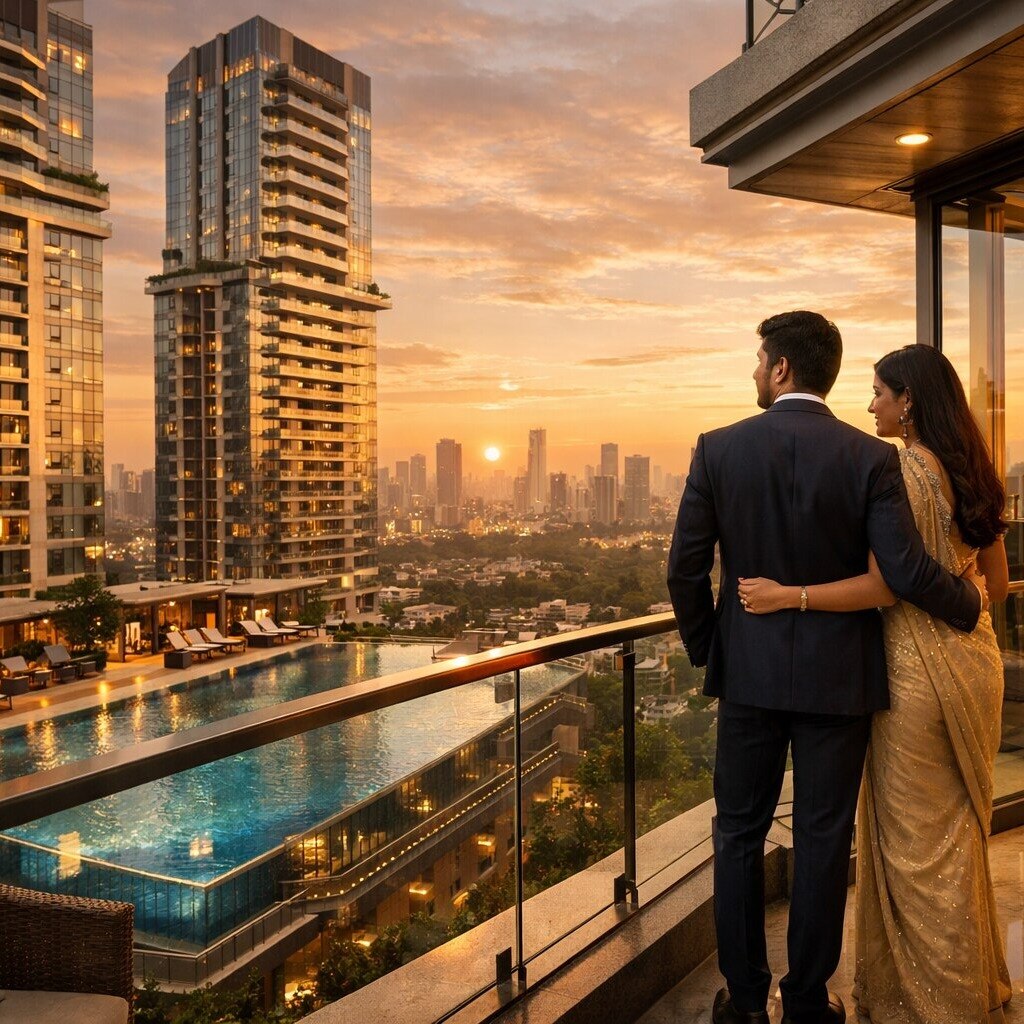
India luxury housing market is proving remarkably resilient in the face of rising global uncertainties, geopolitical tensions, and mounting concerns about inflation and interest rates, with high-net-worth individuals and non-resident Indians continuing to drive strong demand for premium residential properties across the country's most sought-after cities. While buyers in the mass and mid-income housing segments have become noticeably more selective as economic caution spreads, affluent purchasers in markets like Gurugram, Noida, Bengaluru, Hyderabad, and Mumbai are maintaining their appetite for premium homes with a consistency that has surprised even experienced market watchers. Industry experts say the explanation lies in a fundamental shift in how India's wealthy are thinking about real estate, not as a lifestyle indulgence but as a serious long-term wealth preservation and wealth creation instrument that belongs alongside equities, gold, and other traditional HNI asset classes.
The divergence between luxury and affordable housing performance in the current environment reflects a structural characteristic of the premium segment that becomes particularly relevant during periods of macro stress. Luxury home purchases are predominantly funded through accumulated equity and existing wealth rather than through home loans and equated monthly installments, meaning that interest rate movements have a much more limited impact on buying decisions at the upper end of the market than they do for mid-income buyers who are directly sensitive to changes in mortgage costs. When the Reserve Bank of India adjusts the repo rate or signals tightening, the ripple effects through the affordable and mid-income housing segments can be immediate and significant, while the luxury segment absorbs the same news with considerably more composure. That structural insulation has been a defining feature of the luxury market's performance through 2025 and into the first quarter of 2026.
The broader context of India's wealth creation story provides the underlying demand foundation that makes the luxury market's resilience possible. Technology, financial services, startups, and manufacturing have all generated substantial new wealth across India's major metropolitan areas over the past several years, expanding the pool of affluent buyers who have both the financial capacity and the lifestyle aspiration to purchase premium residential properties. Improved infrastructure, better connectivity, and the development of world-class amenity ecosystems around premium residential developments have added supply-side quality that matches the elevated expectations of this buyer segment. The combination of growing wealth, rising lifestyle aspirations, and a product offering that has improved dramatically in quality and sophistication has created conditions in which luxury housing demand remains structurally well-supported even when the macro environment becomes more challenging.
Premiumisation Trend Drives Demand as HNIs and NRIs Prioritise Space, Wellness, and Smart Living
The premiumisation trend that dominated India's luxury housing market through 2025 has carried its momentum firmly into 2026, reshaping what affluent buyers are looking for and what developers must deliver to capture their interest. Sudeep Bhatt, Director of Strategy at Whiteland Corporation, told industry observers that HNI and NRI buyers are consistently prioritizing space and lifestyle quality over interest-rate sensitivity, a behavioral pattern that reflects the equity-driven nature of their purchasing decisions and their focus on long-term lifestyle value rather than near-term financing cost. Developers report that the specification requirements of luxury buyers have become significantly more sophisticated, with demand concentrated around spacious floor plans, curated amenities, smart-home technology integration, wellness-focused design, and what the industry describes as integrated lifestyle ecosystems that deliver convenience, community, and quality of life within a single development.
In previous market cycles, luxury housing in India was often defined primarily by location and unit size, with premium pricing justified by address and square footage above everything else. The current generation of HNI and NRI buyers has moved well beyond that framework, demanding a holistic residential experience that reflects international standards of design, amenity, and service delivery. Wellness infrastructure including gymnasiums, swimming pools, yoga and meditation spaces, and green environments has become a baseline expectation rather than a differentiator at the top end of the market. Smart-home features, from automated lighting and climate control to integrated security systems and high-speed connectivity infrastructure, are similarly expected as standard rather than as optional upgrades. Developers who have invested in delivering against these elevated expectations have been rewarded with strong sales velocity and premium pricing power even in a more cautious macro environment.
NRI buyers represent a particularly important and growing component of luxury housing demand, and their preferences are shaping product development in meaningful ways. For NRIs evaluating Indian real estate as part of a broader international wealth management strategy, the combination of favorable rupee-denominated pricing, strong rental yield potential in premium markets, and the lifestyle benefit of maintaining a high-quality home base in India has become increasingly compelling. The depreciation of the rupee against major international currencies has effectively provided NRI buyers with a pricing advantage that makes Indian luxury properties appear attractively valued relative to comparable premium real estate in the international markets where they live and work. Industry participants note that NRI inquiry volumes and transaction activity have remained strong through the current period of global uncertainty, suggesting that the investment case for Indian luxury real estate continues to resonate strongly with this buyer segment.
NCR, Bengaluru, and Hyderabad Lead Luxury Demand While Market Transitions to a More Balanced Phase
The geographic distribution of luxury housing demand in India reflects the concentration of wealth creation that has occurred across the country's major economic hubs over the past decade. Mohit Goel, Managing Director of Omaxe, identified the National Capital Region as one of the strongest luxury housing markets in the country, with Gurugram in particular serving as a primary destination for premium residential investment driven by its combination of corporate headquarters, multinational presence, infrastructure quality, and lifestyle amenity development. Gurugram's evolution from a corporate suburb into a genuinely cosmopolitan residential destination has been one of the most significant real estate stories of the past decade, and the luxury segment there continues to attract both end-users and HNI investors who view premium NCR properties as long-term appreciating assets with strong rental income potential.
Bengaluru and Hyderabad maintain their positions as strong luxury markets on the back of sustained technology sector wealth creation that has consistently produced new cohorts of affluent buyers with both the financial capacity and the lifestyle aspiration to purchase premium homes. The technology ecosystem in both cities has generated significant equity wealth through startup exits, stock appreciation, and senior executive compensation packages that align with luxury price points in a way that was much less common a decade ago. The density of tech-sector wealth in these two cities, combined with the quality of luxury residential development that has followed that wealth, has created self-reinforcing market dynamics where premium supply is absorbed by locally generated demand rather than depending primarily on speculative investment or NRI purchasing. Mumbai has maintained relative stability in its luxury segment, supported by the financial services, entertainment, and corporate sectors that have long made it India's most expensive residential market.
Despite the overall positive picture, industry experts are careful to acknowledge that the market is transitioning from the exceptional hyper-growth phase it experienced between 2023 and 2025 into a more measured and balanced environment. Goel noted that there is noticeably more caution following Prime Minister Modi's address on economic conservation and the ongoing West Asia crisis, with concerns about crude oil prices, rupee depreciation, inflation, and potential further rate hikes all adding hesitation to buyer decision-making timelines. Buyers are taking slightly longer to commit to purchases, conducting more due diligence, and being more selective about which projects and developers they trust with large capital commitments. Binitha Dalal, Founder and Managing Director of Mt. K Kapital, said it would be premature to draw definitive conclusions about structural impacts on the luxury segment and that the fuller implications of global economic and geopolitical developments may only become clear over the next six to twelve months.