
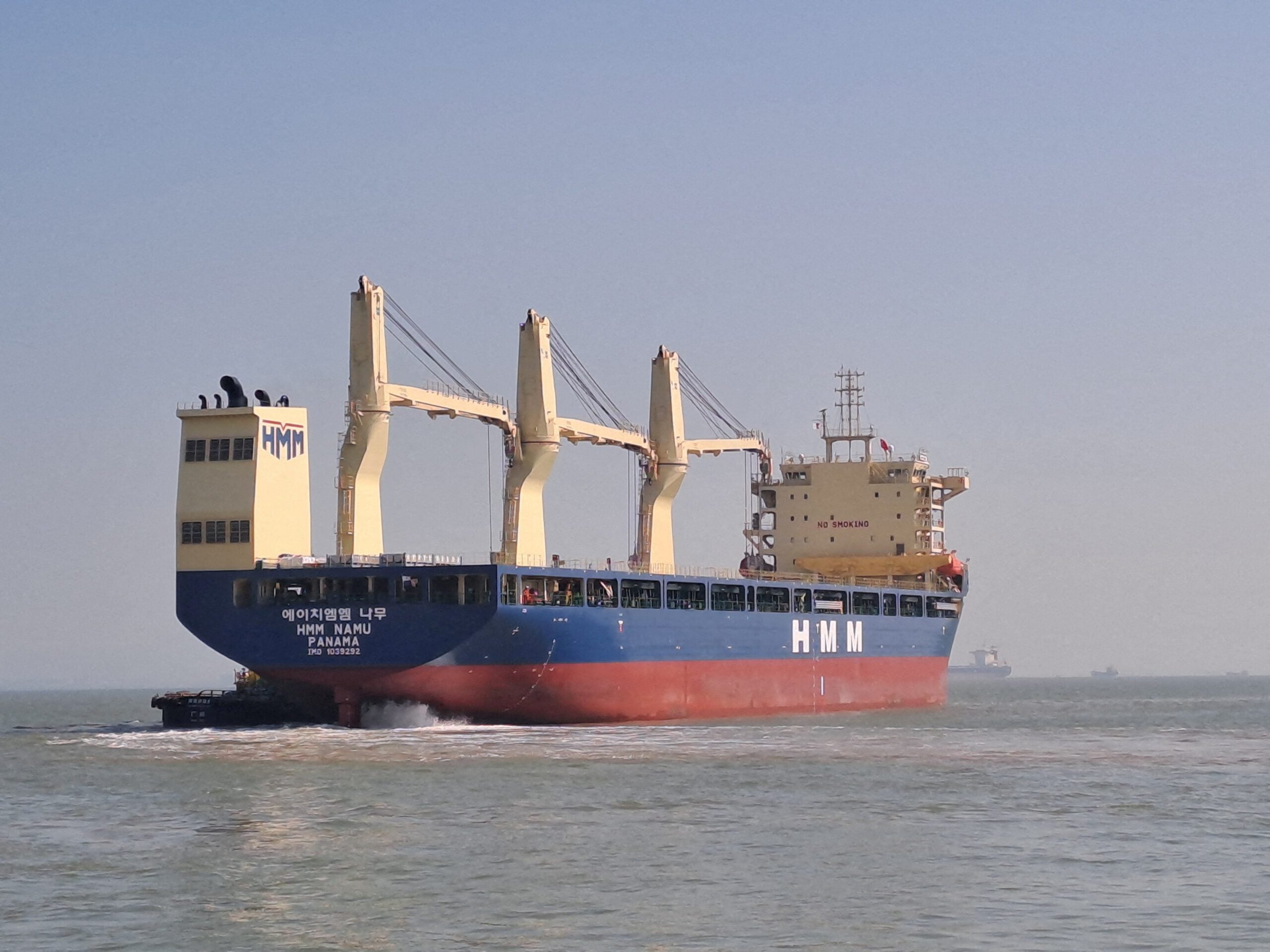
South Korea HMM ship Iran missile Hormuz attack 2026 investigation has concluded that an attack on a bulk carrier operated by South Korean shipper HMM in the Strait of Hormuz earlier this month likely involved an Iranian anti-ship missile, with South Korea's Foreign Ministry announcing the assessment on Wednesday following a government probe into the May 4 incident that caused a fire and damaged the lower stern hull of the vessel named Namu. First Vice Foreign Minister Park Yoon-joo told a briefing that various pieces of evidence point toward Iran while noting that Seoul had not conclusively determined who was responsible or whether the attack was intentional, a careful formulation that establishes Iranian attribution based on physical evidence while maintaining the diplomatic space that uncertainty about intent provides in a situation where South Korea must decide how to respond without precipitating further escalation in a maritime environment already profoundly destabilised by the broader Iran war. The probe found that the Namu was struck twice, with the first warhead failing to explode while the second detonated, and that components in the debris found inside the ship after the attack indicated the objects were likely made in Iran, with their engines similar to turbojet engines manufactured in Iran and one component bearing markings that appeared to be used by an Iranian manufacturer.
The warheads recovered in the investigation resembled those used in Iranian anti-ship missiles, specifically the Noor or Qader models, Park said, providing the specific technical comparison that connects the debris evidence to the known inventory of Iranian naval weapons whose use in the Hormuz conflict has been documented in multiple previous incidents since the war began on February 28. South Korea will summon the Iranian ambassador to Seoul to share the results of the investigation and deliver a protest message demanding that Iran take responsible measures to prevent a similar incident recurring, Park confirmed, representing the formal diplomatic escalation that a government finding of likely Iranian missile use against a civilian cargo vessel requires. The Iranian embassy in Seoul did not immediately respond to a request for comment, and no Iranian official communication on the attribution finding had been received before the ministry's briefing concluded.
U.S. President Donald Trump had said soon after the incident that Iran had fired at the South Korean vessel and urged Seoul to join U.S.-led efforts to secure shipping through the Strait of Hormuz, a request that places South Korea in the difficult diplomatic position of balancing its alliance relationship with the United States, its economic exposure to the Iran war's energy disruption, and its specific interest in protecting the HMM shipping operations that connect the South Korean economy to global trade through the Hormuz corridor. Park declined to speculate on why a South Korean ship would have been targeted, acknowledging that Seoul could not determine intent without access to the attacker's decision-making process, while a South Korean defence official added from a naval perspective that the firing of two missiles suggested an intention to cause damage rather than a miscalculation or accidental engagement.
The May 4 Attack and the Context of Iran War Maritime Violence
The May 4 attack on the HMM bulk carrier Namu in the Strait of Hormuz occurred in the broader context of Iran's disruption of maritime traffic through the waterway that has been the most economically consequential feature of the ongoing conflict between Iran and the United States and Israel, with the Hormuz closure and associated attacks on shipping creating the global energy supply crisis that has driven oil prices to record levels and imposed inflationary pressure across the global economy. The specific targeting of a South Korean-operated civilian bulk carrier rather than a military vessel or a ship directly involved in the conflict's economic warfare represents an escalation in the scope of maritime violence that the investigation's findings make necessary to address through formal diplomatic channels. South Korea's probe of the physical evidence, conducted through analysis of debris from unidentified objects found inside the ship, provided the forensic foundation for the ministry's attribution assessment rather than relying solely on open-source or intelligence reporting about the incident.
The finding that the Namu was struck twice in the same incident, with the first warhead failing to detonate and the second exploding, is itself a technically significant detail that the defence official's naval perspective observation about intention addresses directly. A single missile strike that misses or fails to detonate can be characterised as an accident or a warning, but two sequential strikes on the same vessel, with the second succeeding in causing an explosion and fire, represents a sustained engagement whose military character the defence official explicitly connected to an intention to cause damage. The two-strike pattern is consistent with Iranian anti-ship missile doctrine in which a first missile is used to overwhelm or occupy defensive countermeasures while a second follow-on missile exploits the window created by the first, a tactical approach that the Noor and Qader missiles have been designed to execute against naval targets.
The Noor anti-ship missile, whose warhead design the recovered components resembled according to Park's briefing, is a reverse-engineered Iranian copy of the Chinese C-802 anti-ship cruise missile that Iran acquired in the 1990s and has since domestically produced and upgraded through its naval weapons development programme. The Qader is a more recent Iranian anti-ship missile derived from a similar technological lineage, with comparable seeker and warhead designs that share identifiable physical characteristics with the components recovered from the Namu. The ministry's specific naming of these two missile systems as the likely source of the recovered components provides the technical precision that distinguishes the assessment from a general attribution to Iranian weapons and connects the physical evidence to specific items in Iran's documented naval weapons inventory that can be independently cross-referenced against the recovered debris characteristics.
South Korea's Strategic Position in the Iran War Context
South Korea's relationship to the Iran conflict has been shaped by its significant economic exposure to both the energy market disruption the war has created and the potential broader consequences of the conflict for the global trade routes that the South Korean economy depends on for its export-oriented growth. South Korea is a major importer of Middle Eastern crude oil, and the Iran war's disruption of Gulf energy supplies through the Hormuz closure has imposed direct economic costs on the South Korean economy through higher energy prices and supply chain uncertainty. The earlier Reuters reporting documenting South Korea's fiscal response to the war, including an emergency bond buyback programme to stabilise financial markets, illustrated the specific economic vulnerabilities that make the conflict directly consequential for Korean policymakers rather than a distant geopolitical event.
Trump's call for South Korea to join U.S.-led efforts to secure shipping through the Strait of Hormuz places Seoul in the classic dilemma of a medium-sized ally whose relationship with the United States is central to its security architecture but whose specific national interests in the conflict may not fully align with the maximalist positions that the American-led coalition has been pursuing. Joining a U.S.-led maritime security operation in the Hormuz corridor would entangle South Korea more directly in the military conflict while potentially providing limited additional deterrence given the scale of American naval presence already deployed in the region, but declining to join risks appearing to free-ride on American security provision while simultaneously failing to respond adequately to the attack on a South Korean vessel that the investigation has now attributed to Iranian weapons. Seoul's response to the ambassador summoning and the investigation's findings will establish the baseline for how it navigates this diplomatic and strategic dilemma in the coming weeks.
Iranian Naval Weapons and the Documentation of Hormuz Maritime Violence
Iran's anti-ship missile capability, developed systematically since the 1980s Iran-Iraq War through domestic production, foreign acquisition, and reverse engineering of captured and acquired systems, represents one of the most significant asymmetric military capabilities that Iran possesses relative to the superior naval forces of its adversaries. The deployment of these capabilities against commercial shipping in the Hormuz context is consistent with Iran's established doctrine of threatening the economic consequences of conflict to impose costs on adversaries and the international community that provide leverage in diplomatic negotiations, with the maritime disruption strategy requiring ongoing incidents to maintain its credibility as a threat rather than a one-time demonstration. The targeting of shipping from countries not directly involved in the military conflict, if the Namu attack was indeed deliberate targeting of a South Korean vessel, extends the maritime pressure campaign beyond the direct military and economic adversaries to create broader international pressure for a diplomatic resolution that restores shipping freedom.
The investigation's finding that Seoul cannot determine intent without access to the attacker's decision-making process is an honest acknowledgment of the fundamental intelligence limitation that all attribution assessments face, particularly in the fog of an active conflict where multiple parties are conducting operations with different specific objectives and where individual operational decisions may or may not reflect centrally directed policy. The distinction between an Iranian military operation specifically targeting South Korean shipping for strategic reasons and an Iranian naval unit targeting any available non-Iranian vessel in the Hormuz corridor based on tactical opportunity affects the diplomatic and strategic significance of the attack but cannot be resolved from the physical evidence alone. South Korea's demand that Iran take responsible measures to prevent similar incidents is the diplomatic formulation that addresses both possibilities by requiring Iran to exercise control over its forces' engagement decisions regardless of whether the specific attack was strategically directed or tactically opportunistic.
The Ambassador Summoning, the Trump Request, and What Seoul Must Decide
The summoning of the Iranian ambassador to receive South Korea's investigation findings and protest message is the appropriate diplomatic instrument for a government that has found likely Iranian weapons use against its merchant shipping but has not conclusively established intentional targeting or definitively attributed command responsibility. A formal diplomatic protest delivered through the ambassador summons creates the official record of Korean government objection and demand for preventive measures while stopping short of the more escalatory responses that conclusive attribution with clearer evidence of intentional targeting might support. The Iranian embassy's silence in response to the advance request for comment suggests Tehran is assessing its response rather than immediately dismissing the attribution, which is itself a diplomatic signal about the seriousness with which the investigation's findings are being received.
The potential impact of the Namu attack on South Korea's domestic debate about the appropriate response to the Iran war and Trump's request for coalition participation in Hormuz security operations is significant, because physical evidence linking the attack on a South Korean vessel to Iranian missiles creates the domestic political pressure for a stronger Korean response than pure economic interest calculations would produce. Politicians, defence officials, and public opinion in South Korea will be engaging with the question of how a government whose merchant shipping has been attacked responds to an ally's request for coalition security participation, in a context where the investigation's findings make continued non-engagement with the Hormuz security question harder to justify on diplomatic caution grounds alone. Park's statement that Seoul will demand Iran take responsible measures to prevent recurrence is the minimal diplomatic response that the evidence supports, but it does not answer the larger strategic question of whether South Korea will join or support the American-led maritime security framework that Trump has been urging.
The investigation's outcome also creates a precedent for how South Korea conducts and communicates attribution assessments in the context of the broader Iran conflict, with the ministry's careful formulation of various pieces of evidence pointing toward Iran while not conclusively determining responsibility modelling an evidentiary approach that maintains credibility through epistemic honesty rather than overreaching to definitive conclusions that the evidence does not fully support. This credibility serves Korean diplomatic interests in engaging both with Iran over the attack and with the United States over the broader coalition question, because a carefully calibrated attribution statement is more defensible internationally than either a premature definitive attribution or a political reluctance to acknowledge the evidence's direction that would appear to prioritise diplomatic convenience over transparency.