
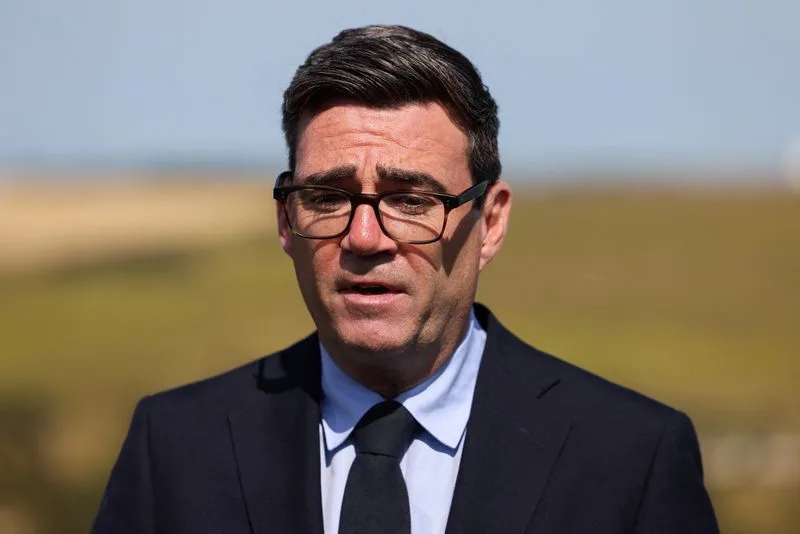
Two weeks into his tenure as Britain's new prime minister, Andy Burnham Social Media has accumulated 4.7 million views on a single X video of himself and Finance Minister John Healey ranking pub snacks, 5 million views on TikTok for a summary of his government's first-week achievements, and a social media following that is growing by tens of thousands of people on a single day. For a Labour Party that spent the preceding two years watching Nigel Farage's Reform UK build a dominant online presence that played a significant role in shifting public opinion polls in the populist party's favour, the speed and apparent authenticity of Burnham's digital operation represents both a tactical departure and a strategic bet: that the same social media space where Reform built its following can be contested by a governing party prime minister willing to be genuinely relaxed on camera.
Burnham is not, by the measurement of raw follower counts, close to Farage yet. Reform UK's leader has 2.3 million followers on X, 1.5 million on TikTok, and 1 million on Instagram, numbers accumulated through years of consistent, high-engagement content on immigration, crime, and cultural identity that performs extremely well algorithmically because it produces strong emotional reactions in viewers who either strongly agree or strongly disagree. Burnham currently has approximately 730,000 followers on X, 450,000 on TikTok, and 600,000 on Instagram. But the growth rate is the number that matters more than the current total: adding 50,000 followers on TikTok and Instagram in a single day in his second week suggests algorithmic momentum that, if sustained, will meaningfully close the gap with Farage's numbers within months rather than years.
What political communication experts are identifying as distinctive about Burnham's approach is not the production quality or the posting frequency but the specific tone he has chosen to occupy. James Lyons, former director of strategic communications for Burnham's predecessor Keir Starmer and a former TikTok employee who now works at the corporate advisory firm Penta Group, described the strategy with precision: "Instead of being polarizing, he's just seeking to be popular and inclusive." That distinction, between Reform's high-engagement-through-conflict model and Burnham's high-engagement-through-warmth model, is the central thesis of what Labor is attempting to build digitally, and the early evidence from view counts, follower growth, and polling data suggests it is working.
What Happened: From Monster Munch to 5 Million Views in Two Weeks
The specific videos that have generated the largest audiences for Burnham in his first two weeks as prime minister illustrate the range of tones and contexts he and his team are deploying. The pub video with Healey, built around the announcement of a tax cut for hospitality venues, used the policy announcement as a pretext for the kind of informal, unguarded-feeling content that traditional political communication would never have produced: two senior ministers genuinely debating the relative merits of pub snacks, with Burnham confessing to a specific weakness for pickled-onion flavor Monster Munch and asking aloud, with genuine Northern curiosity, whether anyone outside the North of England puts crisps into sandwiches. The policy announcement was there. The political message about supporting pubs was there. But the dominant experience of watching the video was not one of being communicated at; it was one of watching two people be themselves.
The response to Conservative opposition leader Kemi Badenoch's dismissal of Burnham as "a pair of eyelashes and a black T-shirt" was a masterclass in the kind of self-deprecating political humor that turns an insult into an asset. A video of Burnham blinking hard, looking at his dark blue T-shirt, and saying "It's dark blue, actually," received wide circulation because it did exactly what political communication rarely manages: it demonstrated that the target of the insult was more charming, more quick-witted, and more human than the insult suggested. The correction of Badenoch's color identification was incidentally accurate and accidentally funny, and the combination made it shareable.
The montage made in the style of the American version of The Office, the workplace comedy series known for its mixture of awkward earnestness and deadpan observation, tapped into a cultural reference frame with strong resonance among the demographic that spends the most time on social media. Political figures appearing in content that references popular culture rather than formal political tradition signals a specific kind of cultural fluency that younger audiences respond to, not because they are easily fooled into thinking politicians are genuine cultural participants, but because the willingness to make the reference at all communicates a certain relaxation about the dignity of high office that contrasts with the defensive formality of most political communication.
Why It Happened: Why Labor Chose Burnham and What Problem He Was Hired to Solve
The Labor Party's decision to replace Keir Starmer with Andy Burnham, after Starmer had led the party to a landslide general election victory in 2024, was explicitly and primarily a communication decision. Starmer's legal background produced a precise, cautious, and frequently stilted public communication style that was effective in the controlled environments of parliamentary debate and formal interviews but performed poorly in the informal, high-authenticity-demand environment of contemporary social media. Reform UK, under Farage's direction, had spent years building a social media operation that was effective precisely because Farage's pub-going, pint-drinking, direct-speaking persona translated naturally onto TikTok and Instagram in ways that Starmer's lawyerly precision did not.
Rosalynd Southern, senior lecturer in political communication at the University of Liverpool, identified the specific shift that Burnham represents in Labour's digital approach. Where Labour had previously produced "fairly random memes" on TikTok alongside some policy posts, Burnham had delivered a "more coordinated and integrated strategy." The integration she identifies is the key: the pub video was not just casual content but a vehicle for a specific policy announcement; the first-week achievements video was not a spontaneous impulse but a structured communication of tangible outcomes. The informality is real but it is also purposeful, and that combination, genuine personality deployed in service of strategic objectives, is considerably harder to achieve and considerably more valuable politically than either genuine personality without strategic purpose or strategic purpose without genuine personality.
Burnham's nine-year absence from Westminster and 16-year absence from government is, paradoxically, part of his asset base in this context. Lyons described it as giving him "a second chance at a first impression," a phrase that captures something important about how public memory and political brand work in the digital age. Burnham was well known in Labour circles and in Greater Manchester, where his decade as metro mayor built a specific regional governing reputation. But he was not primarily known to the mass national social media audience that Reform has been building for years, and that relative freshness means he is not carrying the accumulated negative associations that Starmer's prolonged period as Labour leader had generated in the public mind.
Timeline: The Labour Communication Crisis and the Burnham Alternative
2024, July — Labour wins a landslide general election under Keir Starmer. The scale of the victory generates initial optimism about the government's communication capacity.
2024 to 2025 — Labour struggles with social media. Reform UK, under Farage, continues to build its following with high-engagement content on immigration, crime, and cultural issues. Polls show Labour losing ground to Reform despite its parliamentary majority.
2025, earlier this year — Keir Starmer resigns following sustained internal and external pressure, including from his inability to close the social media gap with Reform and his low personal favourability ratings. Andy Burnham is selected as his replacement.
Two weeks ago — Burnham becomes prime minister. His first social media posts generate immediate traction. The Monster Munch pub video gets 4.7 million views on X. The first-week achievements montage gets 5 million views on TikTok.
Last week — Burnham adds 50,000 followers on TikTok and Instagram in a single day. Initial polling after his appointment shows Labour closing the gap with Reform UK. The government advertises social content creation roles paying £40,000 to £80,000, signalling investment in the digital operation.
Current — Burnham's digital team, led by Abby Tomlinson, is now producing coordinated, cross-platform content at pace. Traditional media is amplifying social media content, creating a virtuous cycle of reach.
Political Impact: Reform UK's Lead, Labour's Recovery, and What the Polls Actually Show
The political significance of Burnham's social media operation extends beyond the view counts and follower numbers to the polling data that has emerged in his first two weeks. Initial surveys following his appointment as prime minister show Labour closing the gap with Reform UK in opinion polls, a movement that Keiran Pedley, UK director of politics at the pollster Ipsos, described as "a pretty positive start." The polling shift cannot be attributed solely to social media, and the next general election is approximately three years away, meaning the current gap or advantage in polling is directionally significant rather than electorally determinative. But the direction matters: the Reform-Labour gap that had been widening under Starmer appears to have begun narrowing under Burnham, and the social media narrative is a plausible contributing factor.
Farage's challenge to Labour has always been primarily about tone and cultural resonance rather than policy detail. His 2.3 million followers on X, 1.5 million on TikTok, and 1 million on Instagram were built through content that positioned him as a truth-teller speaking for people who felt excluded from mainstream political conversation, a positioning that is politically powerful precisely because it cannot be easily countered by fact-checking or policy rebuttal. Burnham's response to that challenge is not to out-fact or out-policy Farage but to offer a different version of authentic political personality: one that is warmth-based rather than anger-based, inclusive rather than exclusionary, and willing to find humour in the absurdities of high office rather than in the perceived failures of outgroups.
Katy Parry, professor of media and politics at the University of Leeds, identified the crucial distinction: "He's not anti-politics in the way that some right-wing populist politicians are." Farage's political project depends on sustaining a narrative in which the political establishment is corrupt, incompetent, or contemptuous of ordinary people. Burnham is attempting to offer something different: a political establishment figure who demonstrates through his behaviour that politics can be done with human warmth, genuine communication, and an absence of the condescension that has characterised much of the elite political communication that Farage has spent decades positioning himself against.
Economic Impact: The Digital Content Economy, Government Jobs, and Political Advertising
The government's recruitment of social content creation, production, and strategy roles at salaries of £40,000 to £80,000 provides a concrete economic measure of the investment being made in Burnham's digital operation. The salary range is competitive with the commercial digital media market and signals that the government is not treating social media content as a secondary function to be staffed with junior officials but as a strategic communications priority requiring professional-grade talent. Abby Tomlinson's leadership of the operation, described by those familiar with the digital media and politics intersection as an experienced choice given her history with viral political campaigns dating back to the Miliband era, suggests a deliberate decision to staff the function with people who understand both the political objectives and the specific content creation skills required to achieve them on the relevant platforms.
The broader economic context for Burnham's social media strategy is the shift in political advertising and communication spending away from traditional media toward digital platforms that has been accelerating across all major democracies for more than a decade. Reform UK's social media dominance was built relatively cheaply in organic terms, because Farage's personal magnetism and the emotional intensity of his content generate shares and engagement without the scale of paid promotion that traditional political advertising required. Burnham is attempting to build a similar organic reach through a different emotional register, and the 4.7 million views on a single video suggest the algorithm is rewarding the approach even without the years of follower base accumulation that Farage's operation represents.
For the commercial digital content industry, the growth of professional government social media operations at competitive salaries is a relevant labour market development. The skills required to produce engaging political social media content, understanding of platform algorithms, video production, copywriting for different platform registers, and the ability to identify cultural moments and trends to tap into, are transferable between commercial and political clients, and the government's willingness to pay market rates for those skills is a signal that the political sector is competing seriously for talent that might otherwise go to commercial brands or entertainment companies.
Business Impact: Brand Communication Lessons From Burnham's Approach
Political communication has always borrowed from and informed commercial brand communication, and Burnham's early social media operation offers several lessons that marketing and communications professionals are already beginning to discuss. The pub video's combination of a policy announcement with genuinely informal content is an example of what commercial brand marketers would call "purpose-led" content that works: the purpose (tax cut for hospitality) is real and relevant to the target audience (pub-goers, hospitality sector), and the content format (authentic informal conversation) is appropriate to the platform and the message. The fact that it received 4.7 million views on X without being primarily constructed as a stunt suggests that authenticity and relevance are more powerful algorithmic signals than production value or controversy.
The dark-blue-T-shirt response to Badenoch's eyelashes insult is a case study in crisis communication executed through humour. The immediate instinct in conventional political media management would have been either to ignore the insult, issue a formal rebuttal through a spokesperson, or respond with counter-attack. Burnham's team chose instead to make the response entertaining enough to share, which converted a moment of political attack into a moment of audience engagement. For commercial brands managing social media criticism, the Burnham response illustrates the specific conditions under which humour works as a crisis communication tool: when the brand has enough established goodwill to make the humour read as confident rather than defensive, and when the humour is genuinely funny rather than trying too hard.
The government's digital team structure, with professional social media roles at competitive salaries under experienced leadership, reflects a business organisation model for political communication that more closely resembles a media company's content team than a traditional government communications department. That structural choice has implications for how quickly the operation can respond to news cycles, how consistently it can produce content across platforms, and how effectively it can maintain quality while scaling production volume.
Global Impact: What Burnham's Social Media Approach Means for Democratic Engagement Worldwide
The contest between Andy Burnham and Nigel Farage for social media dominance in British politics is not a uniquely British phenomenon but a British instance of a global dynamic that has been reshaping democratic politics in every major democracy for the past decade. Populist movements across Europe, North America, and beyond have systematically out-competed mainstream parties on social media by exploiting the algorithmic preference for high-emotional-intensity content that generates strong reactions, comments, and shares. The question that political communication researchers, democratic institutions, and political parties have been trying to answer since the Brexit referendum and the 2016 US presidential election is whether that algorithmic advantage is inherent to the populist message or whether it can be matched by a different kind of content.
Burnham's early results suggest, tentatively, that warmth-based inclusive content can compete with anger-based divisive content on the same platforms if it is authentic and well-executed enough to generate shares through a different emotional pathway: affection, amusement, and the desire to share something that makes other people feel good rather than something that validates their grievances. If that hypothesis holds over the next months and years, it would have significant implications for centre-left and centrist parties across Europe and beyond that are trying to rebuild their social media operations in the face of populist online dominance.
The specific platform dynamics are also worth noting. TikTok's algorithm is particularly receptive to content that generates "watch time," meaning videos that people watch all the way through and re-watch, rather than merely content that generates high-emotional-intensity initial reactions. Warmth-based content, in which viewers enjoy the experience of watching rather than feeling provoked by it, can perform well on watch-time metrics even when it does not generate the intense comment-section activity that divisive content produces. Burnham's team's apparent understanding of these platform-specific dynamics, evidenced by the consistently strong performance of his early videos, suggests a social media strategy that is genuinely platform-native rather than simply repurposing television-era political communication formats.
Expert Analysis: What Political Communication Researchers Are Saying
The academic assessment of Burnham's social media strategy, as represented by the two named university experts in the source reporting, converges on a specific set of conclusions that are worth examining individually. Southern's observation that Burnham has moved Labour from "fairly random memes" to "a more coordinated and integrated strategy" identifies the key organisational change: the content is not happening because someone thought of something funny to post, but because there is a strategy that determines what content serves which objective and how those pieces fit together across platforms and time. The pub video serves the hospitality sector tax cut announcement; the achievements video serves the week-one narrative of a government taking action; the T-shirt response serves the broader personality narrative that positions Burnham as quick-witted and self-aware. Each piece has a function in a larger picture.
Parry's observation about Burnham not being "anti-politics" is the most analytically important single insight about what distinguishes his approach from Farage's. Farage's social media success depends on a constant supply of political failure, institutional incompetence, and elite contempt for ordinary people, because his content is built on the premise that the political system is broken and that he alone represents the people against it. That content model is self-sustaining as long as political failures and institutional controversies continue to emerge, which in any functioning democracy they reliably will. Burnham's content model depends on something more fragile: the perception that politics can work, that politicians can be genuine, and that the gap between ordinary people and their government can be bridged by a prime minister willing to debate whether pickled onion Monster Munch counts as an acceptable pub snack.
Pedley's caveat, that Burnham's longer-term fortunes depend on "delivering voters' priorities and showing resilience in adversity," is the most important constraint on the entire analysis. Social media reach is a necessary condition for political success in the current environment but not a sufficient one. The most effective social media operation in the world cannot sustain a politician whose policies produce outcomes that voters dislike, and Burnham is operating an economy that is described as "stagnant" with living standards under pressure in ways that his content strategy does not yet need to address directly. When it does, the tone of that content will need to shift from warm and inclusive to honest about difficulty, and whether Burnham can maintain his communication effectiveness through that transition is the question that will ultimately determine his premiership's outcome.
Reputation Analysis: Building Trust in the Digital Age
Andy Burnham's social media approach is, at its core, a reputation-building exercise conducted in real time through the medium that now reaches more British voters daily than any newspaper, broadcaster, or traditional political event. The specific reputation he is constructing through his early content choices is one of authenticity, warmth, competence, and Northern identity, a combination that is simultaneously a personal brand and a political argument. The personal brand says: this is a real person who likes Monster Munch and is amused by the gap between how politics is supposed to look and how it actually feels from the inside. The political argument says: Labour under Burnham is different from Labour under Starmer, different from the political establishment that Reform UK positions as its enemy, and different in ways that are positive rather than merely claiming to be.
Reputation in political communication is built through consistency, credibility, and contrast. Consistency, Burnham's team is posting regularly and on-brand. Credibility, the content references specific policy announcements and real outcomes, not just personality. Contrast, the relaxed warmth is explicitly different from both Starmer's formality and Farage's confrontationalism. All three elements are present and functioning in the early weeks of the Burnham social media operation, which is why expert assessments are uniformly positive despite the obvious caveat that two weeks is a very short period on which to build confident conclusions.
The reputation risk embedded in the strategy is the same risk that all warmth-based communication faces: the expectation of warmth creates a standard against which cold or harsh decisions will be measured. When Burnham must deliver genuinely unwelcome news, whether economic bad news, policy failures, or the management of a crisis that does not lend itself to Monster Munch analogies, the contrast between the established warm persona and the difficult message will be sharper than it would be for a leader who had not built that persona. Managing that contrast, and the audience's reaction to it, will be the true test of whether Burnham's team has built a sustainable communication identity or a brittle one.
What Happens Next: The Farage Competition, the Governing Challenge, and the Long Game
Short term, months one to six — Burnham's social media following will continue to grow if view rates hold. Whether he can approach Farage's follower numbers by the end of his first year as prime minister will be a meaningful measure of the operation's effectiveness. The first major policy or political difficulty will test whether the warm communication style can bend to accommodate harder messages.
Medium term, year one to two — The economic conditions that Burnham has inherited, described as a stagnant economy with pressure on living standards, will produce either evidence of improvement or evidence of continued strain that Labor's social media operation will need to communicate honestly. The difference between how Burnham's team handles good economic news and how it handles bad economic news will determine whether the authentic reputation it has built in the good times survives into the harder conversations.
Long term, before the next election — The next general election is approximately three years away, a timeline that gives Burnham's digital operation time to close Farage's follower gap and to build the cross-platform presence that would allow Labor to compete effectively in the online space during an actual campaign. Whether the "inclusive not polarizing" approach sustains its traction over three years of governing, rather than just two weeks of honeymoon, is the question that everyone from Ipsos to Farage's own strategy team will be watching.
Conclusion: Why Burnham's Approach Matters Beyond British Politics
Andy Burnham's early social media operation is being watched far beyond the UK because it represents a serious attempt to answer a question that center-left politics has been struggling with globally for the better part of a decade: whether the social media space that populist movements have colonised through anger and identity grievance can be contested by governing parties through warmth, inclusion, and a willingness to be genuinely human on camera rather than carefully managed.
The Monster Munch video is not a gimmick. It is a test of a theory of change: that voters will respond to political authenticity regardless of its ideological register, that the algorithmic advantage enjoyed by high-anger content is not inherent but is a consequence of the political establishment's failure to produce content that people actually want to watch, and that a prime minister who debates crisp flavors with the same apparent sincerity with which he discusses economic policy can build a following large enough to contest the social media space that populist movements have claimed as their own.
Two weeks is too short a period to know whether the theory is correct. Three years of governing will provide the answer.