
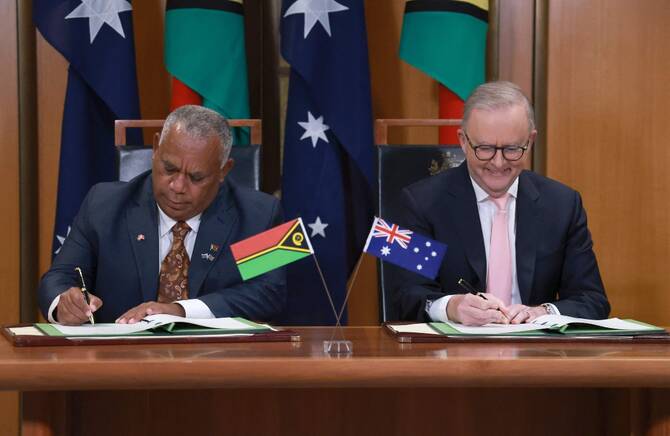
Australia Vanuatu security deal Nakamal Agreement China 2026 has been formally signed after months of delay, with Australian Prime Minister Anthony Albanese and Vanuatu Prime Minister Jotham Napat completing the development and security pact in a ceremony that gives Canberra consultation rights on any third-party investment in Vanuatu's critical infrastructure and establishes Australia as Vanuatu's preferred security and policing partner, backed by A$500 million over 10 years in development funding that represents the most significant bilateral Pacific partnership investment that Australian strategic policy has deployed in the current Pacific influence competition with China. The agreement, known as the Nakamal Agreement after the traditional Vanuatu meeting place whose name gives the pact its cultural grounding, was originally scheduled for signing in September before Napat's coalition partner raised concerns that it could restrict Vanuatu's ability to secure infrastructure funding from other countries, creating the specific diplomatic complication that delayed the agreement for months and whose resolution required the sovereign framing that Monday's signing ceremony emphasised. Albanese's characterisation of the agreement as encapsulating Vanuatu's sovereign decision not to permit its territory to be used for any foreign military base and to keep its critical infrastructure free from militarisation translates the strategic competition dynamics that drive Australian interest in the pact into the sovereignty language that Vanuatu's domestic political audience requires to accept the agreement as a Pacific island nation's exercise of agency rather than a concession to Australian strategic interests.
China's position as Vanuatu's largest external creditor, having provided loans through Chinese banks that financed Chinese contractors to build the presidential office complex, parliament building, and road network, creates the specific financial dependency context within which the Nakamal Agreement's consultation requirement on third-party infrastructure investment must be understood as primarily targeting Chinese investment in future projects rather than the established Chinese-financed infrastructure whose completion predates the agreement. Vanuatu's simultaneous pursuit of its own economic deal with China that Napat said on Monday was awaiting approval from Beijing creates the specific diplomatic complexity of a small Pacific island nation managing simultaneous major partnership arrangements with two of the world's largest economies whose strategic competition with each other makes neutrality increasingly difficult to maintain without the sovereign framing that both the Nakamal Agreement's language and Napat's willingness to share the China deal's terms are designed to project. The trade and diplomacy assessment of Monday's signing must account for this dual-track diplomacy as the specific strategic reality that Vanuatu is navigating, rather than the binary China-versus-Australia framing that Australian strategic commentary tends to impose on Pacific island nation decision-making.
The A$500 million over 10 years commitment, converting to approximately $344 million at current rates, provides the financial foundation that differentiates the Nakamal Agreement from previous Australian Pacific security arrangements whose strategic aspirations lacked the development funding that Pacific island nations consistently identify as their primary interest in any bilateral partnership. The financial commitment's scale and duration, representing sustained engagement rather than project-by-project funding whose continuation is annually uncertain, addresses the specific criticism that Australian Pacific engagement has historically prioritised security outcomes for Canberra over development outcomes for Pacific partners, making the Nakamal Agreement's development-and-security framing the deliberate rebalancing whose persuasiveness will be tested by whether the A$500 million is deployed in ways that Vanuatu's communities experience as genuinely meeting their development priorities.
How Pacific Influence Competition Created the Nakamal Agreement's Strategic Logic
China's emergence as Vanuatu's largest external creditor through the infrastructure loan programme that financed the presidential office complex, parliament building, and road network represents the specific economic relationship whose strategic consequences Australian policy has been attempting to address through the Nakamal Agreement's consultation mechanism. Chinese infrastructure lending in the Pacific, delivered through the Belt and Road Initiative's Pacific extensPacific Islandsion, has followed the pattern established across Africa, South Asia, and Southeast Asia in which Chinese state-owned banks finance Chinese contractors to build infrastructure in developing countries, creating the dual dependency of debt to Chinese lenders and technical reliance on Chinese operators that has given Beijing significant leverage over recipient countries' policy decisions in other regions where the model has been deployed at larger scale. Vanuatu's specific infrastructure objects, the presidential office, parliament, and main road network, are not peripheral additions to the country's infrastructure but its most symbolically and operationally significant facilities, making the Chinese financing relationship embedded in the very institutions of Vanuatu's state governance rather than in commercial or peripheral infrastructure.
The coalition partner concerns that delayed the Nakamal Agreement's original September signing, specifically the worry that it could restrict Vanuatu's ability to secure infrastructure funding from other countries, reflect the genuine political economy reality that a small Pacific island nation with significant infrastructure needs and limited domestic financing capacity has rational reasons to preserve access to all available external financing sources rather than committing to arrangements that create preferences for Australian-approved investors over Chinese lenders whose financing terms may be more accessible than Australian or Western alternatives. The delay's resolution required sufficient modification or clarification of the agreement's infrastructure consultation provision to address these concerns while maintaining the strategic content that Australian negotiators required, with the sovereign framing that Monday's ceremony emphasised serving as the political vehicle for reconciling Vanuatu's domestic coalition dynamics with the strategic commitments that Australia was seeking.
Australia's Pacific Step-Up policy, announced in 2018, was the strategic framework whose development the Nakamal Agreement represents as a specific bilateral expression, reflecting the Morrison and then Albanese governments' recognition that China's growing Pacific presence required active Australian diplomatic and development engagement rather than the assumption that Pacific island nations' historical Australian relationships would persist without competitive investment. The infrastructure investment gap that Chinese lending has been filling in Vanuatu and other Pacific island nations reflects the specific development financing deficit that Australian policy had not addressed with the scale or consistency that Pacific governments require, creating the opening that Chinese strategic engagement exploited and that the Nakamal Agreement's A$500 million over 10 years is designed to partially close.
The Solomon Islands Warning and Why Vanuatu Matters for Australian Strategy
The 2022 Solomon Islands security agreement with China, which shocked Australian strategists by demonstrating that Pacific island nations would sign security arrangements with Beijing if Australian engagement was insufficient, provided the specific strategic warning whose lessons the Nakamal Agreement's development represents in Australian Pacific policy. The Solomon Islands episode demonstrated that Pacific island nations evaluate security and development partnerships through their own national interest calculations rather than historical Commonwealth relationships, and that Chinese engagement offers genuine alternatives to Australian partnership rather than merely rhetorical competition. Vanuatu's geographic position in the South Pacific, northeast of Australia and within the maritime zone that Australian strategic planning identifies as critical to its northern approaches' security, gives the Nakamal Agreement's preferred security partner provision its specific strategic value beyond the development investment's intrinsic worth to Vanuatu's infrastructure programme.
The no foreign military base provision that Albanese specifically cited as a central element of the agreement creates the specific reassurance for Vanuatu's domestic politics that the agreement is not a vehicle for Australian military basing whose imposition would be domestically unpopular and regionally concerning. The provision's dual function is both genuine sovereignty protection for Vanuatu, which has consistently maintained its non-aligned posture through decades of post-independence foreign policy, and strategic Australian interest protection, because a no-foreign-military-base commitment that Vanuatu has publicly affirmed as a sovereign choice implicitly commits it to the same standard toward Chinese military basing requests that would be the most serious Australian strategic concern about any Pacific island nation's security relationship with Beijing.
Napat's China Deal, the Consultation Mechanism, and Vanuatu's Dual-Track Position
The specific mechanism by which Australia will be consulted on third-party investment in Vanuatu's critical infrastructure is the operational detail whose practical implementation will determine whether the Nakamal Agreement delivers the strategic content that Australian negotiators sought or whether the consultation requirement is satisfied through notification procedures that give Canberra awareness without meaningful influence over investment decisions. A consultation mechanism that requires Australia's views to be sought but not necessarily followed differs substantially from a veto mechanism that gives Canberra approval authority over third-party infrastructure investment, and the distinction between these models determines the agreement's strategic effectiveness in the specific case that motivates it, a major Chinese infrastructure loan application whose approval Canberra opposes. Napat's transparency about the parallel China economic deal awaiting Beijing approval, and his willingness to share that agreement's terms, suggests Vanuatu's approach to the dual-track relationship is one of public transparency rather than compartmentalisation, creating the diplomatic accountability that makes managing both relationships simultaneously more politically sustainable than concealment would allow.
The development investment dimension of the A$500 million commitment will determine whether the Nakamal Agreement produces the tangible outcomes for Vanuatu's communities that make it politically sustainable beyond the current Napat government, because a security partnership whose strategic benefits accrue primarily to Australia while development benefits to Vanuatu remain abstract will face the same domestic political erosion that previous Australian Pacific arrangements have experienced when their community-level benefits did not match their diplomatic prominence. Australian development programming's historical strengths in governance, education, and health service delivery in the Pacific provide the implementation framework through which the A$500 million can be deployed in areas that Vanuatu communities prioritise, but the specific allocation decisions between infrastructure, services, capacity building, and budget support will reflect the negotiated balance between Australian programming preferences and Vanuatu's expressed development needs.
Napat's statement that there is nothing to hide about the parallel China economic deal being pursued, offered in response to a direct question about whether that deal would contain security elements, is the diplomatic transparency gesture that positions Vanuatu as a genuinely sovereign actor managing multiple international relationships openly rather than playing partners against each other covertly. For a small Pacific island nation with enormous infrastructure needs, limited domestic resources, and powerful external partners whose competition for influence creates leverage that can be converted into development financing, Vanuatu's dual-track approach to Australian security partnership and Chinese economic engagement represents a rational and in many ways impressive exercise of small-state diplomacy whose maintenance requires exactly the kind of transparency that Napat's statement projects.