
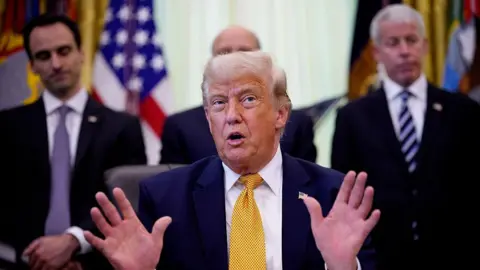
Trump 100 percent tariff Europe digital services tax 2026 threat has been issued on Truth Social with the U.S. president vowing to impose immediate 100 percent import tariffs on any European country that introduces a digital services tax on American technology companies, warning that the punitive penalties would supersede any existing bilateral trade agreements and would apply immediately upon what he described as the imminent implementation of such levies in numerous European countries. The threat arrives days after the United States and European Union finalised a new trade deal, creating the specific diplomatic dissonance of a president who just concluded a major bilateral trade agreement immediately threatening the same trading partners with tariff escalation that would render the agreement's terms irrelevant, and weeks after Trump told the UK it faced a big tariff for purportedly targeting major U.S. companies with its existing 2 percent Digital Services Tax. France, Italy, and Spain each impose digital services taxes of 3 percent on large companies operating within their territories, Britain has had its DST in place since 2020, and several other EU nations have implemented or proposed similar levies, creating the specific landscape of existing and planned taxes whose collective scope makes Trump's threat applicable across virtually the entirety of the European Union and potentially to Britain's established tax as well.
The trade and diplomacy assessment of this threat must immediately distinguish between its application to countries planning new digital taxes, which the Truth Social post explicitly targets as its primary audience, and its implications for countries including the UK, France, Italy, and Spain that already have such taxes in place. Trump's framing of imminent implementation as the trigger condition appears to target countries on the verge of introducing new levies rather than retroactively penalising established taxes, but his April statement that the UK faced a big tariff for its existing DST creates the specific ambiguity whose resolution the Department for Business and Trade and Treasury were asked to comment on but had not addressed at time of publication. A threat that supersedes existing bilateral trade agreements is in itself the most legally significant element of the Truth Social post, because it claims executive authority to override internationally negotiated treaty frameworks whose modification normally requires the congressional engagement and formal diplomatic process that a presidential social media post bypasses.
Cyprus Minister Michael Damianos's reminder that the EU can respond swiftly and proportionately when the deal is not respected or its interests are at stake, made in the context of the just-concluded EU-U.S. trade deal, was the most direct European institutional response to the tariff threat, connecting the trade deal's completion to the retaliatory capacity that the EU's collective economic weight provides. The specific timing of Trump's threat days after a trade deal that both sides had presented as a diplomatic achievement creates the political credibility challenge for European negotiators who must now explain to domestic audiences why the deal they delivered is immediately being threatened by the same American administration that signed it. Amazon's decision to raise fees on sellers earlier this year citing digital services taxes adds the specific corporate behaviour dimension that documents how the DST-tariff tension is already affecting the commercial relationships that Europe's digital economy depends on.
How the Digital Services Tax Dispute Became a Transatlantic Trade Flash Point
European countries began developing digital services taxes in the late 2010s in response to the specific tax avoidance problem that large American technology companies had systematically exploited for decades through the manipulation of transfer pricing, intellectual property location strategies, and profit shifting arrangements that allowed companies earning billions from European consumers to report minimal taxable profits in the jurisdictions where their revenues were generated. The OECD's long-running effort to develop a global minimum tax framework and new profit allocation rules for digital businesses, known as Pillar One and Pillar Two of the OECD/G20 Inclusive Framework on Base Erosion and Profit Shifting, was the multilateral attempt to address the underlying problem through international agreement rather than unilateral national action, but its slow progress prompted individual European countries to implement their own interim digital services taxes whose revenue generation would continue until global agreement produced a more comprehensive solution.
Britain's 2 percent DST, in place since 2020 and raising more than £800 million in 2024-25 up from £678 million the previous year according to Treasury data, targets search engines, social media platforms, and online marketplaces with global revenues from digital businesses exceeding £500 million and UK revenues above £25 million. This threshold design specifically catches the major American platforms, Apple, Google, Meta, and Amazon, while exempting smaller digital businesses whose scale does not reflect the profit-shifting concern that the tax's architecture addresses. France, Italy, and Spain's 3 percent levies follow a similar logic but at a higher rate, creating the specific revenue collection that American technology companies and the U.S. government have consistently characterised as discriminatory targeting of American companies rather than neutral application of tax principles to digital business models.
- The Trump administration's opposition to European digital services taxes reflects the specific intersection of American commercial interests, technology sector political influence in Washington, and the broader America-first trade policy that positions any foreign tax on American companies as an economic attack requiring retaliatory response. The technology sector's substantial political contributions to American political campaigns across both parties, combined with the specific concentration of major digital companies in states with significant electoral college weight, creates the domestic political incentive for presidential DST opposition that is independent of the abstract tax policy arguments about whether the European levies constitute fair application of tax principles or discriminatory targeting. Trump's own characterisation of European countries as thinking they can make an easy buck and taking advantage of the United States frames the DST as predatory extraction rather than legitimate tax policy, creating the emotional and political register in which a 100 percent tariff response appears proportionate rather than extreme.
The EU-US Trade Deal and the Contradiction Trump's Threat Creates
The EU-U.S. trade deal finalised days before Trump's DST tariff threat was itself the product of extended diplomatic negotiation whose conclusion was celebrated by both sides as a breakthrough in the transatlantic economic relationship that Trump's earlier tariff actions had severely damaged. A trade deal concluded and immediately threatened with supersession by a presidential social media post is not simply a diplomatic inconsistency but a specific credibility problem for the European negotiators who presented the deal to their domestic constituencies as a genuine achievement of U.S. market access improvements and tariff reduction commitments. Damianos's response connecting the EU's retaliatory capacity to deal respect frames the European position as conditional compliance with the agreement rather than unconditional acceptance, signalling that the EU views Trump's DST threat as a potential trigger for the proportionate response that the bloc's collective economic weight and its own retaliatory tariff toolkit makes credible.
The U.S. Supreme Court's February striking down of Trump's earlier attempt to impose a global 10 percent tariff provides the specific legal precedent context within which the 100 percent DST tariff threat must be assessed, because the constitutional limits on presidential tariff authority that the court enforced against the global tariff also potentially apply to the country-specific retaliation that Trump's Truth Social post announces. The legal mechanism through which a president can impose country-specific retaliatory tariffs differs from the global tariff authority that the court struck down, with section 301 of the Trade Act of 1974 providing potential legal cover for retaliatory tariffs against countries whose trade practices the U.S. Trade Representative has determined to be unfair, but the scale of 100 percent and the explicit supersession of bilateral trade agreements creates legal exposure that previous DST tariff threats have also faced without fully resolving.
The UK's Ambiguous Position, Amazon's Fee Increases, and What Europe Must Decide
Britain's position is the most diplomatically and legally complex among the countries affected by Trump's threat, because its DST has been in place since 2020 rather than being planned for imminent implementation, creating the specific question of whether Trump's targeting of imminent new levies applies to Britain's established tax or whether the April statement about a big tariff for the UK represented a separate and continuing American position that makes Britain's exposure equivalent to countries planning new taxes regardless of the post timing distinction. The UK government's silence at time of publication, with both the Department for Business and Trade and Treasury having been contacted for comment without immediate response, is itself politically informative, because a government that could confidently state its DST falls outside Trump's threat would have significant incentive to provide that reassurance promptly rather than leaving the ambiguity to compound through media coverage.
Britain's simultaneous pursuit of a U.S.-UK trade deal that has been a post-Brexit government priority across multiple administrations creates the specific bilateral leverage dynamic within which the DST dispute operates, because Washington has consistently identified the UK DST as an obstacle to trade deal progress while London has consistently maintained the DST's legitimacy as domestic tax policy. The £800 million annual revenue that the UK DST generates, and its year-on-year growth from £678 million, creates the specific fiscal dependency that makes unilateral DST removal in response to American pressure politically difficult for any UK government to execute without the OECD global digital tax agreement that was supposed to replace the interim national levies but whose finalisation has remained elusive.
Amazon's decision to raise fees on sellers citing digital services taxes documents the specific commercial pass-through mechanism through which DST costs are transmitted from the technology platforms that pay them to the smaller businesses and ultimately consumers who use those platforms, creating the constituency of affected parties beyond the major technology companies themselves whose interests the DST dispute mobilises. European small businesses that sell through Amazon marketplaces and have experienced fee increases attributed to digital services taxes are experiencing the specific consequence of the tax policy dispute in their operating costs, creating the domestic political dynamic in which the DST's visible revenue for government is set against the less visible cost increases that the platforms distribute through their seller fee structures. This commercial pass-through reality complicates the clean narrative that European DST defenders present of taxing profitable American technology companies, because the cost ultimately distributes across the commercial ecosystem in ways that reach well beyond the intended targets.