
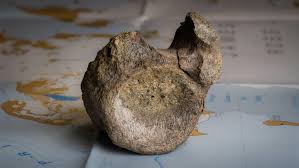
First dinosaur bone Antarctica Titanosaur BAS discovery 2026 has been confirmed after a fossil that spent four decades lying forgotten in a drawer at the British Antarctic Survey in Cambridge turned out to be a tail vertebra from a Titanosaur, the group that contained the largest dinosaurs ever to walk the Earth, making it the first dinosaur bone ever found in Antarctica despite having been collected from James Ross Island in 1985 and stored unidentified among thousands of specimens in the BAS geology collection. Dr Mark Evans, the collections manager at BAS, spotted the specimen while working through the collection's drawers and immediately recognised that the vertebra looked dinosaur-like rather than belonging to the marine reptile that the original field team had likely assumed it represented, prompting him to bring in Prof Paul Barrett from the Natural History Museum to confirm the identification. Barrett's confirmation was immediate and unequivocal: the fossil's distinctive combination of a hollow on one end and a rounded bump on the other, creating the ball-and-socket joint sequence that runs from head to tail in Titanosaurs, is a combination of features that Barrett described as completely unique to these types of dinosaurs, making the identification a dead certainty from the moment he held the specimen in his hands.
The fossil's journey from its 1985 discovery, recorded in a field notebook by geologist Dr Mike Thomson with a tiny neat sketch dated December 9 and the annotation vertebra of large reptile with a noted width of approximately 10 centimetres, through four decades of storage in a Cambridge drawer to its current status as the most historically significant Antarctic palaeontological specimen represents the specific kind of scientific discovery whose narrative power derives from the contrast between the unassuming physical appearance of the fossil, which Barrett acknowledged is not too much to look at, and the extraordinary significance of what it reveals about Antarctica's prehistoric past. Evans's own reflection that it is only when you start thinking about what is in a drawer that you sometimes come across something and think it looks interesting captures the specific discovery circumstance whose lesson, that institutional collections contain historical significance that active engagement rather than passive storage can reveal, applies across the museum and scientific collection world far beyond this single specimen.
The Antarctic Titanosaur whose tail bone Evans identified was approximately 23 feet or 7 metres in length according to the scientists' estimate from the bone's size, either a juvenile of the Titanosaur group or a genuinely smaller adult that bucked the trend for a group that elsewhere reached lengths exceeding 115 feet and weights approaching 60 tonnes. This dinosaur lived 82 million years ago during the Late Cretaceous Period when Antarctica bore no resemblance to the ice-covered continent of today but was instead covered in lush forest whose plant material provided the food source that a large four-legged herbivore with a very long neck evolved to reach up into trees and a long counter-balancing tail required for stability. The discovery helps reveal more about how these animals lived in a part of the world where the fossil record is sparse and where the ice that makes Antarctica uninhabitable today conceals the prehistoric record in the rock beneath, limiting palaeontologists' ability to reconstruct the full ecosystem that once supported a huge cast of characters at the very bottom of the world.
How the 1985 Discovery Went Unrecognised and What Antarctica's Fossil Record Has Revealed
The December 1985 collection of the fossil on James Ross Island documents the specific geographical and temporal context of a discovery whose significance went unrecognised in the field because the Late Cretaceous marine environment whose fossils dominate Antarctic collections made a marine reptile attribution the obvious first hypothesis for any large vertebrate bone found in the region. The field conditions that Antarctic geological expeditions face, working in extreme cold with limited time on site, reference materials, and specialist consultation opportunities, create the specific circumstances in which a field geologist's annotation of vertebra of large reptile represents the appropriate cautious documentation of an uncertain identification rather than a missed opportunity for a definitive palaeontological assessment. Thomson's field notebook with its tiny neat sketch is the specific archival document that preserved the discovery's existence and provenance across four decades during which the specimen's true identity remained unknown, and whose contents provided the original discovery context that the current identification has retrospectively elevated to historical significance.
The BAS geology collection's holdings of thousands of specimens from decades of Antarctic expeditions documents the scale of the scientific legacy that Antarctic exploration has accumulated and whose systematic examination Evans's discovery demonstrates can yield unexpected findings with major scientific significance. Large natural history and geological collections around the world hold specimens whose original identification was made under the constraints of the knowledge and expertise available at the time of collection, and whose reanalysis with contemporary scientific methods and specialist knowledge regularly produces reclassifications that change the scientific record in ways that the original collectors could not anticipate. The 40-year gap between the fossil's collection and its correct identification is not unusual in the history of natural history collections, and Evans's spotting of the specimen while working through BAS drawers exemplifies the active engagement with historical collections whose scientific value the natural history museum community has been advocating as a research priority.
James Ross Island's palaeontological significance in the Antarctic context comes from its position in the Antarctic Peninsula region where sedimentary rocks of the appropriate Late Cretaceous age are exposed at the surface rather than buried under the ice sheet that covers most of the Antarctic continent, making it one of the few places where Antarctica's prehistoric biological record is accessible to palaeontologists without the deep drilling into ice and rock that most of the continent would require. Other dinosaur fossils have been found on the Antarctic Peninsula and nearby islands in the years after 1985, but not many, and the confirmation that the 1985 specimen was the first places the subsequent finds in the context of a fossil record that began with the unrecognised specimen in Thomson's collection rather than with the later finds whose discovery came with immediate identification. The reclassification of the 1985 specimen as the first thus changes not just the record of when the first Antarctic dinosaur fossil was found but the history of palaeontological understanding of Antarctica's Late Cretaceous terrestrial ecosystem.
Titanosaurs as a Group and What Antarctica's Species Reveals About Their Range
The Titanosaur group, whose more than 100 identified species represent one of the most diverse and widely distributed dinosaur lineages in the Late Cretaceous period, provides the specific taxonomic context within which the Antarctic specimen's significance for understanding global Titanosaur distribution can be assessed. Titanosaurs have been found on every other continent where Late Cretaceous terrestrial sediments have been studied, with spectacular examples from Patagonia in South America, the Gobi Desert in Central Asia, the Sahara in Africa, and multiple European and North American sites providing the comparative anatomical framework that Barrett used to identify the Antarctic specimen's Titanosaur affinity from its distinctive ball-and-socket vertebral morphology. The Antarctic find extends the group's confirmed geographic range to the sixth continent, completing a global distribution whose consistency with the Late Cretaceous supercontinent geography helps palaeontologists understand how Titanosaurs dispersed across the landmasses that were in the process of separating into the continents we know today.
The size estimate of approximately 7 metres for the Antarctic Titanosaur, sitting at the smaller end of the group's known size range, creates the specific biological question that Barrett articulated about whether this represents a juvenile of a species that would have grown much larger or a genuinely small adult from a lineage that evolved reduced body size in the specific ecological conditions of Late Cretaceous Antarctica. Island and polar dwarfism, the evolutionary tendency for large animals to evolve smaller body sizes in resource-limited island or high-latitude environments, is a documented biological pattern whose potential application to the Antarctic Titanosaur would make it scientifically interesting as a potential example of polar adaptation in a lineage whose other members are famous for their gigantism. The single tail bone's limited anatomical information prevents definitive resolution of the juvenile-versus-dwarf question, making additional Antarctic Titanosaur specimens the highest palaeontological priority for James Ross Island and adjacent exposures.
What the Discovery Means for Antarctic Palaeontology and What Comes Next
The scientific value of the Antarctic Titanosaur specimen, despite its small size and single-element nature, extends across multiple research areas simultaneously, providing the first direct evidence of non-marine dinosaurs in Antarctica, contributing to the biogeographic understanding of Titanosaur global distribution, and offering insights into the Late Cretaceous Antarctic ecosystem whose reconstruction from the sparse fossil record has been a long-standing palaeontological challenge. Barrett's NHM identification, grounded in comparative anatomy with the more than 100 known Titanosaur species' documented skeletal morphology, transforms a piece of fossilised bone whose surface features were puzzling to non-specialists into the specific taxonomic evidence whose scientific communication will appear in peer-reviewed palaeontological literature and become part of the permanent scientific record of Antarctic prehistoric life.
The discovery's timing, coming as palaeontological attention to Antarctica has been growing through improved field logistics and the recognition that climate change-driven ice retreat may be exposing additional fossil-bearing rock surfaces, creates the specific research context in which the confirmed existence of Titanosaurs in Late Cretaceous Antarctica motivates targeted searching in the exposed sedimentary sequences of the Antarctic Peninsula and nearby islands. A single confirmed species presence, even from a single bone, establishes the hypothesis whose testing drives field research in directions that the absence of confirmed specimens does not justify, making the specimen's identification a research programme catalyst whose effect on Antarctic palaeontology will be measured in the expeditions it motivates and the specimens those expeditions find.
Barrett's broader reflection that the discovery shows an area now considered really uninhabitable was once very habitable with a huge cast of characters living on it, and that the specimen is helping to work out how these animals fitted into broader ecosystems at the very bottom of the world about 80 million years ago, frames the scientific significance in the terms that connect to the public's genuine curiosity about deep time, continental change, and the extraordinary difference between Antarctica's inhabited Cretaceous past and its current frozen state. The 40-year journey from Thomson's field notebook sketch to Barrett's NHM identification is the specific scientific narrative whose human elements, the field geologist who noted something interesting, the collections manager who looked in the drawer, the museum professor who recognised the shape, combine with the deep time narrative of a 7-metre plant eater in a forested Antarctica to create the kind of scientific discovery story that communicates palaeontology's excitement and importance to audiences well beyond the specialist community.