
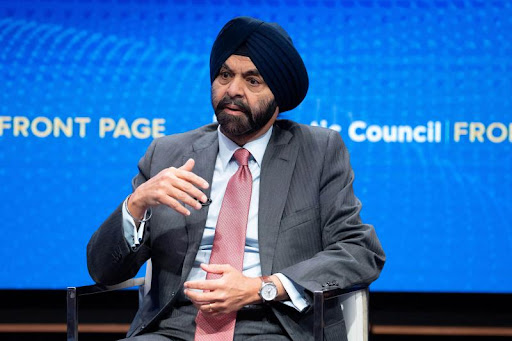
Banga World Bank Gaza reconstruction Board of Peace defence came under immediate public pressure on Tuesday when two protesters interrupted World Bank President Ajay Banga's speech at an Atlantic Council event in Washington, urging him to resign from Trump's Board of Peace before he could complete his remarks explaining the multilateral lender's rationale for participating in the Gaza reconstruction initiative. Banga responded by underscoring the United Nations Security Council resolution that had explicitly called on the World Bank and other financial institutions to work with the Board of Peace to provide financial resources for Gaza's recovery, framing his participation not as a discretionary political alignment with the Trump administration but as compliance with a clear and binding multilateral directive from the world's most authoritative international security body. His position as a limited trustee of the trust fund into which governments have contributed money for Gaza reconstruction, rather than as a decision-maker about how those funds are used, was the central distinction he offered to address the protesters' implicit concern that the World Bank was lending institutional legitimacy to a Trump political initiative.
The Board of Peace, proposed by President Donald Trump in September 2025 as part of his plan to end the war in Gaza, brought together a diverse executive board including U.S. Secretary of State Marco Rubio, presidential advisers Jared Kushner and Steve Witkoff, and Banga among others, with Trump serving as permanent chairman. The board's first formal meeting in February 2026 produced an announcement that a host of nations had contributed $7 billion to a reconstruction fund for Gaza, an amount that represents a fraction of the estimated up to $70 billion that analysts project will be required to rebuild a territory that was reduced to rubble after two years of war between Israel and Palestinian militants. The gap between the $7 billion committed and the $70 billion estimated need encapsulates the scale of the reconstruction challenge that the Board of Peace and the World Bank's participation in it must eventually address, alongside the many unresolved political questions about disarmament, withdrawal, and governance that any reconstruction programme will encounter.
Banga's articulation of the World Bank's specific role as a limited trustee, holding the funds while the Board of Peace decides how the money is used and who receives it, is a careful positioning that attempts to preserve the bank's institutional independence and development mandate while fulfilling the UN Security Council direction to participate in the reconstruction financing architecture. The Atlantic Council event, one of Washington's most prominent foreign policy forums, provided the setting for a World Bank president trying to explain a complex institutional position to an audience that includes both supporters of the Gaza reconstruction effort and critics who see the Bank's Board of Peace participation as a compromise of its multilateral character. Whether Banga's trustee framing succeeds in maintaining the political sustainability of the World Bank's Gaza engagement will depend as much on what the Board of Peace actually does with the reconstruction funds as on how convincingly Banga explains the institutional arrangements governing the Bank's role.
The Gaza Crisis, the World Bank's Prior Engagement, and How the Board of Peace Was Created
The two-year war between Israel and Palestinian militants in Gaza has produced a scale of physical destruction that makes the territory's reconstruction one of the most complex humanitarian and development challenges in the contemporary world. Gaza's built environment, infrastructure, healthcare system, educational institutions, and economic base have been devastated by the conflict in ways that independent assessments, including those from the United Nations and World Bank's own damage evaluation frameworks, place in the range of $50 billion to $70 billion in reconstruction costs. The physical rebuilding challenge is compounded by the political and governance questions that surround any sustainable reconstruction plan, including the unresolved status of Hamas's armed presence in the territory, the conditions under which Israeli military forces would withdraw, and the question of what governing authority would oversee reconstruction programmes and ensure their accountability.
The World Bank had begun preparing for Gaza's eventual reconstruction well before the Board of Peace existed, creating a Palestinian expert group two years ago that brought together representatives from Jordan, Palestine, Egypt, Israel, the United States, and Europe. This expert group reflects the bank's standard approach to preparing for post-conflict reconstruction in complex political environments, building the technical and institutional capacity for financing and programme design before the political conditions for large-scale reconstruction are fully established, so that the development infrastructure is ready when the window for reconstruction opens. The inclusion of Palestinian, Israeli, and regional representatives alongside Western parties in the expert group reflects the Bank's attempt to maintain a position of technical legitimacy across the political spectrum of parties whose cooperation any successful Gaza reconstruction will require.
The Bank's decision to invest in the equity of the Bank of Palestine, ensuring that the Palestinian banking institution remained viable and available as a financial system partner when the crisis ended, represents a more directly operational form of preparation that goes beyond policy analysis and programme design into the institutional architecture of post-conflict economic recovery. A functioning banking system is a prerequisite for any reconstruction economy, enabling contractors to receive payments, workers to deposit wages, businesses to access credit, and households to maintain basic financial transactions. By providing equity support to preserve the Bank of Palestine's viability through the conflict period, the World Bank was making a bet that a Palestinian banking institution with continuity and credibility would be more valuable for reconstruction than having to rebuild financial sector capacity from scratch after the fighting stopped.
The UN Security Council Resolution and Its Direction to the World Bank
The United Nations Security Council resolution that Banga cited as the directive basis for the World Bank's Board of Peace participation is the multilateral legitimacy framework that allows the bank to engage with a Trump administration initiative while maintaining its institutional claim to operating on the basis of international law and multilateral consensus rather than bilateral political preferences. Security Council resolutions, particularly those adopted under Chapter VII of the UN Charter which applies to situations threatening international peace and security, create obligations and directions that international financial institutions treat as authoritative guidance for their own institutional engagement decisions. When a Security Council resolution specifically calls on the World Bank to work with a particular reconstruction financing mechanism, the bank's participation in that mechanism is not a political choice but a legal and institutional obligation.
The specificity of the Security Council resolution's direction, calling on the World Bank and other financial institutions to work with the Board of Peace to provide financial resources for Gaza's reconstruction including through establishment of a dedicated trust fund, gave Banga the institutional framework he needed to participate in the Board without appearing to be making a unilateral alignment with the Trump administration's Gaza policy. The trust fund mechanism that the resolution references and that the World Bank is administering as limited trustee is a standard development finance instrument that the Bank has used in multiple post-conflict reconstruction contexts, providing a governance structure for pooled donor funding that establishes accountability, reporting, and fiduciary management requirements that protect both the donors and the intended beneficiaries.
The Board of Peace's composition, combining U.S. government officials including Rubio and Kushner with international development figures like Banga, represents Trump's attempt to create a mechanism that has both American political ownership and international institutional credibility. The inclusion of the World Bank president on the executive board serves this dual legitimacy purpose, lending the initiative the development finance expertise and multilateral institutional reputation that the American political figures alone cannot provide. Banga's presence on the board is therefore instrumentally valuable to the Board of Peace's credibility in the international donor and development community, and his continued participation is something that both the Trump administration and the World Bank's own governance structures have an interest in maintaining, albeit for different reasons.
The Trump Board of Peace Initiative and Its Reconstruction Financing Architecture
Trump's September 2025 announcement of the Board of Peace as the vehicle for Gaza's post-war reconstruction represented a departure from conventional post-conflict reconstruction frameworks, in which the United Nations, the World Bank, and regional development banks typically play the central coordination and financing roles with donor nations contributing through established multilateral channels. The Board of Peace's structure, with the U.S. President as permanent chairman and a mixed executive board of American officials and international figures, places American political leadership at the centre of the reconstruction architecture in a way that reflects the Trump administration's preference for direct American engagement over multilateral institutional management. The $7 billion in nation contributions announced at the February board meeting provides an initial financing base, but the gap between that figure and the $70 billion reconstruction estimate means that the board's fundraising and resource mobilisation work is far from complete.
Kushner's role on the executive board reflects his prior involvement in Middle East diplomacy during Trump's first term, when he led the development of the Abraham Accords that normalised relations between Israel and several Arab states and when he was involved in earlier Gaza reconstruction planning discussions that did not ultimately produce a comprehensive programme. His presence on the Board of Peace brings continuity of Trump administration Middle East engagement alongside specific knowledge of the regional relationships and political dynamics that any Gaza reconstruction programme must navigate, including the Gulf state financial commitments that have been a consistent component of Gaza reconstruction planning discussions across multiple administrations.
The many unresolved questions that Banga acknowledged regarding disarmament, withdrawal, the reconstruction fund's total size, and the flow of humanitarian aid represent the political prerequisites that have historically blocked Gaza reconstruction programmes from moving from planning to implementation. Any reconstruction programme that begins before the security situation is resolved runs the risk of seeing rebuilt infrastructure destroyed in subsequent conflict, wasting the investment and deterring future donor contributions. Any programme that waits for complete political resolution risks allowing the humanitarian situation in Gaza to deteriorate further while the political negotiations proceed at their own pace. The Board of Peace's navigation of this sequencing challenge will determine whether the $7 billion committed and the World Bank's institutional participation produce lasting reconstruction outcomes or become another chapter in the long history of Gaza reconstruction plans that did not fully materialise.
Banga's Atlantic Council Defence, the Protesters' Challenge, and What the World Bank's Role Means
The disruption of Banga's Atlantic Council speech by two protesters urging him to resign from the Board of Peace illustrates the political controversy that the World Bank president's participation in the Trump-led initiative has generated within the development and foreign policy communities that the Atlantic Council convenes. Protests at think tank events are unusual enough that this disruption made news independently of its content, signalling that the Gaza reconstruction politics have reached a level of intensity where even the normally controlled environment of Washington foreign policy discourse is subject to direct action. The protesters' demand that Banga resign from the Board of Peace reflects a view among some critics that the World Bank's institutional integrity requires distance from a Trump administration political initiative rather than participation in its governance structure.
The criticism of the World Bank's Board of Peace participation reflects a broader tension within the multilateral development institution community about how to maintain institutional independence and political neutrality while fulfilling the mandates that member governments and UN Security Council resolutions establish. The World Bank's Articles of Agreement establish the Bank as an apolitical institution that bases its decisions on economic and development considerations rather than political ones, and critics who oppose the Board of Peace participation argue that a Trump administration initiative with strong political characteristics is exactly the kind of engagement from which the Bank should maintain distance to protect that apolitical character. Banga's counter-argument, that the UN Security Council resolution gives the Bank a clear multilateral direction rather than a political preference, attempts to resolve this tension by placing the Bank's participation within the framework of its obligations to the multilateral system rather than within the framework of alignment with any particular government's agenda.
The Atlantic Council's decision to host Banga for this speech reflects the think tank's positioning as a forum where difficult policy questions about the intersection of geopolitics and multilateral institutions can be discussed with appropriate nuance and expert engagement. The protest disruption transformed what would have been a policy explanation into a visible public confrontation that gave Banga the opportunity to articulate his Board of Peace defence more directly and personally than a prepared speech would have required. In one sense, the protesters' intervention was counterproductive from their own advocacy perspective, because it provided the World Bank president with a more sympathetic public forum for explaining his position than a quietly delivered speech would have created, and his calm and reasoned response to the disruption reinforced his personal credibility with the audience.
The Limited Trustee Role and Its Implications for World Bank Independence
Banga's repeated emphasis on the World Bank's role as a limited trustee of the Board of Peace trust fund, holding the funds rather than deciding how they are used or who receives them, is the institutional boundary that he is drawing to preserve the Bank's operational independence while fulfilling its participatory mandate. The limited trustee structure is a genuine fiduciary constraint that gives the Board of Peace, not the World Bank, decision-making authority over fund allocation, meaning that the Bank's Gaza reconstruction engagement does not compromise its ability to apply its own development standards and safeguards to the disbursements that it manages. In this structure, the Bank is the financial plumbing through which reconstruction funds flow rather than the architect of how those funds are deployed, a role that provides meaningful separation between the Bank's institutional credibility and the political decisions that the Board of Peace makes about reconstruction priorities.
The trust fund mechanism's accountability and reporting requirements, which the World Bank's standard trustee practices impose, provide a governance structure for the reconstruction financing that independent of the Board of Peace's own decision-making process creates transparency and fiduciary discipline around the use of donor funds. Donors who contribute to the trust fund through the World Bank's trustee mechanism can rely on the Bank's established financial management and accounting standards to ensure that their contributions are tracked, reported, and disbursed in accordance with the purposes for which they were given, even if the Board of Peace's political decisions about allocation priorities differ from what a pure development finance perspective would recommend. This combination of World Bank financial management rigour and Board of Peace political allocation authority is the specific hybrid that Banga is defending as appropriate for Gaza's reconstruction context.
The Bank's goal of reconnecting Palestine and Gaza with its neighbours digitally and physically, and facilitating trade, that Banga articulated at the Atlantic Council represents the development objectives that inform the World Bank's Gaza engagement beyond the trustee role itself. Digital and physical connectivity, trade facilitation, and regional economic integration are standard World Bank development objectives whose application to Gaza's reconstruction context connects the Bank's participation to its core institutional mandate rather than positioning it as a political actor in the Israeli-Palestinian conflict. The Palestinian expert group that the Bank established two years ago has been working on exactly these connectivity and trade objectives, and Banga's reference to that pre-existing work serves to demonstrate that the Bank's Gaza engagement predates the Board of Peace and is grounded in development rationale rather than political convenience.