
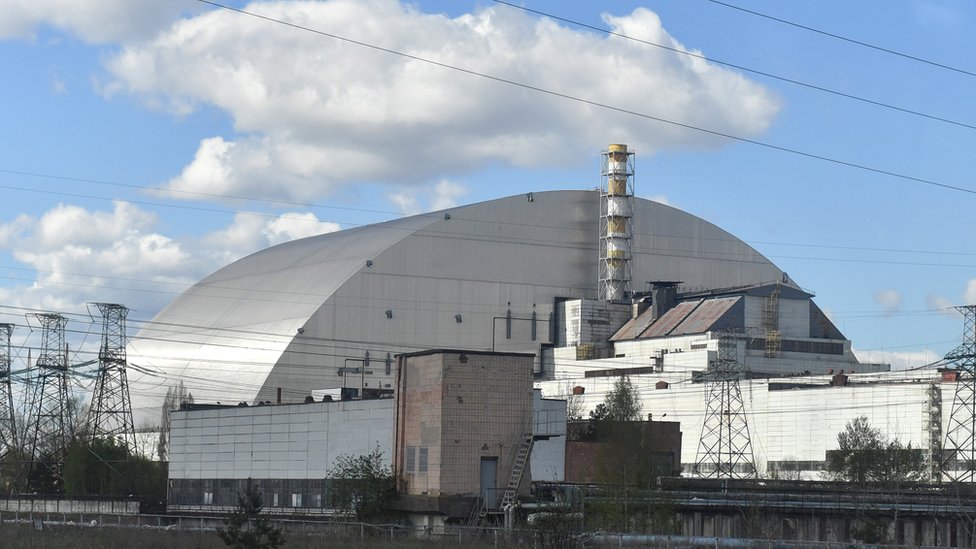
Four decades after the world's worst nuclear disaster sent radioactive clouds billowing across much of Europe and permanently altered humanity's relationship with nuclear energy, the Chornobyl war nuclear riskplant in northern Ukraine stands at the intersection of two distinct but equally urgent crises, haunted simultaneously by the unfinished business of the 1986 catastrophe that destroyed reactor four and by the active and ongoing threat of Russian military strikes that have already damaged the protective structure meant to contain that catastrophe for the next century. The forty-year anniversary of the April 26, 1986 explosion falls this Sunday in circumstances that the plant's workers, its international supporters, and Ukraine's government could not have imagined when the gleaming two-billion-euro protective arc was installed over the ruined reactor in 2016 and was expected to last a hundred years without the kind of damage it has already sustained from a Russian strike drone that tore into its membrane on February 14, 2025. The anniversary marks not a moment of closure or commemoration from a distance but an active and continuing emergency being managed by approximately 2,250 employees who continue to work at the facility through the conditions of a war that has made their already extraordinarily demanding work more dangerous, more logistically complicated, and more existentially consequential than it was when they chose careers maintaining a stricken nuclear plant in an eerily quiet exclusion zone one hundred kilometers north of Kyiv.
Denys Khomenko, the deputy director for technical operations at the Chornobyl plant, spoke to Reuters during a recent visit to the facility with the calm and measured affect that his role demands in circumstances where emotional reactions could compromise the clarity of judgment required to manage high-stakes nuclear safety decisions in a wartime environment. He described the February 2025 drone strike, which tore a visible hole in the protective arc covering the remains of reactor four, in terms that communicated the gravity of what had happened without melodrama or visible agitation, noting that maintaining composure was not simply a professional preference but a practical necessity in a job where emotions getting in the way of logic could have consequences that extended far beyond the plant's boundaries. Workers have since patched the hole left by the drone strike with a large panel, a repair that is visible but dwarfed by the massive scale of the 256-meter-wide steel structure that surrounds the damaged reactor, but the patch represents a temporary fix rather than the comprehensive repair work that experts say is urgently needed in the years ahead to prevent the corrosion and structural deterioration that could compromise the arc's nuclear safety function before its intended century-long operational lifespan has been remotely approached.
The physical reality of what working at Chornobyl in wartime means for the facility's employees extends beyond the psychological challenge of maintaining professional calm while Russian drones fly within kilometers of a nuclear safety structure to the practical constraints imposed by the radiation environment that remains dangerous enough to severely limit how long even highly qualified workers can spend in certain areas of the facility. Khomenko described the specific challenge that the drone-damaged areas of the arc present for repair workers, noting that a welder or other highly qualified personnel may only be able to work in the most sensitive areas for a few minutes or perhaps a few hours at a time, a constraint that transforms what might be a manageable repair project into a massive logistical challenge requiring a large number of skilled workers who are not readily available in the numbers and with the specializations the repairs demand. This radiation-driven constraint on work duration, combined with the wartime disruption of supply chains, personnel routes, and international support mechanisms, has created a repair challenge of considerable complexity that the European Bank for Reconstruction and Development estimates will cost at least 500 million euros to address properly before the window for effective intervention closes and permanent structural damage becomes unavoidable.
How the 1986 Chornobyl Disaster Created the Nuclear Safety Challenge That War Is Now Threatening to Destabilize
The explosion that destroyed reactor four at the Chornobyl nuclear power plant on April 26, 1986 was the product of a fatally flawed reactor design combined with a series of human decisions during a safety test that collectively created the conditions for a runaway chain reaction and steam explosion that blew the reactor's roof off and sent a plume of radioactive material into the atmosphere that spread across much of Europe over the following days and weeks. The immediate human cost included the deaths of plant workers and first responders in the hours and days following the explosion, and the longer-term health consequences for the populations of Ukraine, Belarus, and other affected regions have been debated and studied for four decades without producing consensus on their full scale and severity. The thirty-kilometer exclusion zone established around the plant was initially conceived as a temporary measure but has become a permanent feature of the landscape, an area where the abandoned city of Prypiat, built to house plant workers and their families, has been slowly reclaimed by nature in ways that now attract a different kind of visitor, with wild moose roaming the approach road and the streets of the abandoned town in a haunting reversal of the human occupation that defined the area before the explosion.
The Soviet-era response to the disaster included the hurried construction of a steel and concrete sarcophagus over the destroyed reactor four, a structure built by workers in extremely dangerous conditions to contain the radioactive debris remaining in and around the exploded reactor and prevent further releases of radioactive material into the environment. This original sarcophagus was never designed to be a permanent solution and was understood from the time of its construction to be a temporary containment measure that would eventually need to be replaced with something more robust and durable. By the 1990s and 2000s, as independent Ukraine grappled with the political and financial challenges of managing the Chornobyl legacy with far fewer resources than the Soviet state had commanded, the deteriorating condition of the original sarcophagus became an increasingly urgent international concern that eventually mobilized a significant international fundraising effort to finance the construction of a more sophisticated and longer-lasting containment structure that could protect the original sarcophagus and its radioactive contents for a meaningful period while longer-term decommissioning plans were developed and implemented.
The New Safe Confinement, the massive steel arch structure that was installed over reactor four in 2016 after years of construction, represents one of the most significant international nuclear safety cooperation achievements in the post-Soviet period and the largest movable land structure ever built, an engineering feat that was designed to last a hundred years and to provide the protected working environment needed to eventually dismantle the original sarcophagus and remove the radioactive debris from reactor four in conditions safe enough for the workers who will need to perform that extraordinarily dangerous work. The structure was funded through a major international consortium with significant contributions from European governments, the United States, and other donors, reflecting the recognition that the Chornobyl nuclear safety challenge was not Ukraine's problem alone but a matter of shared international responsibility given the transboundary nature of the radioactive contamination that the 1986 explosion had dispersed across national borders without regard for political geography. The February 2025 drone strike that damaged this structure, and the broader pattern of Russian military activity in and around the exclusion zone, has introduced a threat that none of the planners or funders of the New Safe Confinement could have anticipated when the structure was designed and financed in the years before Russia's full-scale invasion of Ukraine transformed the security environment of the entire region.
What the Russian Drone Strike Damage Means for Nuclear Safety and the International Response Required
The specific damage caused by the February 14, 2025 Russian drone strike to the New Safe Confinement goes beyond the visible hole that workers have temporarily patched with a large panel to include damage to the membrane that seals the original steel and concrete sarcophagus from the external environment, a component whose integrity is essential to the containment function that the entire structure is designed to perform. The drone strike sparked a weeks-long fire that burned within the structure, damaging the membrane in ways that have not yet been fully repaired and that experts say will lead to progressive corrosion of the structure's steel elements if moisture infiltration is allowed to continue through the damaged seal. Odile Renaud-Basso, the president of the European Bank for Reconstruction and Development, articulated the specific nuclear safety risk that this corrosion process creates, explaining that structural deterioration driven by unaddressed moisture damage could eventually undermine the New Safe Confinement's integrity in ways that create genuine nuclear safety risks, not immediately but over a timeline of years rather than decades if the repairs are not completed within the window that experts say remains available for effective intervention.
The European Bank for Reconstruction and Development is actively seeking to raise the estimated 500 million euros that it calculates will be needed to fund the comprehensive repairs that the drone-damaged New Safe Confinement requires, a fundraising effort that takes place in the context of a war that has already stretched the financial and political bandwidth of Ukraine's European partners and that competes for attention and resources with the much larger and more immediately visible humanitarian and military support needs generated by Russia's ongoing invasion. The repair funding challenge illustrates a broader pattern in which the war's secondary effects on critical infrastructure, including nuclear safety infrastructure, create urgent needs that are harder to mobilize international support for than the more visible and immediate needs generated by combat operations, civilian casualties, and the displacement of millions of people. Yet the nuclear safety case for prioritizing the Chornobyl arc repairs is in some respects more compelling than many of the competing claims on international attention, because the consequences of failing to maintain the structure's integrity extend beyond Ukraine's borders in ways that directly implicate the interests of European countries that contributed to its construction precisely because they understood the transboundary nature of Chornobyl's nuclear risks.
The Russian government denied any involvement in the February 2025 drone strike, with Moscow claiming instead that Ukraine had attacked its own nuclear facility to obtain more weapons and financial support from Western partners, an accusation that Ukrainian officials and international observers have comprehensively rejected. Ukraine's security service attributed the attack to a Shahed drone, a weapon type supplied by Iran to Russia and used extensively in Russian strikes on Ukrainian infrastructure throughout the war, noting that Ukrainian forces do not use this type of weapon system. Ukraine's top state prosecutor Ruslan Kravchenko told Reuters this week that Russia has repeatedly directed drones and missiles on flight paths near the facility, with radar systems detecting at least 92 Russian drones that had flown within a five-kilometer radius of the protective shield since June 2024 alone. This pattern of flight paths near the facility, whether the proximate passages are intentional targeting or incidental routing of drone strikes against other targets, creates a persistent and statistically concerning risk of additional strikes on a nuclear safety structure that was not designed to withstand aerial bombardment and that cannot easily be defended within the broader context of Ukraine's air defense resource constraints.
What Life at Chornobyl Looks Like for Workers Managing a Nuclear Safety Emergency in Wartime
The approximately 2,250 employees who continue to work at the Chornobyl facility do so under conditions that combine the inherent challenges of working at a damaged nuclear plant in an active exclusion zone with the additional pressures and practical difficulties imposed by four years of full-scale war that have fundamentally altered the logistical environment in which the facility operates. Workers spend thirteen days at a time on duty at the plant, a rotation schedule that reflects both the practical challenges of daily commuting to a remote facility and the need to maintain continuous staffing for safety-critical functions that cannot be interrupted regardless of the security situation or the personal circumstances of individual workers. The route that many workers previously used to reach the facility through neighboring Belarus has been cut as a consequence of Belarus's alignment with Russia in the conflict, forcing workers to use alternative and longer routes through Ukrainian territory that add time, cost, and logistical complexity to the already demanding business of staffing a nuclear facility in a war zone.
National Guardsmen patrol the plant and its grounds, providing a security presence that acknowledges the facility's status as a potential target while operating within the real limitations of what conventional military security can do to protect against drone strikes on infrastructure as large and as structurally vulnerable as the New Safe Confinement. Khomenko noted that other parts of the facility beyond the protective arc itself are also vulnerable to the kinds of aerial threats that Russian military operations have introduced to the exclusion zone, specifically identifying a nuclear fuel storage site near reactor four as a structure that was not designed for the impact of aerial vehicles and that would present serious safety challenges if struck by a drone or missile. The combination of the damaged arc membrane, the vulnerable fuel storage infrastructure, and the pattern of Russian drone activity near the facility creates a multi-dimensional nuclear safety risk management challenge that the plant's leadership and its international partners are working to address simultaneously on repair, security, and diplomatic fronts.
The eerily calm and natural beauty of the exclusion zone, where wild moose roam roads that once carried thousands of workers and residents and where the abandoned buildings of Prypiat are slowly being consumed by the returning forest, creates a surreal backdrop for the very active and very urgent work being conducted by the facility's staff to maintain nuclear safety in wartime conditions. The juxtaposition of nature's reclamation of the human-built environment and the continuing human effort to manage the nuclear legacy of the 1986 catastrophe has always been one of the defining characteristics of the Chornobyl exclusion zone, but the addition of drone strikes, security patrols, and the constant background awareness of military threats has introduced a new dimension of tension to what was already one of the world's most unusual and historically significant workplaces. As Ukraine marks the forty-year anniversary of the disaster this Sunday, the plant's workers and the international community that supports them face the challenge of ensuring that the structure built to contain the consequences of the worst nuclear accident in history survives not only the passage of time but the active and ongoing threat of a war that has already proved capable of damaging what was supposed to be one of the most robust and durable structures ever built specifically to protect against the consequences of nuclear catastrophe.