
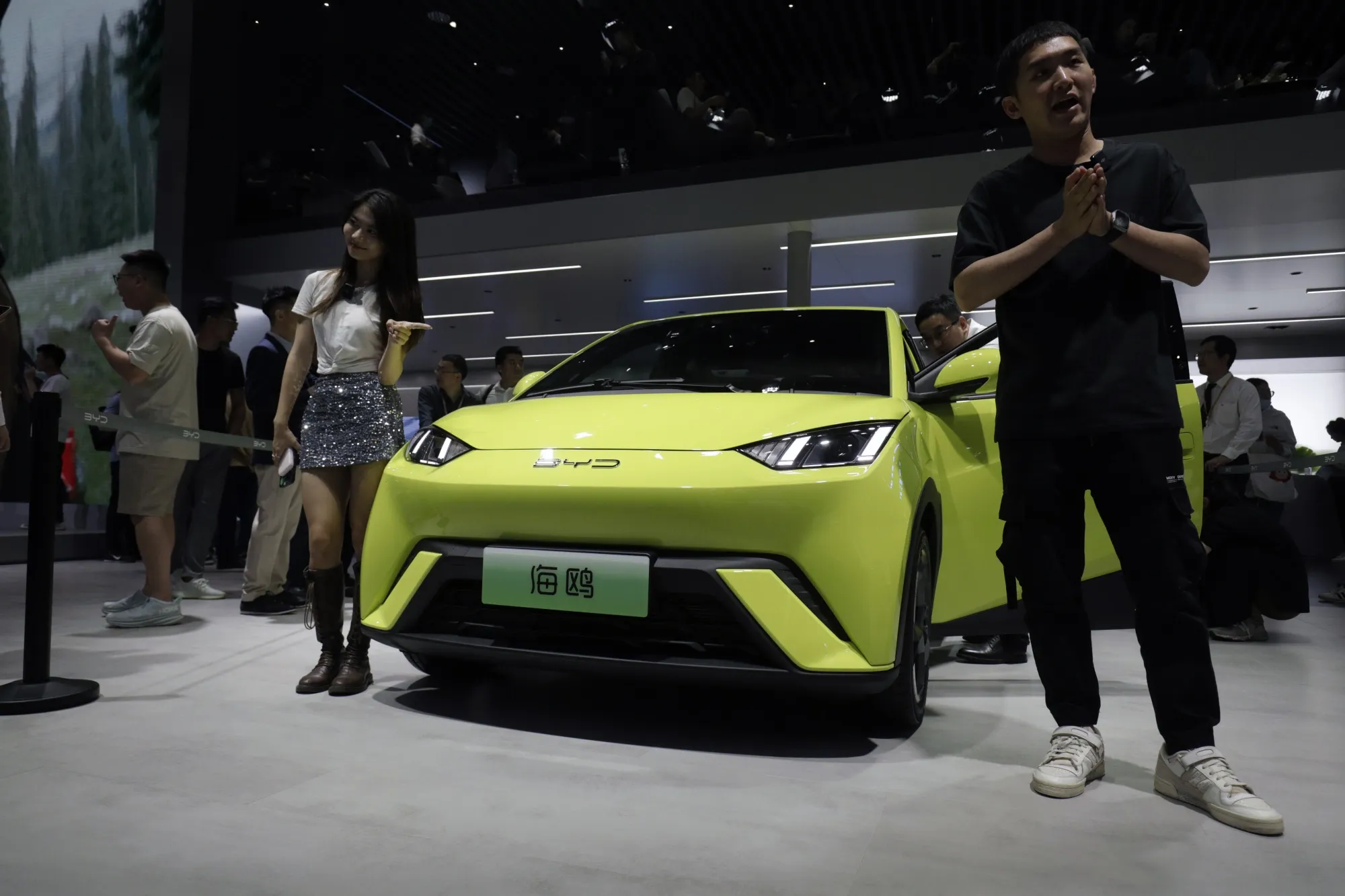
Sooren Moosavy is 28 years old, lives in Baltimore, and wants an affordable electric car. He cares about the environment, appreciates the smooth and quiet ride that EVs offer, and has done his research thoroughly enough to narrow his wish list to three specific models. The problem is that none of those three vehicles from Chinese automakers BYD, Geely, and Zeekr are available for him to buy, test drive, or even sit inside anywhere in the United States. The cars exist, they work, they are selling in large numbers across Europe, Latin America, and Canada, and they cost a fraction of what American buyers pay for comparable vehicles Chinese EVs in America. They are simply not allowed in.
Moosavy is not an outlier. As the average price of a new car in the United States approaches $50,000, a growing share of the car-buying public is openly interested in Chinese electric vehicles curious about their technology, attracted by their price points, and increasingly frustrated by a trade barrier that keeps those options permanently out of reach. The U.S. government has effectively banned Chinese-made cars through tariffs exceeding 100 percent, citing data security concerns and the need to protect American manufacturing jobs. The result is a market where American consumers are paying more than ever for vehicles while affordable alternatives sit just across the border in Mexico, selling briskly to everyone except them.
The gap between what American buyers want and what American trade policy permits them to have has never been more visible or more contested. The conversation is happening in showrooms, on YouTube channels with millions of views, in congressional hearings, and at kitchen tables where families are calculating whether they can afford a new car at all. Chinese EVs have become the clearest illustration of a tension that runs through the entire American economic debate between protecting domestic industries and giving consumers access to affordable goods.
How China Became the World's Dominant Electric Vehicle Manufacturer
China's rise to the top of global vehicle exports did not happen by accident it was the product of two decades of deliberate industrial policy, massive state investment in battery technology and manufacturing infrastructure, and a domestic market large enough to give Chinese automakers the scale advantages that drive costs down to levels Western manufacturers struggle to match. The Chinese government identified electric vehicles as a strategic priority in the early 2000s and systematically built the supply chain, the manufacturing capacity, and the consumer incentive structures that would turn that priority into a global competitive advantage.
By the early 2020s, China had surpassed Japan to become the world's largest vehicle exporter a milestone that would have seemed implausible a decade earlier, when Chinese cars were widely regarded in Western markets as low-quality products unsuitable for discerning buyers. The transformation in product quality over that period has been dramatic and, for Western automakers, deeply unsettling. Chinese EVs sold in European markets today come equipped with advanced driver assistance software, sophisticated infotainment systems, premium interior materials, and features like built-in mini fridges and karaoke capability amenities that American buyers would expect to pay luxury-tier prices to access.
The price at which these vehicles are offered in open markets is what has made the global automotive industry take notice with genuine alarm. In Europe, a number of Chinese EVs sell at prices under $30,000, offering technology and feature sets that European and American brands charge $45,000 to $60,000 to match. That price gap reflects the structural cost advantages Chinese manufacturers have accumulated through battery supply chain integration, lower labour costs, government subsidies, and the sheer scale of their domestic production volumes advantages that are not easily or quickly replicated by established Western automakers.
The Tariff Wall That Keeps Chinese Cars Out of America
The United States has responded to China's automotive rise not with a plan to compete directly but with a tariff wall that makes Chinese vehicles economically unviable to import regardless of their quality or consumer appeal. Tariffs on Chinese-made cars currently exceed 100 percent, a level that effectively functions as a ban doubling the cost of any vehicle before it reaches a showroom floor and eliminating the price advantage that makes Chinese EVs attractive in the first place. The policy has bipartisan support in Washington, with both major political parties agreeing that Chinese cars should not be competing freely in the American market.
The stated justifications for the tariff barrier are twofold: data security and job protection. On data security, U.S. officials and legislators have raised concerns that Chinese-made vehicles, with their extensive sensor arrays, cameras, GPS systems, and connectivity features, could collect and transmit data about American roads, infrastructure, and driver behaviour to servers accessible by the Chinese government. On job protection, the argument is that allowing low-cost Chinese vehicles to compete freely would devastate American auto manufacturing employment, particularly in Midwestern states where the industry remains a significant employer and a politically potent symbol.
The job protection argument carries particular weight in states like Ohio and Michigan, where the political economy of automotive manufacturing shapes elections and legislative priorities. Republican Senator Bernie Moreno of Ohio made the position clear at a January event at a Ford plant, stating that Chinese vehicles would not be sold in the United States as long as he held office. Major auto trade groups submitted a letter to the U.S. government earlier this year urging that Chinese carmakers be kept out of the American market entirely, citing competitiveness concerns that reflect how seriously the industry takes the threat that affordable Chinese EVs would pose to their market position if the tariff barrier were lowered.
Canada and Mexico Open the Door That America Keeps Shut
While the United States maintains its tariff wall, its immediate neighbours have made different calculations. Canada recently agreed to cut tariffs on Chinese EVs to 6.1 percent on an initial annual allowance of 49,000 vehicles — a policy shift that gives Canadian consumers access to affordable Chinese electric vehicles while protecting the broader domestic industry through volume limits. The contrast with the American approach is stark: Canada is managing the competitive pressure of Chinese EVs through structured market access rather than prohibition, betting that consumers and the industry can adapt together rather than being shielded from competition indefinitely.
Mexico has gone further and faster. Chinese automakers have been selling vehicles in Mexico for years, and Chinese manufacturers are actively eyeing factory space in the country as they assess longer-term manufacturing strategies for the North American market. The presence of Chinese EVs in Mexico creates an interesting dynamic for American consumers who live within driving distance of the border the vehicles they cannot legally import are available just across the frontier, and some American buyers have begun exploring whether they can purchase a Chinese EV in Mexico and drive it back into the United States. Car enthusiast Rich Benoit, whose YouTube reviews of Chinese vehicles attract millions of views, has stated publicly that buying a BYD in Mexico and driving it across the border may be the only way to own one in America.
American Consumers Are Paying Attention and Their Views Are Shifting
The survey data on American consumer attitudes toward Chinese EVs tells a story that the political debate in Washington has been slow to absorb. A Cox Automotive poll of 802 Americans planning to buy a car within the next two years found that nearly half 49 percent rated Chinese cars as having very good or excellent value, and 40 percent expressed support for allowing Chinese auto brands to enter the U.S. market. These are not fringe numbers or the views of a niche group of tech enthusiasts they represent a substantial and growing segment of mainstream car-buying Americans who are doing their own research and reaching their own conclusions about value.
The Harris Poll findings reinforce the complexity of consumer attitudes on this issue. American buyers are not uniformly enthusiastic about Chinese EVs concerns remain about data security and the impact on U.S. businesses, and those concerns are real and shared across demographic groups. But the same consumers holding those concerns are also confronting the reality that the average new car now costs nearly $50,000, that affordable EV options from American and European brands remain limited, and that Chinese alternatives offering comparable or superior technology at dramatically lower prices are readily available to buyers in almost every other developed country. The tension between those two sets of facts is shaping consumer opinion in ways that pure protectionist messaging cannot fully contain.
Clint Simone, senior features editor at car-shopping website Edmunds, drove several Chinese vehicles at the CES trade show earlier this year and described the technology they offer for their lower price tags as astounding. His assessment carries authority precisely because Edmunds exists to evaluate cars objectively for buyers it is not an advocacy organisation with a trade policy agenda. When a credible automotive evaluation platform's senior editor uses the word astounding to describe the value proposition of Chinese EVs at their price points, it captures something real about the product gap that American consumers are becoming increasingly aware of.
The Dealer Network Resists but Consumer Demand Builds Underground
American car dealers occupy an interesting position in the Chinese EV debate caught between their professional self-interest in blocking low-cost competition and their direct daily exposure to customers who are actively asking about Chinese vehicles. Rhett Ricart, an Ohio dealer selling Ford, Chevrolet, and Hyundai, said he has no doubt that customers would snap up Chinese models if they became available, a candid acknowledgment from within the industry that the demand is real and present. The Cox Automotive dealer survey found that only 15 percent of dealers supported allowing Chinese auto brands into the U.S. market, and just 26 percent trusted that those brands would comply with U.S. safety standards.
The safety standards concern is legitimate and not merely protectionist cover. Chinese EVs are not currently certified to meet U.S. safety regulations, and that gap is real not meeting those standards is one of the reasons Chinese EVs cannot be permanently owned in the United States even by buyers who manage to import one. But the dealer resistance goes beyond safety standards to a straightforward business calculation: a Chinese EV selling at $25,000 with features comparable to a $45,000 American or European model would fundamentally reshape the competitive landscape of the showroom in ways that would disadvantage every brand those dealers currently represent.
The underground consumer interest in Chinese EVs has found expression in the digital content economy in ways that are difficult for trade policy to address. Rich Benoit's YouTube videos reviewing Chinese EV models attract millions of views from American audiences who have no legal pathway to purchase the vehicles being reviewed but are watching anyway comparing specifications, discussing prices, and sharing the videos with friends who are also in the market for a new car. This organic consumer education is building familiarity with and appetite for Chinese vehicles that will make the political case for keeping them out harder to sustain as the price gap between American and Chinese EVs remains wide.
Trump, Tariffs, and the Contradictory American Position
President Donald Trump's position on Chinese EVs captures the essential contradiction at the heart of American trade policy on this issue. At a January appearance in Detroit the symbolic capital of American automotive manufacturing Trump said he would be receptive to Chinese automakers opening factories in the United States, as long as they employed American workers. That statement represents a meaningfully different position from a blanket ban: it acknowledges the reality of Chinese automotive capability while trying to redirect its economic benefits toward domestic employment rather than blocking it entirely.
But the same administration maintains the 100-plus percent tariff wall that makes imported Chinese EVs economically impossible, and the political pressures from manufacturing states, auto industry trade groups, and Republican senators make any significant tariff reduction politically costly regardless of consumer demand. The result is a policy environment where Chinese automakers are theoretically welcome if they build American factories but practically blocked from selling the vehicles they currently make, creating a strategic standoff that serves neither American consumers seeking affordable EVs nor the goal of accelerating electric vehicle adoption that climate policy requires.
The longer this standoff persists, the more it costs American consumers in the most direct and measurable way in the price they pay for every new car they buy. The average transaction price approaching $50,000 is not an abstract statistic. It represents families stretching budgets, buyers settling for older used vehicles, and people like Sooren Moosavy spending hours researching cars they cannot buy, drawn by price points and feature sets that the American market simply does not offer at comparable levels. Chinese EVs are not hypothetically compelling they are actually compelling, and American consumers are figuring that out one YouTube video at a time.