
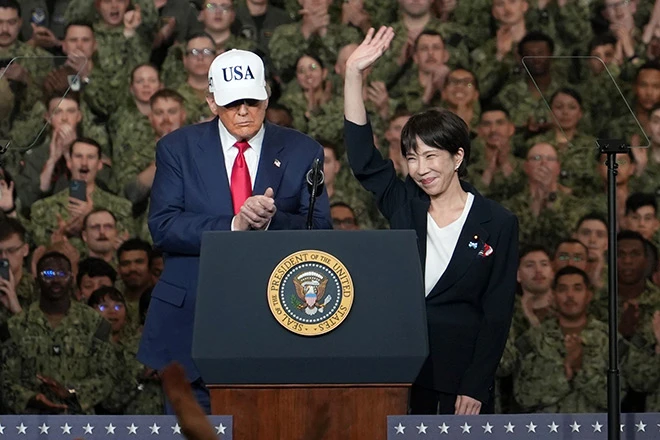
Japan PM Takaichi Trump pressure over Iran war commitments as she arrives in Washington on Thursday for talks that could redefine the decades-old U.S.-Japan security alliance. Prime Minister Sanae Takaichi becomes the first major U.S. ally to hold face-to-face meetings with President Donald Trump since he demanded that Japan join a coalition of nations and send warships to escort oil tankers through the Strait of Hormuz, a waterway largely closed by Iran since the outbreak of the conflict. The visit arrives at one of the most diplomatically sensitive moments in the modern history of the U.S.-Japan relationship.
Trump's demand puts Takaichi in an extraordinarily difficult position at home and abroad. Fewer than 10 percent of Japanese citizens support the U.S.-Israeli military campaign against Iran, according to a poll published this week by the Asahi newspaper, making any open military commitment to the Gulf mission politically toxic. At the same time, Japan depends on the United States for its own national security, with roughly 50,000 American troops, a carrier strike group, and multiple squadrons of fighter jets stationed on Japanese soil to deter threats from China and North Korea.
David Boling, of the Asia Group consultancy in Tokyo and a former U.S. trade negotiator with Japan during Trump's first term, captured the stakes plainly. He said Takaichi is in a tight spot and that the biggest risk is Trump publicly pressing her for security commitments she cannot deliver. That precise scenario, a televised confrontation that forces a public yes or no answer, is what Japanese officials have been working quietly to avoid in the days leading up to the summit.
Background: Why the Strait of Hormuz Is Central to Japan's Security Calculation
Japan's dependence on the Strait of Hormuz is not abstract or marginal. Approximately 90 percent of Japan's oil shipments pass through the waterway, making it one of the most exposed major economies in the world to any prolonged closure. The conflict between the United States, Israel, and Iran has already disrupted global energy flows through the Strait, which handles around 20 percent of the world's oil and liquefied natural gas trade, and Japan's import-dependent economy is already feeling the pressure through rising fuel and consumer costs.
Tokyo has a history of offering logistical support and intelligence gathering in support of U.S. military efforts in the Middle East, stopping well short of direct combat involvement. That careful calibration has allowed Japan to maintain its pacifist constitutional framework while demonstrating solidarity with Washington during past regional crises. But sending Japanese naval vessels into an active conflict zone, where Iranian forces have demonstrated the continued ability to launch missile strikes despite weeks of bombardment, would be a qualitatively different and legally far more complex step.
Japan's pacifist constitution, written after World War Two under American supervision, places strict limits on the use of military force abroad. Any deployment of Japanese ships into the Gulf conflict zone would require legal justification that Japanese officials and constitutional lawyers say is extremely difficult to construct under current law. Takaichi told parliament on Monday that Japan had received no official request from the United States and that her government was examining what actions might fall within the constitutional limits, a framing designed to buy diplomatic time without triggering a public crisis before the summit.
Trump's Leverage Over Tokyo and the Risk of Being Made an Example
Trump holds considerable leverage over Japan and has shown no reluctance to use it publicly. Beyond the security dependency, Trump has already wielded tariffs as a tool to extract billions of dollars in investment commitments from Tokyo, using trade pressure to correct what he describes as a massive and unacceptable imbalance between the two economies. Japan's economic vulnerability to both U.S. tariff policy and Middle East energy disruption gives Washington multiple pressure points simultaneously, a combination that few other allied nations face with the same intensity.
Kazuhiro Maeshima, a politics professor at Sophia University in Tokyo, described the situation in stark terms, saying the discussion has turned into one that shakes the very foundations of the Japan-U.S. security alliance. He added that if Trump can bring Japan into the coalition of the willing, it will dramatically increase pressure on other nations still holding out. Conversely, if Japan refuses outright, Trump can make an example of Tokyo and demonstrate to the world what happens when a country says no to American demands during a moment of declared strategic priority.
Other U.S. allies have already drawn clear lines. Germany, Italy, and Spain have ruled out participation in any Gulf escort mission. Kaja Kallas, the European Union's foreign policy chief, said bluntly on Tuesday that nobody is ready to put their people in harm's way. Japan's response, whatever form it takes, will now be watched by every allied capital as an indicator of how far Trump's demands can reach and how much political cost nations are willing to absorb to preserve their relationships with Washington.
What Takaichi Hoped to Discuss and What Trump Will Actually Press
Japanese officials had originally hoped the White House summit would focus heavily on China. Tokyo wanted to remind Trump of Beijing's growing regional assertiveness ahead of his planned visit to China, initially scheduled for late March before being delayed, and to advance two specific strategic priorities. Japan has been seeking a deal that would allow it to diversify critical mineral supplies away from Chinese dependency and to formally join Trump's Golden Dome missile defence system designed to counter hypersonic weapons being developed by China and Russia.
Those ambitions have not disappeared but have been pushed to the margins by the Iran crisis dominating Washington's foreign policy agenda. Trump is expected to use the full schedule of the summit, including formal talks, a working lunch, and a dinner, to press Takaichi directly on the Gulf mission. Kurt Campbell, former deputy secretary of state under President Biden, said Trump was likely to have a very specific request requiring a yes or no answer, describing it as a moment of enormous political peril for the Japanese leader.
Tokyo is now scrambling for alternative offers that might satisfy Trump without crossing constitutional or political red lines. One option raised by analysts is Japan playing a diplomatic intermediary role with Tehran, a path Japan has explored before. In 2019, Takaichi's mentor and former Prime Minister Shinzo Abe carried a personal message to Iran's Supreme Leader during a failed peacekeeping mission. But with neither Washington nor Tehran currently showing any appetite for negotiations, analysts say that offer is unlikely to meet the threshold of what Trump is actually demanding this time.