
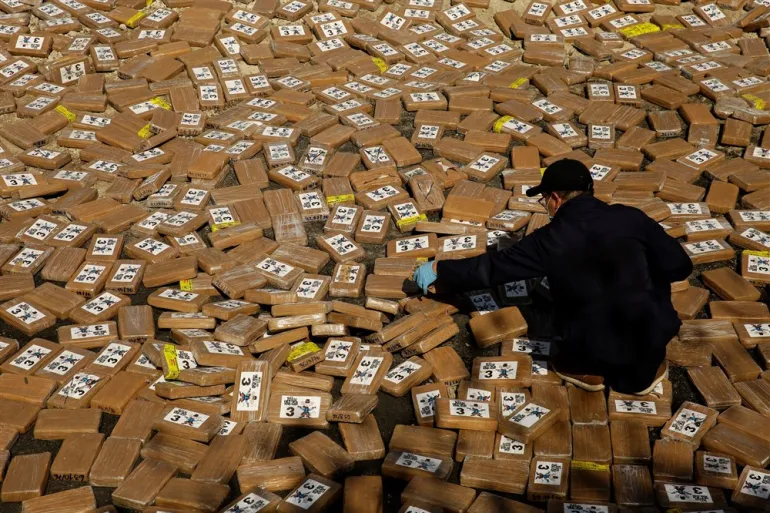
The United Nations Office on Drugs and Crime released its annual UN World Drug Report 2026 on Friday with findings that reframe the global narcotics trade as one of the most rapidly expanding illicit industries in the world. Cocaine production reached approximately 4,100 metric tons of pure product in 2024, the latest year on record, representing a fourfold increase from levels recorded just ten years earlier. Methamphetamine seizures, which investigators use as a proxy for production volumes, suggest the drug is being manufactured at a rate growing 13 percent annually, placing both substances simultaneously at all-time highs in a single reporting cycle.
UNODC Executive Director Monica Juma framed the scale of the problem in terms that went beyond the production statistics. "We have seen an unprecedented spike in new types of drugs on the market, and worryingly, some are more potent or dangerous than before," she said in a statement accompanying the report's release. That observation points to a dynamic that the raw production numbers alone do not fully capture: not just more drugs, but structurally different drugs, designed or selected by market actors for higher potency, lower detectability, and wider geographic reach than the substances they are supplementing or replacing.
The investigative significance of these figures lies in what they reveal about the resilience and adaptability of transnational drug supply networks. A fourfold increase in cocaine production within a decade does not happen by accident or through the expansion of a single organisation. It reflects a systematic expansion of cultivation, processing, and distribution infrastructure across multiple producing countries, most significantly in Colombia, which the UNODC has consistently identified as the world's largest cocaine producer, alongside growing contributions from Peru and Bolivia. The methamphetamine trajectory tells a similar story of organised, industrial-scale production growing faster than law enforcement seizure capacity in most regions.
How the Taliban's opium ban in Afghanistan created a dangerous vacuum now being filled by synthetic opioids across Europe and Oceania
One of the most consequential findings in the 2026 World Drug Report is the direct connection between the Taliban's 2023 opium ban in Afghanistan and the surge in synthetic opioid availability across multiple regions. Afghanistan was the dominant global supplier of opium, the raw material from which heroin is derived, for decades. When the Taliban banned opium cultivation after returning to power, production plummeted and heroin supply began declining, removing a substance that millions of dependent users across Europe, South Asia, and beyond had built their drug use around. Markets do not leave such gaps unfilled for long.
The UNODC documented a sharp increase in reports of new synthetic opioids, particularly fentanyls and the even more potent nitazenes, appearing in drug early warning systems across most regions in 2024. The regional data is stark: reports of new psychoactive substance synthetic opioids rose by more than 80 percent in Europe and by 150 percent in Oceania in 2024 compared with the previous year. North America, where fentanyl had already largely displaced heroin before the Afghan ban, recorded a comparatively modest 10 percent increase in new synthetic opioids identified. The divergence between regions reflects different starting points: North America was already deep into a fentanyl crisis, while Europe and Oceania are experiencing a more recent and rapid onset.
The investigative concern that the UNODC's data raises is about potency and harm, not just volume. Nitazenes, which have been appearing with increasing frequency in European early warning systems, are estimated to be significantly more potent than fentanyl, which is itself roughly 50 to 100 times stronger than heroin by weight. A market transition from heroin to fentanyl to nitazenes represents a successive escalation in the lethality of the substances circulating in illicit drug markets, with each step requiring smaller quantities to produce overdose and giving users and harm reduction services progressively less margin for error. The Afghan opium ban, however effective as a supply-side enforcement measure, has not reduced the underlying demand for opioids but has instead redirected it toward more dangerous chemical alternatives.
Cocaine's changing consumer profile: how the drug moved from nightlife into daily routines and crack use spread among Europe's most vulnerable communities
The UNODC's 2026 report documents not just the growth in cocaine supply but a significant shift in how and by whom the drug is consumed, findings that carry important investigative and public health implications. Qualitative research conducted in 2024 indicated that cocaine use has expanded beyond its traditional association with nightlife and entertainment settings into daily routines for a growing proportion of users. Alongside rising purity levels and falling prices in consumer markets, that normalisation of use patterns suggests the drug's social footprint is broadening in ways that conventional policing and treatment frameworks built around the nightclub-era cocaine user are not well equipped to address.
The crack cocaine dimension of the report's findings is particularly significant from an inequality and public health perspective. The UNODC documented an upsurge in crack cocaine use among socioeconomically disadvantaged groups across Western and Central Europe, alongside a pattern of users shifting from heroin to crack cocaine as heroin supply contracted following the Afghan opium ban. Treatment data from Western and Central Europe strongly suggest that this trend began as early as 2015, meaning the shift has been underway for a decade and has been accelerating rather than stabilising. Crack cocaine is cheaper to produce and purchase than powder cocaine, faster in its onset of effect, and more physically destructive in patterns of heavy use, making its expansion among the most economically marginal populations a compounding vulnerability.
The investigative picture that emerges from combining the supply data with the consumption data is of a drug market that is simultaneously becoming more productive, more chemically dangerous, more geographically distributed, and more socially embedded across different consumer demographics. Law enforcement agencies measuring success by seizure volumes face a market where production is growing faster than seizure capacity, pure product purity is rising even as street prices fall, and the consumer base is diversifying in ways that make traditional demand-side intervention points harder to identify and reach. The UN report does not offer easy policy conclusions, but its data makes the scale and direction of the problem impossible to ignore.
What the methamphetamine surge and regional drug market shifts reveal about the future of global drug enforcement
Methamphetamine's continued expansion is the drug market story that receives less public attention than cocaine or opioids but may represent the most structurally entrenched enforcement challenge of the three. Unlike cocaine, which requires specific coca plant cultivation in limited geographic areas, or heroin, which depended heavily on a single country's opium supply, methamphetamine can be synthesised from a range of precursor chemicals in facilities that can be established quickly and relocated easily. The UNODC's finding that methamphetamine production is growing at 13 percent annually reflects a supply dynamic that is fundamentally harder to disrupt through crop eradication or territorial enforcement than plant-based drugs.
The geographic spread of methamphetamine production has also changed significantly over the past decade. What was once concentrated primarily in North America and East Asia has expanded substantially into Southeast Asia, where large-scale production compounds, some connected to the same transnational criminal networks implicated in the pig-butchering scam operations documented by Thailand's Department of Special Investigation, have become major sources of supply for markets across the Asia-Pacific region. The overlap between drug production networks and other transnational criminal enterprises, including fraud, money laundering, and human trafficking, is one of the most consequential structural findings to emerge from a decade of regional investigations.
For global drug enforcement, the UNODC's 2026 report functions as both a status update and a warning. Supply-side enforcement measures have demonstrably failed to reduce the volume of cocaine reaching consumer markets, as evidenced by a fourfold production increase achieved despite decades of interdiction effort. The Afghan opium ban, the most significant supply disruption the global drug market has experienced in years, has not reduced opioid-related harm but has redirected it toward more potent and more dangerous synthetic alternatives. The methamphetamine market continues to grow independently of enforcement pressure. What the data collectively suggests is that the enforcement architecture built over the past three decades of the global drug war is being systematically outpaced by the speed, scale, and chemical adaptability of the markets it is trying to contain.