
A coordinated wildfire crisis is burning across southwestern Europe's most popular summer tourist corridor, with ordering the complete France Spain wildfires evacuation of the Cap Ferret peninsula in the Gironde region as 40,000 people flee by boat and road, and Spain declaring a national emergency as fires burn out of control in several areas west of the capital Madrid. The twin emergencies, separated by fewer than 500 kilometres, are unfolding simultaneously during peak summer season on a continent whose warming trajectory has made these events not exceptional but structurally predictable, recurring expressions of what climate scientists describe as the new normal for Mediterranean and Atlantic Europe in July.
In France, 8,700 hectares of the Gironde have been consumed since the fires began on Tuesday near Saumos, approximately 21,500 acres of pine forest and holiday landscape that has been turned to ash in less than four days. Two firefighters have already died while battling a blaze near Bordeaux airport. Around 80 homes have burned, with approximately 50 completely destroyed. A second major fire in the Landes region near Biscarosse has forced the evacuation of more than 23,000 additional people, bringing the total evacuated across southwestern France to well above 60,000. French President Emmanuel Macron has invoked European Union solidarity, requesting aircraft from Croatia, Portugal, the Czech Republic and Slovakia.
In Spain, Interior Minister Fernando Grande-Marlaska declared a national emergency as fires burned simultaneously at Villa del Prado and San Martín de Valdeiglesias in the Madrid region and at Burgohondo in Ávila. More than 10,000 people were evacuated. Prime Minister Pedro Sánchez described a dramatic situation and pledged that the government had deployed all available resources.
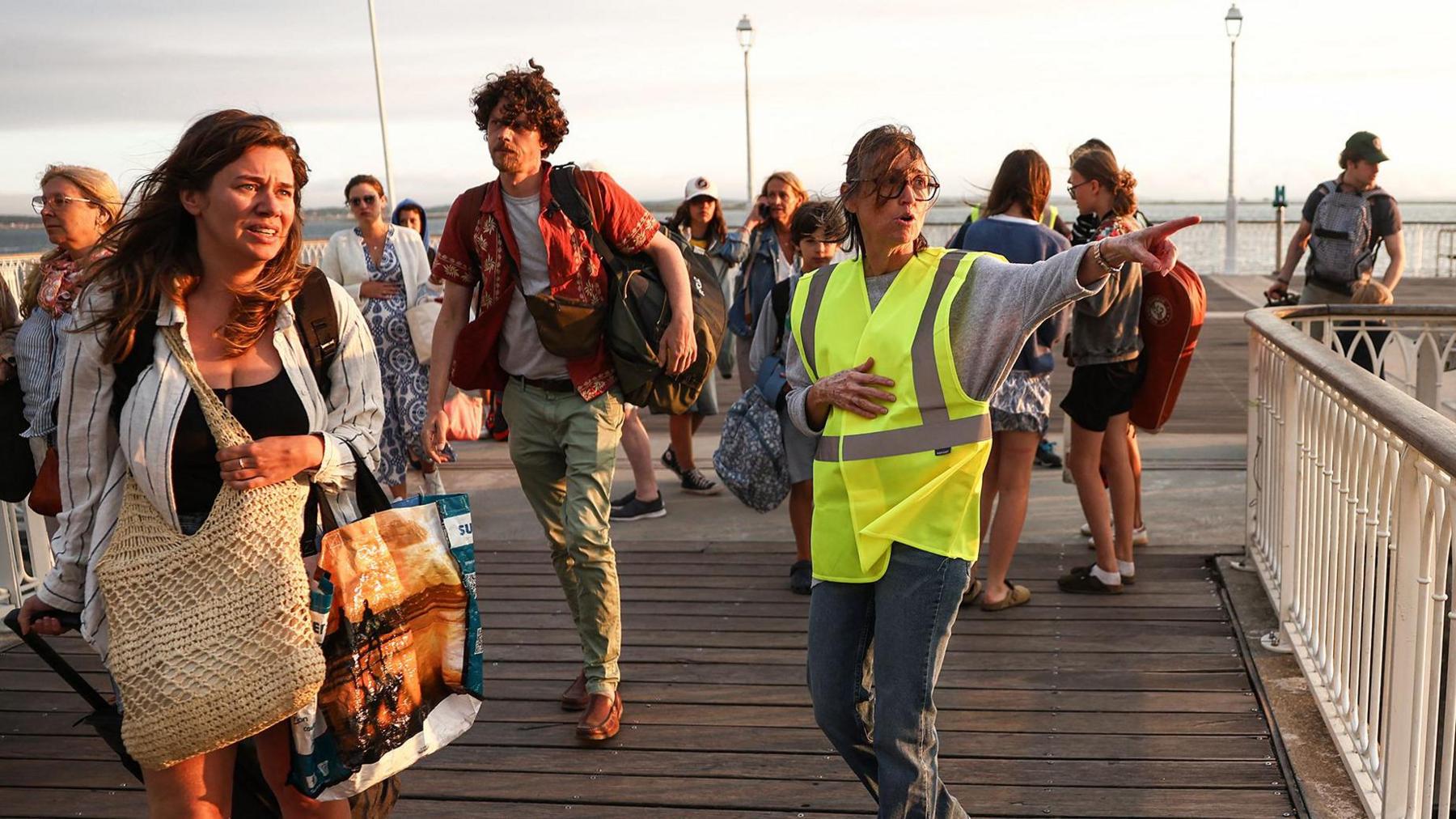
The scenes of hundreds of people boarding boats from four piers on the Cap Ferret peninsula, crossing the Bay of Arcachon to reach Arcachon on the southern side, are the most immediate and visceral images of a crisis that is simultaneously a natural disaster, a climate accountability story, a tourism industry emergency, and a test of European cross-border emergency management capacity.
Two Countries, One Crisis, Thousands Displaced Overnight
The Cap Ferret evacuation is the single most dramatic event of the current wildfire crisis in terms of its logistics and human scale. The peninsula, a narrow finger of land with the Atlantic Ocean on one side and the Bay of Arcachon on the other, has limited road access. The main D106 route toward Bordeaux is the primary land exit for those with vehicles. But for the estimated thousands who arrived at holiday campsites and accommodations without cars, or whose road access was cut by fire or traffic, the boats represent the only practical emergency exit.
French Interior Minister Laurent Nuñez confirmed 40,000 people had either been evacuated or were in the process of evacuation from the Cap Ferret peninsula. The mayor of Arès, south-east of Lège-Cap Ferret on the Bay of Arcachon, confirmed his town was being evacuated alongside the peninsula. A local councillor confirmed that 2,000 evacuees from the peninsula had already arrived by boat at the port of Arcachon by early Friday.
Gironde prefect Sophie Brocas ordered the final phase of the peninsula evacuation early on Friday morning, with boat services running from 07:00 to 10:00 local time from four piers. Homes in evacuated areas were to be monitored by authorities to prevent vandalism, a practical detail that reveals the scale of the property abandonment that an emergency evacuation of this size creates.
The Biscarosse fire, beginning Thursday afternoon further down the Atlantic coast in France's Landes region, created a second simultaneous emergency whose management stretched fire and emergency services across a large geographic area. Approximately 18,000 people evacuated from Biscarosse and around 5,000 from Parentis-en-Born, including residents, campsite visitors, a nursing home, and a summer camp, providing the specific category of evacuee vulnerability that mass displacement of non-mobile populations creates in fire emergencies.
In Spain, the three fires burning west of Madrid at Villa del Prado, San Martín de Valdeiglesias, and Burgohondo in Ávila were all active Friday morning. The Interior Minister's national emergency declaration activated the full resources of the Spanish state. Friday morning's update from emergency services described both fires as out of control, though their progression in recent hours had been limited, the specific phrase that emergency managers use to communicate that the fire has not made significant recent gains without committing to the characterisation that it is under control.
The Climate and Forest Management Factors Behind This Crisis
The simultaneity of severe wildfires in France and Spain during the same July period is not coincidental. It reflects the specific atmospheric and meteorological conditions that Europe's warming climate is producing with increasing frequency and intensity in the Atlantic coast and Mediterranean basin regions whose vegetation, temperature patterns, and wind conditions combine to create extreme fire weather when a heat event intersects with dry pre-existing landscape conditions.
The European Copernicus Climate Change Service has documented that the continent is warming at more than twice the global average rate, creating the specific amplification of summer heat extremes, drought conditions, and fire weather frequency that makes the current crisis an expected expression of a known trend rather than an unpredictable anomaly. The fires that France and Spain are managing this week would have occurred in any summer of extreme heat and drought, but the probability of a summer reaching the fire weather threshold that produces emergencies of this scale is measurably higher in 2026 than it was in 2006 or 1996, and measurably higher still than it will have been 20 years from now if the warming trajectory continues.
France's Gironde region has specific landscape characteristics that make it exceptionally vulnerable to wildfire when fire weather conditions materialise. The Landes de Gascogne forest, one of Western Europe's largest artificial pine forests planted in the 19th century to stabilise coastal dunes, covers approximately one million hectares of southwestern France with a monoculture of maritime pine whose resinous wood and tight spacing creates a highly flammable fuel load that burns intensely when ignited in dry, windy conditions. The same landscape that has made the Gironde coast one of France's most popular holiday destinations, pine-scented, oceanic, and spectacularly beautiful, is also an inherently fire-prone landscape whose management requires the specific fire prevention and early suppression resources that the current fires have overwhelmed.
Spain's Madrid region wildfires reflect different but related conditions, with the area's oak and scrubland landscape having experienced the drought stress that several months of below-average precipitation and the current heat event have produced, creating the elevated fuel moisture content that makes the difference between a fire that is contained within hours and one that becomes the emergency that Grande-Marlaska declared a national emergency over.
The European heatwave that has been moving eastward across the continent in recent weeks, having produced deaths in France and Germany earlier this month, created the specific antecedent dryness conditions that both the French and Spanish fires are burning in. Drought-stressed vegetation ignites more easily, burns more intensely, and produces the firebrands that carry the fire faster than firefighting resources can follow, explaining both the speed with which the Cap Ferret and Biscarosse fires grew to their current scale and the out of control characterisation that Spanish emergency services used for the Madrid region fires.
From First Ignition to Full Emergency Declaration
Tuesday: Fires begin near Saumos in the Gironde region of southwestern France. Two firefighters die while tackling a blaze near Bordeaux airport in circumstances not yet fully elaborated in reporting. The Gironde fire begins the spread that will consume 8,700 hectares by Friday morning.
Wednesday to Thursday: The Gironde fire spreads toward the Cap Ferret peninsula as firefighting resources are deployed. The decision to begin evacuation of the peninsula is made as the fire's trajectory makes remaining in place unsafe for the 40,000 residents and tourists on the narrow land mass.
Thursday afternoon: A second major fire begins near Biscarosse in the Landes region. Evacuations begin for more than 23,000 people including the nursing home and summer camp populations whose non-mobile character creates the specific priority evacuation requirement.
Thursday evening: Macron describes the wildfire situation as very tense and invokes EU solidarity, requesting aircraft from Croatia, Portugal, Czech Republic, and Slovakia to augment French aerial firefighting capacity.
Thursday night: Further evacuations from La Porge take place, described by the Gironde prefect as proceeding calmly. The final phase of the Cap Ferret peninsula evacuation is ordered for early Friday morning.
Friday morning: Gironde prefect Brocas orders the complete final evacuation of the Cap Ferret peninsula. Boat services run from four piers. Spain's Interior Minister declares a national emergency as three fires burn west of Madrid. Pedro Sánchez describes a dramatic situation. More than 10,000 evacuated in Spain. Both Spanish fires described as out of control but with limited recent progression. EU aircraft from four countries heading to assist France.
What the Dual Emergency Reveals About European Climate Governance
The simultaneous wildfire emergencies in France and Spain create a specific political moment whose management will be assessed against the background of the European Union's climate policy ambitions, its emergency coordination mechanisms, and the domestic political accountability that disasters of this scale impose on governments.
For Macron, whose presidency has been associated with ambitious climate rhetoric and whose G7 summit in Evian earlier this month was partially shadowed by the European heatwave that preceded this crisis, the wildfire emergency creates the specific political accountability test that natural disasters during periods of claimed climate leadership impose on heads of government. The request for EU aircraft, rather than presenting France as struggling, was framed as an expression of European solidarity whose activation demonstrates that the EU's joint emergency response mechanisms are functioning. Macron's very tense characterisation of the situation and the EU solidarity request together project leadership under pressure rather than crisis management failure.
For Sánchez, whose government declared a national emergency and deployed all available resources, the political management of three simultaneous fires west of Madrid, with the capital's population within range of the smoke and the emotional resonance of fires in the region that surrounds the national capital, creates the specific visibility that ensures the emergency response is conducted under the maximum possible political scrutiny. The dramatic situation framing and the government will stand by your side language are the specific political communications whose delivery alongside actual resource deployment distinguishes effective crisis leadership from reactive management.
The EU's cross-border emergency mechanism, activated through Macron's request for aircraft from four member states, demonstrates the specific value of the European civil protection system whose development since the catastrophic 2003 heatwave that killed more than 70,000 Europeans has been the institutional response to the recognition that individual member states cannot maintain sufficient firefighting aircraft for the worst-case fire season scenarios that climate change is making more frequent.
Tourism, Property, and the Cost of an Uncontrolled Fire Season
The economic consequences of the Cap Ferret and Biscarosse fires are immediately visible in the 80 burned homes, 50 of them completely destroyed, and in the 8,700 hectares of forest that will not regenerate for decades. The less immediately visible but larger economic impact is on the tourism industry of one of France's most popular summer destinations.
The Cap Ferret peninsula and the Arcachon Basin are among the most economically significant tourism destinations in southwestern France, drawing hundreds of thousands of visitors each summer whose spending supports the local restaurant, accommodation, water sports, and retail economy through the peak July and August season. A wildfire evacuation affecting 40,000 people during the height of summer does not simply displace the current visitors but creates the reputational damage and the physical infrastructure disruption that affects bookings for the remainder of the current season and potentially for subsequent seasons as travellers reassess the risk of holiday destinations in wildfire-affected regions.
The Biscarosse fire's evacuation of campsite populations reflects the specific vulnerability of the outdoor tourism economy that the Landes Atlantic coast depends on, with major campsites representing significant fixed investment whose partial or total destruction creates insurance claims and rebuilding timelines extending across multiple seasons. A summer camp evacuation and a nursing home evacuation also represent the specific disruption of institutional operators whose business continuity the fire has interrupted for periods that will extend beyond the fire's eventual containment.
For property owners in affected areas, the insurance dimension of wildfire damage is an increasingly fraught economic question as European insurers reassess the risk models they apply to properties in fire-prone regions. The combination of climate change increasing the frequency and severity of fire events and the growing value of properties in Atlantic coast destinations whose tourism appeal has driven price appreciation creates the specific insurance market stress that multiple consecutive severe fire seasons produce.
From Wine Estates to Holiday Operators
The Gironde is globally famous not only as a holiday destination but as the heartland of some of the world's most valuable wine production, with the Bordeaux wine region's most prestigious estates concentrated in the area whose wildfire risk the current crisis has elevated to international attention. While the Cap Ferret peninsula itself is primarily coastal holiday land rather than vineyard territory, the broader Gironde wildfire threat extends to the viticultural landscape whose smoke exposure and heat stress create specific quality risks for vineyards that escape direct fire damage.
Holiday operators across southwestern France face the specific business impact of mass cancellations by visitors who have been evacuated or who pre-emptively cancel planned stays in the affected region as news of the evacuations reaches them. For tour operators, campsite companies, and hotel groups with significant Gironde and Landes exposure, the financial impact of a major wildfire evacuation during the peak fortnight of the French summer tourism season represents one of the highest possible revenue loss concentrations in their annual calendar.
For businesses in Arcachon, which received 2,000 boat evacuees on Friday morning with more arriving through the morning, the sudden population surge creates the specific logistical demands on accommodation, food service, and transportation infrastructure that emergency hosting of large displaced populations creates, with the economic impact being simultaneously a cost pressure and a revenue opportunity depending on the business type and whether displaced populations have the means and desire to engage with local commercial services.
What France and Spain's Crisis Signals for European Summer Safety
The simultaneous French and Spanish wildfire crisis is not simply a bilateral national emergency but a signal of the specific trajectory that European summer safety is following as the climate warming that has been measured and projected for decades produces the observable consequences whose accumulation is changing the risk profile of entire regions for both residents and tourists.
International travellers who have been planning summer holidays in southwestern France, the Arcachon Basin, and the Madrid region of Spain are directly affected by the current crisis through cancellations and disrupted travel plans. The broader tourism industry consequence is the assessment that travellers make over the coming months about whether Atlantic France and inland Spain remain appropriate summer holiday destinations, or whether the recurring wildfire risk makes late July and August visits to these regions systematically more dangerous than the same destinations in other seasons.
The European Union's climate adaptation policy dimension of this crisis is significant in the specific context of the current political debates about the pace and ambition of European climate policy. The Omnibus bill rollback of EU sustainability regulations that was being debated earlier this year represents the specific political tension between the climate policy ambition that events like the current dual wildfire crisis justify and the regulatory rollback pressure that economic competitiveness arguments produce in EU policy debates. A wildfire crisis affecting two of the EU's largest economies simultaneously in the same summer week as the EU is debating whether to maintain or reduce its climate regulatory ambitions creates the specific political argument that advocates for maintaining ambitious climate policy will use in the coming legislative debates.
Containment, Recovery, and the Lessons for Future Preparedness
The immediate priority is fire containment, which depends on the wind conditions, humidity, and temperature forecasts for the coming days whose specific values will determine whether existing firefighting lines hold or whether the fires continue to spread. The EU aircraft from Croatia, Portugal, Czech Republic, and Slovakia represent the additional aerial capacity whose arrival Macron announced and whose deployment will augment the French aerial firefighting capability that has been stretched across the simultaneous Gironde and Landes emergencies.
For Spain, the limited recent progression characterisation of the Madrid region fires on Friday morning provides cautious optimism about containment, though the out of control designation means that any wind shift or humidity drop could restart the rapid spread that the current plateau has interrupted rather than ended.
The recovery phase for both countries will involve the damage assessment of burned properties and forest areas, the insurance claims processing that 80 burned French homes and the Spanish equivalents represent, and the longer-term ecological and tourism sector recovery planning that fire-affected landscapes require over years rather than weeks. France's Landes de Gascogne forest management strategy, which has been under review in the context of climate adaptation, will be reassessed in light of the current crisis's evidence about the monoculture pine forest's fire vulnerability.
The European civil protection mechanism's response, with four member states providing aircraft, will be evaluated for both its speed and its effectiveness in the post-fire assessment that will inform future preparedness improvements. The scale and simultaneity of the French and Spanish emergencies will likely strengthen the case for expanding the EU's dedicated firefighting aircraft fleet rather than relying solely on member state bilateral sharing whose availability depends on other member states not simultaneously facing their own emergencies.
What to Watch Next
Watch for the wind and humidity forecasts for southwestern France and the Madrid region over the coming 48 to 72 hours, whose meteorological values will determine whether the fires reach containment or continue to spread into new territory.
Watch for the EU aircraft arrivals and their deployment effectiveness in augmenting the French aerial firefighting capacity that has been stretched across two simultaneous major fires in different parts of the Atlantic coast.
Watch for Spain's national emergency management update on the Madrid region fires' status, particularly whether the out of control characterisation is maintained or whether improved conditions allow emergency services to report meaningful containment progress.
Watch for the political response to the dual crisis from European climate policy advocates and opponents, whose use of the current emergency in the ongoing EU sustainability regulation debate will be one of the political consequences of an environmental disaster at this scale and visibility.
Watch for the insurance industry response to the burned home losses and the tourism sector's early assessment of cancellation impacts, whose data will provide the first economic quantification of a crisis whose full cost will take months to calculate.