
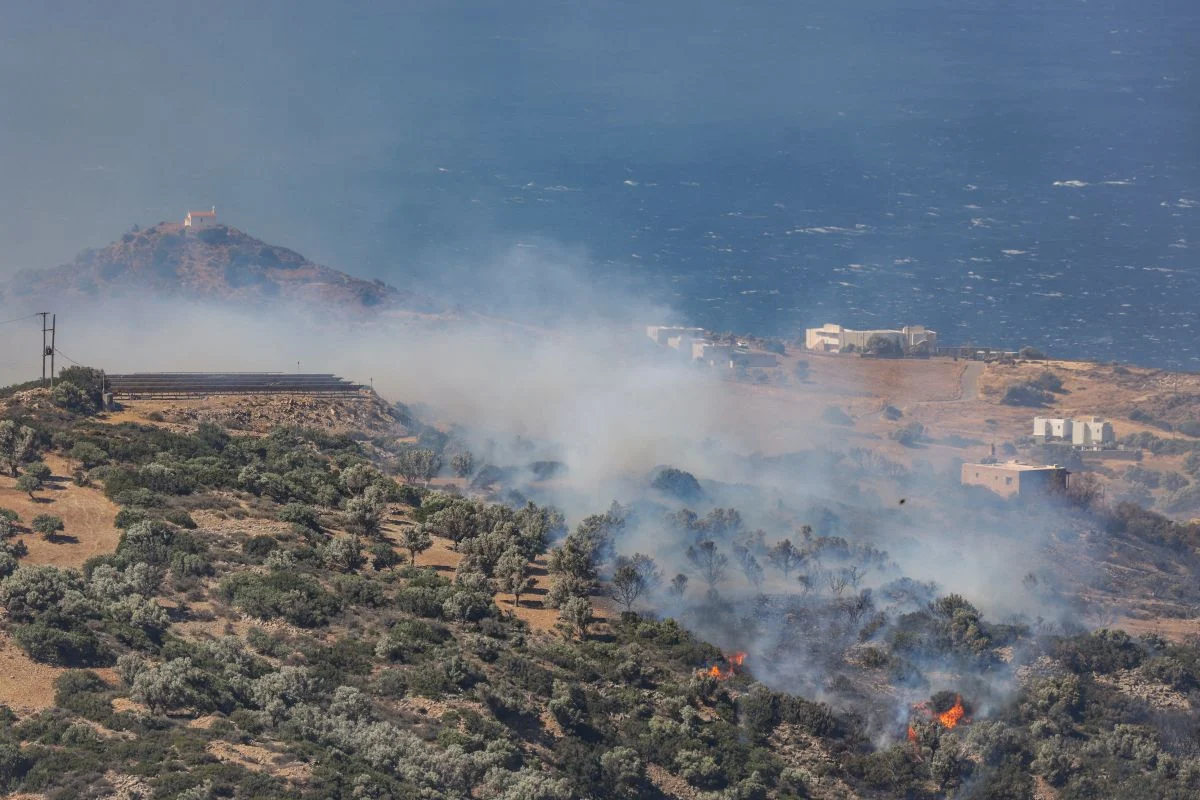
Three firefighters have died in Greece as wildfires burned simultaneously across France, Spain Greece wildfires on Thursday, in what has become the broadest simultaneous wildfire emergency that modern Europe has experienced, driven by a summer heat that the Reuters Climate Monitor recorded as leaving the continent running 3.6 degrees Celsius above its historic average from 1961 to 1990, the furthest any continent was from its norm on the day. Two firefighters died in Crete after becoming trapped in a fire that erupted in the island's central region while they were driving between fire fronts. A third died in a separate fire in the Peloponnese region on the Greek mainland. Hundreds of residents and tourists were evacuated from the area around the community of Krya Vrysi and surrounding villages by sea and by land as gale-force winds pushed the Crete fire out of control near popular coastal holiday spots, grounding firefighting aircraft that cannot safely operate in the wind conditions the blaze was generating.
Greece's entry into the simultaneous multi-country emergency extends the geographic footprint of Europe's 2025 wildfire crisis from the Atlantic coast of France and the mountains around Madrid to the Aegean island chains and the Peloponnese peninsula, a spread of approximately 3,000 kilometres. Spain's Prime Minister Pedro Sánchez, speaking from Mallorca on Wednesday evening, described his country's situation as "extreme" and "critical, highly complex," with at least 10 active wildfires causing concern across multiple Spanish regions simultaneously. He told reporters he had written to European Commission President Ursula von der Leyen requesting that a new EU wildfire-fighting centre for the western Mediterranean region be permanently based on the Balearic island of Mallorca, an institutional response to a crisis that has demonstrated that national firefighting capacities across southern Europe are systematically insufficient for the scale and simultaneity of the fires they now face.
In France, where the Bordeaux area fire has been stabilised at 42,000 hectares without further spread overnight, two people were arrested on Thursday on suspicion of arson, without further identifying details provided by local administration. The arrests introduce a deliberate human ignition dimension alongside the documented climate conditions that created the fire weather environment in which any ignition produces catastrophic results. Approximately 60,000 of the 220,000 evacuated French residents and holidaymakers have been permitted to return, and thousands of businesses that briefly suspended operations during the height of the emergency were gradually reopening. Conditions around Bordeaux were expected to ease on Thursday with the possibility of thunderstorms and greater humidity, but an extreme heat warning remained in force across the Gironde department and authorities explicitly cautioned that the fires were not over.
Three Countries, One Day, a Continent in Crisis
The simultaneous occurrence of major wildfires in France, Spain, and Greece on the same day is the clearest possible expression of the structural European climate emergency that individual national fire seasons, however severe, cannot adequately represent. France's Bordeaux area fire, now stabilised at 42,000 hectares after consuming an area larger than Paris within its ring road and destroying 240 homes, represents the largest and most destructive wildfire near a major European city in modern history. Spain's combination of ten simultaneously active fires in multiple regions, from the eastern province of Castellon where a single fire has established an 82-kilometre perimeter consuming 9,300 hectares, to new blazes in the northwestern provinces of Zamora and León during the country's fourth heatwave of the summer, demonstrates a fire frequency that overwhelms both firefighting resources and the public health and economic systems that manage its consequences. Greece's three firefighter deaths in Crete and the Peloponnese add a human cost that numbers alone cannot convey.
Chrissa Gioukaki, a Crete resident who found shelter in an indoor gym at the coastal resort of Agia Galini on the island's southern coast, captured the immediate experience of the wildfire emergency in language more vivid than any official damage assessment. "The wind is unbelievable, you can't stand sometimes. The flames were huge, it was really scary," she told Reuters. Her testimony, alongside the mayor of Agios Vasilios's description of the situation in the affected municipality as "desperate," provides the human texture of a crisis that is simultaneously a climate data event, an emergency management failure, an economic catastrophe, and a daily lived experience for hundreds of thousands of Europeans who either cannot leave their homes or cannot return to them.
The grounding of firefighting aircraft in Crete due to gale-force winds illustrates one of the cruellest dynamics of the pyrocumulonimbus phenomenon observed earlier in France: fires burning at sufficient intensity generate their own local wind patterns, and those winds can both drive fire spread and prevent the aerial operations that would be most effective at suppressing it. Yiannis Tartarakis, mayor of Agios Vasilios, confirmed directly that aircraft could not be deployed because of the strong winds. The result is a situation in which the fire's own behaviour prevents the most effective response to it, creating a feedback loop that requires ground-based containment operations to establish the conditions under which aerial resources can safely operate.
3.6 Degrees Above Normal and What That Number Actually Means
The Reuters Climate Monitor's finding that Europe ran 3.6 degrees Celsius above its historic 1961-1990 average on Thursday, making it the continent furthest from its historic norm globally on that day, is the single most important number in understanding why France, Spain, and Greece are simultaneously on fire. A 3.6-degree departure from a 30-year average is not a weather event. It is a climate signal of extraordinary magnitude: for context, the 2015 Paris Agreement's most ambitious target was limiting global average warming to 1.5 degrees above pre-industrial levels, a threshold climate scientists regard as the boundary above which severe and potentially irreversible impacts become likely. Europe on Thursday was not 1.5 degrees above a long-term average. It was 3.6 degrees above a relatively recent baseline. The two are not directly comparable, but the scale of the number communicates the severity of what European populations are living through.
The combination of factors creating the fire conditions across France, Spain, and Greece on Thursday is both meteorologically specific to this week and structurally connected to the long-term warming trend that has made Europe the world's fastest-warming continent. The fourth heatwave of the Spanish summer, the gale-force winds driving the Crete fire, the parched vegetation that has accumulated through a dry period following an unusually wet winter that produced abundant growth, and the high-pressure systems that trap heat and pollutants at ground level, are all weather events. But their frequency, their simultaneity, and their interaction with human land use patterns in fire-prone landscapes are shaped by a climate trajectory that has been running above historic norms for decades and is accelerating.
The arson arrests in France add a human agency dimension that requires careful contextualisation. France's fire investigation authorities have arrested two people on suspicion of deliberately starting fires in the France Gironde Fire. If confirmed, these arrests document a human ignition event in a fire environment that was already primed for catastrophic spread by the combination of drought, heat, abundant fuel, and wind. The arrests do not contradict the climate analysis: they illustrate it. A discarded cigarette, a barbecue spark, fallen power lines, or deliberate arson are all ignition sources that have always occurred at some frequency in European landscapes. What has changed is the consequence of ignition in a landscape where climate change has so dramatically altered the conditions that determine how fast a fire spreads, how hot it burns, and how difficult it is to control once it begins.
How Europe's 2025 Wildfire Season Became Unprecedented
Earlier in summer — Spain experiences its first, second, and third heatwaves of the summer in rapid succession, accelerating drought conditions across the Iberian Peninsula. June is the hottest month on record for western Europe according to Copernicus data.
Late July, early week — The Saumos fire begins in France's Gironde department. The Cap Ferret peninsula is evacuated. 40,000 people begin leaving the area. Two French firefighters die near Bordeaux airport. The Biscarosse fire opens a second French front.
Mid-week — Total France-Spain evacuations reach 220,000. A pyrocumulonimbus forms above the Gironde fire. French military is mobilised. Bordeaux's western suburbs are placed under evacuation order. Spain declares a national emergency as fires near Madrid merge. NASA's Deep Space Complex in Spain is affected.
Late week, Wednesday — Total evacuations across France and Spain exceed 330,000. The Bordeaux fire stabilises but is nine miles from the city. Spain's Castellon fire establishes an 82-kilometre perimeter. New fires erupt in Zamora and León. Sánchez writes to the European Commission requesting a permanent EU wildfire crisis centre on Mallorca. Greece enters the crisis as wildfires erupt in central Crete and the Peloponnese.
Thursday — Two Crete firefighters die trapped between fire fronts. A third dies in the Peloponnese. Three hundred thousand-plus tourists and residents remain displaced or under evacuation orders across three countries. France arrests two arson suspects. The Bordeaux fire holds at 42,000 hectares with 60,000 evacuees permitted to return. EU countries confirm they are having an above-average wildfire season that has already surpassed 2024's record.
Sánchez Demands an EU Fire Centre, Accountability Questions Mount
Pedro Sánchez's letter to Ursula von der Leyen requesting a permanent EU wildfire-fighting centre on Mallorca is the most consequential institutional proposal to emerge from the 2025 wildfire season and reflects a political judgment that national emergency management frameworks are structurally inadequate for a crisis that no longer has national boundaries. The western Mediterranean region, encompassing Spain, southern France, Italy, Greece, and the North African coast, is developing into a coherent wildfire risk zone that experiences simultaneous fire emergencies across multiple countries in the same weeks. A permanent EU-level operational centre in the region would address the resource coordination gap that has been visible throughout the 2025 season, when France and Spain were simultaneously requesting EU aircraft assistance while the same pool of European firefighting aviation was required in both countries at the same time.
The political accountability dimension of the crisis has intensified with the arson arrests in France and the firefighter deaths in Greece. Two deaths in Crete from firefighters trapped between fire fronts raise immediate questions about the safety protocols, communication systems, and resource allocation decisions that placed two individuals in a position where they could not escape a rapidly moving fire. The mayor of Agios Vasilios's statement that the situation was "desperate" and that firefighting aircraft could not be deployed because of wind conditions suggests that ground crews were operating in conditions where the aerial resources that would have provided both tactical support and potentially advance warning of fire behaviour changes were unavailable. Post-crisis investigations in Greece will examine the specific decisions and conditions that led to the deaths, but the political context is one in which emergency management systems designed for historical fire seasons are being tested against a new climate reality.
In France, the arson arrests represent a political and legal dimension of the crisis that will develop independently of the climate story. If charges are successfully prosecuted, the cases will test both the investigative capacity of French fire investigation authorities and the legal framework for attributing criminal responsibility in a context where deliberate ignition produced consequences that were massively amplified by climate-driven conditions the arsonist did not control. The question of whether arson in a tinder-dry landscape during extreme fire weather constitutes a qualitatively different level of criminal responsibility than the same act in normal conditions has not been definitively addressed in European criminal law and will be tested by whatever charges emerge from the French arrests.
Tourism Collapse Across Three Countries, Returning Evacuees, and the Cost of 3.6 Degrees
The economic consequences of a wildfire season simultaneously affecting France, Spain, and Greece span three of the world's most important tourism markets. France and Spain consistently rank among the top five global tourism destinations by international visitor numbers. Greece's tourism industry generates approximately 20 percent of national GDP and is the primary economic driver of island communities like those on Crete that are currently managing wildfires in their highest-revenue weeks of the year. The interruption of tourism activity in all three countries simultaneously, at the peak of the European summer season, represents a combined economic loss whose scale has no precedent in European tourism history.
For France, the news that 60,000 of the 220,000 evacuees have been permitted to return and that businesses are gradually reopening provides the first concrete signal of economic recovery beginning. The speed at which evacuated businesses can resume operations, clear inventory that has been disrupted, restore supply chains, and reassure future bookings determines how much of the peak season can be partially salvaged. Early reopening of some areas while others remain under evacuation creates a patchwork commercial environment that is difficult for both operators and potential visitors to navigate, and the incomplete nature of the reopening, combined with the continued extreme heat warning in Gironde, will suppress full recovery below what the season would have generated in normal conditions.
The EU wildfire season data point, that 2025 has already overtaken 2024 as a record-breaking year for European fire activity before the season has peaked, provides the macro-economic context for all the individual country-level economic assessments. Record fire seasons impose costs not only through the direct damage to property, infrastructure, and economic activity but through the systemic repricing of risk that follows. Insurance costs rise across fire-prone regions. Investment decisions for tourism infrastructure account for a higher probability of future season disruption. Agricultural land values in fire-affected regions decline as the productive years of tree crops and perennial vegetation are lost. These effects are distributed across years and are often not captured in immediate disaster assessments, but they represent the long-term economic cost of a changing climate accumulating in the balance sheets of individuals, businesses, governments, and financial institutions.
Tourism at the Peak, Reconstruction Ahead, and the EU Fire Centre Opportunity
For tourism businesses in Greece, the wildfire impacts are hitting at the most commercially sensitive moment of the year. Crete is one of the most visited Greek islands, receiving millions of visitors annually with peak season concentration in July and August. The evacuation of tourists and residents from areas around Krya Vrysi and Agia Galini, the death of three firefighters, and the images of flames near popular holiday destinations being circulated on social media worldwide represent a severe reputational shock to the island's tourism brand at the moment when the financial year's most critical weeks should be generating their maximum revenue.
The 82-kilometre perimeter established around Spain's Castellon fire, encompassing 9,300 hectares in a region that combines agricultural production, tourism, and residential communities, creates direct business disruption across multiple sectors. The overnight operations involving 400 firefighters that fire incident commander Antonio Rodrigo described as "critical" to determining whether stabilisation would occur within 48 hours have consumed resources that have alternative uses and created uncertainty for businesses trying to assess when it is safe to resume operations in the perimeter's vicinity.
Sánchez's Mallorca wildfire centre proposal, if it results in the creation of a permanent EU operational facility on the island, would represent a significant economic investment in regional emergency management infrastructure with potential benefits for insurance pricing, aerial asset maintenance, training, and the coordination capacity that could reduce the economic cost of future seasons. The Balearic Islands' geographic position in the western Mediterranean makes Mallorca a logical base for an operation covering Spain, southern France, and the Italian coast. The political will demonstrated by Sánchez in making the formal request to von der Leyen moves the proposal from discussion to institutional process, with all the procurement, staffing, and governance implications that follow.
Europe's Climate Signal, Dead Firefighters, and What Three Countries on Fire Simultaneously Tells the World
Three countries experiencing simultaneous major wildfires in the same week, with three professional firefighters dead and more than 300,000 people evacuated or displaced, is a climate event of global significance regardless of whether it is reported as such. The continent that the Reuters Climate Monitor identifies as furthest from its historic temperature norm is not a peripheral region whose climate trajectory can be managed as a regional concern. Europe is the home of the largest multilateral climate policy framework in the world, through the EU's emissions trading system, carbon border adjustment mechanism, and Green Deal legislation. The 2025 wildfire season is providing daily empirical evidence for the consequences of inadequate emissions reduction rates and insufficient adaptation investment in the world's most institutionally capable climate policy environment.
The three firefighter deaths in Greece belong to a specific and often underacknowledged category of climate harm: the deaths of professional emergency responders caused directly by the conditions created by a changing climate. Fire behaviour that traps firefighters between fronts, that grounds the aircraft that would provide tactical support and advance warning, and that overwhelms emergency management systems designed for historical risk profiles is a consequence of the 3.6-degree departure from norms that the Reuters Climate Monitor recorded on Thursday. The global count of firefighters, emergency medical workers, and climate-related disaster responders killed in the line of duty by conditions that are directly attributable to climate change is not systematically tracked but represents one of the most direct possible human costs of inadequate climate action.
For governments and international institutions designing climate adaptation investment strategies, the simultaneous France-Spain-Greece emergency provides the strongest possible evidence base for the inadequacy of nationally-siloed emergency management systems. The EU Civil Protection Mechanism, activated simultaneously by France and Spain and now potentially by Greece, was not designed for a scenario in which the union's three most fire-prone members all require aerial firefighting assistance in the same week. The resource constraint that creates is not a logistical failure to be optimised but a structural gap requiring additional EU-level investment in the permanent firefighting capacity that Sánchez is now formally requesting.
What Thursday's Multi-Country Crisis Tells Fire Scientists and Climate Researchers
The 3.6-degree departure from historic norms that made Europe the world's most anomalous continent on Thursday requires interpretation by climate scientists beyond its headline number. The 1961-1990 baseline used by the Reuters Climate Monitor is itself already an elevated baseline compared to pre-industrial temperatures, meaning that the 3.6-degree departure represents warming measured against a period that was already experiencing early-stage climate change effects. The practical implication for fire science is that the fire weather conditions that produced simultaneous major fires in France, Spain, and Greece on Thursday are not an extreme departure from a stable historical mean but a point on a trajectory that has been moving steadily toward these conditions for decades.
Fire scientists examining the Greece situation will focus on the gale-force winds that grounded aircraft in Crete as an example of the fire-weather interaction described in earlier analysis of the pyrocumulonimbus phenomenon in France. Fires burning at sufficient intensity in low-humidity, high-temperature conditions generate local wind patterns that are significantly more powerful than the background weather would produce. Mayor Tartarakis's description of conditions as having winds so strong "you can't stand sometimes" is consistent with fire-induced wind behaviour that can exceed the operational safety envelope for firefighting aircraft. The tragic deaths of the two Crete firefighters trapped between fronts while driving between assignments illustrate the specific operational risk created when fire-generated winds produce rapid and unpredictable changes in fire direction and intensity.
For Spain's fire management community, the Castellon fire's 82-kilometre perimeter and the simultaneous eruption of fires in Zamora, León, and other regions during the country's fourth heatwave of the summer represents an operational tempo that exceeds what any national firefighting system could be expected to manage. The 400 firefighters conducting what Rodrigo described as a "critical" overnight operation to determine whether stabilisation was achievable within 48 hours are making decisions with inadequate resources for the scale of the challenge, not because of any failure of planning or professionalism but because the fire season they are managing in 2025 exceeds every historical precedent against which Spanish emergency management capacity was designed and resourced.
Greek Investigations, Spanish Stabilisation Window, and the EU Centre Proposal
Greece firefighter deaths investigation — The deaths of two firefighters trapped in Crete and one in the Peloponnese will trigger formal investigations by Greek emergency management authorities and potentially the Hellenic Fire Service's own safety review process. The conditions that placed firefighters in positions where they could not escape rapidly moving fires will be examined, and the findings will likely produce operational protocol changes for situations involving high-wind conditions and multiple simultaneous fire fronts.
Crete and Peloponnese containment — The weather conditions determining whether Greek firefighting resources can establish containment lines will be the critical variable of the next 48 hours. High winds that grounded aircraft on Wednesday and Thursday represent the primary operational constraint on an effective response, and any change in wind conditions that allows aircraft to return to operation would substantially improve the containment picture.
Spain's stabilisation test — The Castellon fire's overnight critical window described by Rodrigo will produce a first indication of whether containment is achievable within 48 hours. New fires in Zamora and León add to an already stretched Spanish emergency management picture. Whether the weather conditions across Spain ease sufficiently in the coming days to allow meaningful containment progress will determine how severe the 2025 season ultimately becomes.
France arson investigation — The two arrests on suspicion of arson in the Gironde will proceed through France's criminal investigation system. Whether charges are filed, what specific offences are alleged, and what evidence supports the suspicion will emerge over weeks and months. The broader question of deliberate ignition in extreme fire weather conditions may become a test case for French and European legal frameworks.
EU wildfire centre proposal — Sánchez's letter to von der Leyen will enter the European Commission's formal institutional process. A Commission response, typically within weeks for an initiative of this political priority, will indicate whether the proposal will be taken forward as a formal EU programme, a pilot project, or incorporated into existing Civil Protection Mechanism reform discussions already under way.
What to Watch Next
Whether Greek firefighting authorities can establish containment on the Crete and Peloponnese fires as wind conditions evolve, and whether additional firefighter deaths occur during ongoing operations in dangerous conditions.
The formal Greek investigation findings on the two firefighter deaths in Crete and what they reveal about the operational decisions and conditions that led to the tragedy.
Spain's Castellon fire stabilisation window: whether the 48-hour critical overnight operation produces the containment that Rodrigo described as the key test for whether the fire can be managed within days or weeks.
The European Commission's response to Sánchez's Mallorca wildfire centre proposal and whether the 2025 emergency generates sufficient political momentum for the EU to commit to a permanent operational capability.
France's progress in returning evacuees to additional zones and whether the moderate weather improvement forecast for Thursday is sufficient to reduce the Gironde extreme heat warning and allow full operational de-escalation to begin.