
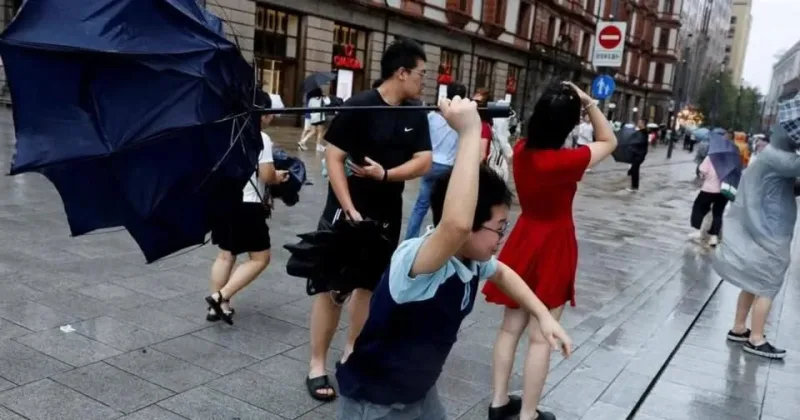
When Typhoon Dolphin arrived on the eastern coast of China, it did not arrive quietly. It arrived with maximum wind speeds of 150 kilometres per hour, a first landfall at Yuhuan in Zhejiang province at 17:30 local time, a second landfall in Wenzhou approximately one hour later, and the specific accumulated force of a storm that had travelled 6,000 kilometres across the western Pacific before it finally hit Chinese soil. That distance, more than three times the lifespan of an average typhoon, meant Typhoon Dolphin China absorbed enormous oceanic energy before delivering it directly onto one of the most densely populated coastlines on earth. The result was a China typhoon emergency whose scale, complexity, and human cost has exposed every vulnerability in the region's disaster management architecture simultaneously.
More than one million people were evacuated from their homes across eastern China including Typhoon Dolphin Shanghai's surrounding provinces before the storm made landfall. 1,400 flights were cancelled in Shanghai alone. Parts of Disneyland and Legoland closed. Viewing platforms along the Bund shut down. Several ground-floor shops in Shanghai’s historic former French Concession were flooded, with water reaching people’s ankles as they walked through the streets. Videos shared by state media showed how quickly the China typhoon evacuation affected everyday life.
For many residents, leaving home was not easy. More than a million people had to leave their homes as the storm approached, creating a difficult and worrying situation for families across the region.
The Storm That Arrived Stronger Than Expected
Typhoon Dolphin was not a surprise. Chinese meteorological authorities had been tracking it for days and had issued their highest-level red alert before landfall. The China typhoon evacuation machinery, which has been refined over decades of typhoon seasons in the western Pacific's most active corridor, was activated with the efficiency that China's centralised emergency management system enables. Wenzhou authorities relocated some 900,000 residents and opened more than 1,000 emergency shelters. Approximately 390,000 people were evacuated from their homes in the city of Taizhou. Maritime authorities in Fujian suspended dozens of passenger ferry routes and halted more than 100 offshore construction projects.
The numbers are impressive. The scale of the evacuation, the speed of the alert system, and the logistical capacity of local governments across multiple provinces to move a million people in the hours before landfall represents a genuine achievement in disaster preparedness whose credit belongs to the years of institutional investment that successive Chinese governments have made in typhoon response capacity.
But impressive preparation does not equal zero consequence. The storm's arrival still produced the specific human tragedy that no evacuation order, however efficient, can fully prevent. A nine-year-old boy from Wenling in Zhejiang was reported missing after being swept into the sea. Chinese officials had not confirmed casualties at time of reporting, but the boy's disappearance is the specific human reality that the abstract numbers of a million evacuated cannot erase. One child swept into the sea during a storm whose arrival was predicted, whose evacuation was ordered, and whose red alert was the highest level available is not a statistical outcome. It is a family's catastrophe.
What the Storm Exposed About Infrastructure, Misinformation and El Niño
The Typhoon Dolphin Shanghai flooding in the former French Concession, one of the city's most internationally recognised tourist areas, documented the specific infrastructure vulnerability that even a city of Shanghai's wealth and modernity cannot fully eliminate. Ankle-deep water in ground-floor businesses is not catastrophic flooding. It is the kind of incremental urban inundation that costs businesses days of trading, damages inventory, disrupts tourism, and imposes the compounding economic cost that frequent typhoon seasons inflict on coastal economies whose drainage and flood defence infrastructure cannot match the intensity of the storms that climate change and El Niño are making more powerful.
This year is a strong El Niño year, which experts say means typhoons can grow to be more intense. Typhoon Dolphin is not simply a natural disaster. It is a climate signal. Its 6,000-kilometre track across the Pacific before landfall, more than three times the average typhoon's lifespan, reflects the specific ocean warming conditions that El Niño creates, allowing storms to maintain and build intensity over longer distances than they would in neutral years. The implications for the China typhoon season's remainder, and for the western Pacific typhoon seasons of coming years as climate change compounds El Niño's intensification effects, are not reassuring.
The misinformation dimension of the China typhoon evacuation is separately alarming. Chinese state media said two people is spreading false information about the storm. One was a 60-year-old man who reportedly created an AI-generated fake video modify that someone is fall from the building in Shanghai during the storm. The other, a 32-year-old man, edited a real storm footage it can mislead the people the authorities said.
The disaster shows how fake information spreads in the social media very quickly. In an emergency if you misleading anything in the online about deaths , shelters so the people will not understand the safe places its push people's lives at risk by sending them away from the safe areas or toward the dangerous ones.
The detentions raise their own questions about the balance between misinformation control and information freedom during emergencies, but the underlying problem they were responding to, the rapid spread of false content during a live disaster, is a genuine threat to emergency management whose management requires both technological solutions and public communication strategies whose development no country, including China, has fully completed.
The Regional Cost: Philippines, Japan, Hong Kong and the Human Chain of Damage
Typhoon Dolphin did not begin in China and it did not only damage China. Before making Typhoon Dolphin China landfall, it brought torrential rains to the Philippines, parts of northern Taiwan, and Japan's Okinawa island. Eight people died in the Philippines because of heavy monsoon rains brought on by Dolphin and storms earlier in the week. More than 7,000 people were sheltering at evacuation centres nationwide. In Okinawa, five elderly people suffered non-life-threatening injuries, three of them falling because of the strong winds.
In Hong Kong, the weather observatory posted a record high temperature of 36.9 degrees Celsius on Sunday as the typhoon swept warm air over the city, a climate data point whose record-breaking character is itself evidence of the atmospheric conditions that produced a typhoon of Dolphin's exceptional duration and intensity.
The regional human cost, eight dead in the Philippines, five injured in Japan, a child missing in China, and millions displaced across the Pacific rim, is the specific accumulated consequence of a single storm system whose 6,000-kilometre journey created the chain of damage that no single country's disaster response can address in isolation
What the Forecast Still Holds
As of Monday morning, Chinese authorities downgraded Typhoon Dolphin from typhoon to tropical storm status. The immediate peak had passed. But the warnings had not. Torrential rains, severe flooding, and the risk of landslides were forecast through to Wednesday across the provinces of Shandong, Henan, Hubei, Anhui, Jiangsu, and Zhejiang, as well as Shanghai. Parts of Zhejiang could receive between 250 and 500 millimetres of rain over the coming days. The storm was moving inland, carrying its moisture with it, and the specific secondary risk of inland flooding and landslides in provinces whose terrain is more vulnerable to water accumulation than the coastal cities whose flood defences have been prioritised in infrastructure investment represents the next phase of the emergency whose management will determine the final human and economic cost.
Local governments urged people to avoid outdoor activities. Hangzhou authorities waived parking fees in all public spaces for drivers seeking shelter from the winds and floodwaters, a practical gesture of civic care whose small scale is in proportion to the human reality of a storm whose large-scale consequences are still unfolding.
How China's Emergency Management Rose to the Moment
At the same time, Typhoon Dolphin China also showed how prepared authorities were for a major disaster. More than one million people were moved to safer places before the storm reached land. Several provincial governments worked together, while thousands of emergency shelters were opened to support those who had to leave their homes.
Moving so many people, especially elderly residents and children, in this situation its a huge challenge. It requires careful planning, strong coordination between authorities, and cooperation from local communities. The large-scale China typhoon evacuation showed how important that preparation can be when a powerful storm is approaching.
Wenzhou's 900,000 relocations. Taizhou's 390,000 evacuations. The 1,000 emergency shelters opened. The 1,400 Shanghai flights cancelled in an orderly process that stranded millions of travellers but did so in the coordinated way that emergency aviation management requires. The red alert issued before landfall giving communities time to act. These are not bureaucratic footnotes. They are the specific operational decisions that saved lives whose number we cannot count because they were evacuated before the storm arrived.
The China typhoon season continues. El Niño continues. The climate signals that Typhoon Dolphin Shanghai sent about storm intensity and track length continue. But so does China's institutional capacity to respond, adapt, and protect its coastal millions in ways that have been built through decades of typhoon experience whose lessons are embedded in the emergency protocols that Monday's evacuation executed. The storm tested those protocols. They held. The boy who went missing is the reminder that holding is never enough. But it is somewhere to build from.
Conclusion: The Storm Passed. The Work Continues.
Typhoon Dolphin has moved inland. The red alert has been downgraded. The million evacuated are beginning the process of returning to homes whose damage they will now assess. The flights are being rescheduled. The floodwaters are retreating.
But the Typhoon Dolphin China crisis leaves behind more than water damage and cancelled flights. It leaves the specific climate accountability question of a strong El Niño year producing a typhoon of exceptional duration and intensity that exposed the limits of even excellent emergency preparation. It leaves the misinformation challenge of AI-generated disaster content spreading faster than verified information through the channels that frightened people turn to when they are trying to understand whether their families are safe. It leaves the specific grief of a family in Wenling whose nine-year-old boy has not been found.
Typhoon Dolphin Shanghai's flooded French Concession will dry out. China typhoon evacuation logistics will be reviewed and improved. The China typhoon season will continue, and the next storm will be tracked, and the red alerts will be issued, and the shelters will be opened. That is not a failure of competence; it is a contribution in itself. In the future, it may happen again, so we need to advance further, improve what we have, and build better things for our future survival.