
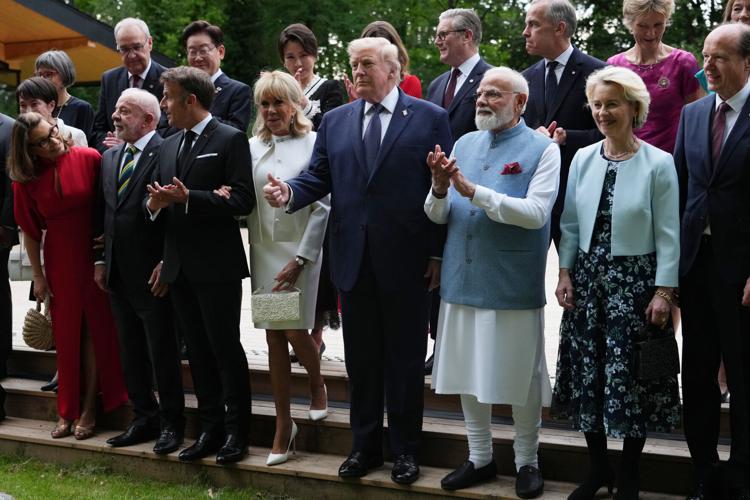
G7 Economies leaders gathered in France this week facing a striking contradiction: rising inflation and a 30 percent jump in oil prices are dragging on global growth, yet the leaders most affected are unlikely to publicly blame President Donald Trump for a war-driven slowdown largely triggered by his own administration's decisions. The reluctance to confront Trump directly, even as the economic fallout becomes harder to ignore at home, is itself the political story of this summit.
The diplomatic calculation behind that restraint is straightforward. G7 leaders, already strained by US tariffs and disputes over NATO funding and Greenland, need Trump's cooperation on issues ranging from Ukraine to broader trade negotiations. Picking a public fight over the economic consequences of a war the US and Israel launched against Iran in late February risks jeopardising progress on those other fronts, a trade-off that several leaders appear to have judged not worth making, even with their own approval ratings suffering domestically.
That tension between private frustration and public diplomacy is not hidden. British Prime Minister Keir Starmer has openly said he is "fed up" with the conflict's impact on energy bills, while Italian Prime Minister Giorgia Meloni has warned of serious economic and social consequences. Yet those statements have largely stayed outside the formal G7 proceedings, with leaders choosing to air grievances individually rather than coordinate a collective rebuke that might force an uncomfortable confrontation with Washington.
How has the Iran war already reshaped the economic and political landscape ahead of this summit?
The war's economic damage was already substantial before this week's talks, and that damage has directly translated into political cost for the leaders attending. Energy prices climbed sharply, inflationary pressure returned to economies that had only recently brought it under control, and concerns mounted about a food supply crisis in developing nations dependent on stable global trade. Rising prices have measurably dented approval ratings for Starmer, German Chancellor Friedrich Merz, and French President Emmanuel Macron, meaning the war's fallout is now a domestic political liability as much as an international economic one.
Central banks responded to that inflationary pressure in the days immediately before the summit, with both the European Central Bank and the Bank of Japan raising interest rates to head off a steeper inflation hit. Those rate decisions are themselves a form of political signal, an acknowledgment by independent monetary authorities that the war's economic consequences had become serious enough to require pre-emptive tightening, even as elected leaders avoided saying so as directly in public.
A weekend breakthrough shifted the immediate mood heading into the summit. The US and Iran announced an agreement to halt the fighting and reopen the Strait of Hormuz, sending a wave of optimism through global markets just before Trump departed for France. That timing significantly reduced the odds of a confrontational summit, giving leaders a face-saving narrative of de-escalation to lean on instead of having to litigate blame for weeks of economic damage that had already occurred.
What does France's handling of the summit agenda reveal about the politics of avoiding conflict with Washington?
France, as this year's G7 president, made a deliberate procedural choice that speaks volumes about the political mood: it preemptively ruled out pushing for a broad final communique, the kind of joint statement that would typically require consensus language on contentious issues like the Iran war's economic impact. Instead, Paris steered the agenda toward narrower, less politically charged declarations on global imbalances, critical mineral supply chains, and shifting development aid toward investment-driven programmes.
That agenda design is itself a political strategy for avoiding a public clash with Trump. By keeping the summit's formal outputs narrow and technical, French organisers reduced the number of moments where leaders would need to either confront the US president directly or visibly avoid doing so in front of cameras. The interim US-Iran deal reached just before Trump's departure further reduced the odds of a public showdown, giving France's friction-minimising approach an assist it may not have otherwise had.
Marcelo Estevao, chief economist at the Institute of International Finance, offered one of the sharpest political critiques of this dynamic, arguing that the situation reflects something larger than diplomatic politeness. "US policymaking has been hurting world economic activity," he said, framing the summit's avoidance of the topic as a structural problem. He warned that having the world's largest economy undermine what could have been a collaborative G7 agenda raises real questions about whether the group can shore up its own relevance at a moment when non-member emerging economies are claiming an increasing share of global output.
Is the G7's avoidance of confrontation a sign of deeper irrelevance in today's global economy?
The G7 was founded in the aftermath of the 1973 oil shock specifically to help coordinate responses to global economic crises, which makes this summit's reluctance to directly address the world's most pressing current economic challenge a pointed irony that analysts have not been shy about pointing out. Several experts argue that the group's choice to duck the issue, rather than confront it collectively, risks accelerating a decline in relevance that has been underway for years.
The numbers support that concern. According to the Center for Strategic and International Studies, the G7 now accounts for just 44.1 percent of global GDP, down sharply from 60.5 percent when the group was first formed. Countries like India, Brazil, and China, none of which are G7 members, have grown into a much larger share of the global economy, steadily eroding the bloc's claim to represent the world's dominant economic powers as a unified decision-making body.
Not everyone is ready to write off the G7's usefulness, however. Martin Muehleisen, a former IMF strategy chief who has participated in past summits including some involving Trump, argued that the group has historically been capable of producing real decisions when a crisis demands it, pointing to its coordinated response during the 2008-2009 global financial crisis as evidence the format can still function when leaders choose to use it. He cautioned that this week's proceedings would likely stay carefully scripted in public, though he did not rule out sharper exchanges happening away from the cameras, in individual meetings and over meals.