
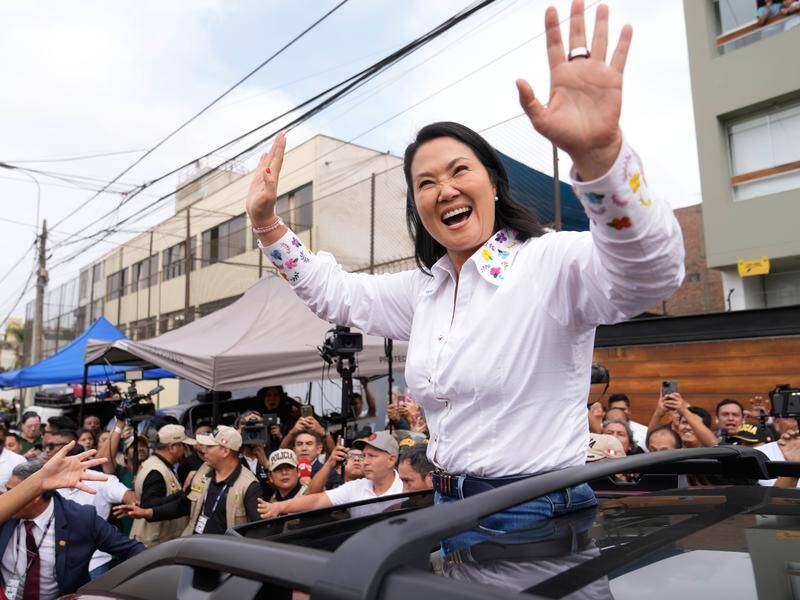
Keiko Fujimori, the conservative four-time peru presidential election candidate and daughter of former President Alberto Fujimori, has secured a lead in Peru's presidential runoff that cannot be overturned by the remaining uncounted ballots. With 50.11 percent of the vote and a margin of 43,386 votes over leftist rival Roberto Sanchez, Fujimori's path to the presidency is now a matter of formal confirmation rather than genuine uncertainty. Peru's ONPE electoral authority confirmed that only 40,213 votes remain to be counted, fewer than the deficit Sanchez would need to close, making the mathematical reality of the outcome clear even before an official declaration.
The road to this result was slow and contested. The runoff count was delayed by a review of disputed ballots, the late arrival of overseas votes, and the razor-thin initial gap between the two candidates, which kept both camps on edge for longer than expected. Sanchez had requested the annulment of thousands of votes cast abroad, arguing they disproportionately favoured Fujimori, but Peru's national electoral jury rejected that request on Tuesday night, removing the last procedural lever available to the left-wing candidate before an official result is declared.
The electoral authority has not yet officially declared a winner and plans to do so in mid-July. That gap between mathematical certainty and formal declaration is itself politically significant. It gives Sanchez's camp a window to sustain its narrative of contested legitimacy, and it prolongs the period of institutional uncertainty in a country that is already deeply accustomed to political turbulence at the top. For Fujimori, the delay means she must project both confidence and restraint simultaneously, claiming a mandate she has effectively won without appearing to pre-empt the institutional process she will need to govern through.
Why Peruvian voters turned to Fujimori after decades of distrust toward her family's political legacy
Keiko Fujimori winning Peru's presidency is a politically striking outcome because her family name has been one of the most divisive in the country's recent history. Her father, Alberto Fujimori, ruled Peru through the 1990s and served 16 years in prison for human rights abuses committed during his authoritarian decade in power. Keiko herself spent time in pre-trial detention on corruption charges, charges she has consistently denied. She ran for president three previous times without winning. That she now stands on the edge of the presidency reflects how dramatically the political mood in Peru has shifted, driven primarily by one issue: security.
Rising rates of extortion and murder have become defining concerns for Peruvian voters across all regions, but particularly in urban areas where organised criminal networks have expanded their reach over recent years. Fujimori read that shift early and ran directly into it, leaning into her father's legacy of strong-hand governance rather than distancing herself from it as she had done in earlier campaigns. Where previous Keiko Fujimori campaigns tried to soften her association with authoritarianism, this campaign embraced it, casting her father's iron approach to order as exactly what a lawless Peru needs rather than as a chapter to be apologised for.
That political repositioning carried real risk given how many Peruvians directly experienced the abuses of the Fujimori era, but it proved effective enough to build a majority. The analysis here is straightforward: when voters feel unsafe and disillusioned with every recent government, a candidate who promises unambiguous strength has a structural advantage over one who offers negotiation and reform. Fujimori's victory is not primarily a rehabilitation of her father's reputation. It is a verdict on the present, delivered by voters who have watched eight consecutive presidents come and go without experiencing meaningful improvement in their daily safety or economic prospects.
What Roberto Sanchez's fraud claim means for Peru's political stability and democratic institutions
Roberto Sanchez's decision to allege fraud before the count was finalised, without providing evidence to support the claim, introduces a destabilising element into Peru's already fragile post-election environment. He stated he would refuse to recognise the election results, a position that echoes the contested election playbook seen in several other Latin American elections in recent years and one that carries real consequences regardless of whether the underlying claim has any merit. When a candidate publicly rejects the legitimacy of a result that independent electoral authorities have upheld, it does not need to be true to be damaging.
Peru's national electoral jury has already demonstrated its institutional independence in this cycle by rejecting Sanchez's request to annul overseas ballots, a ruling that directly undercuts the factual basis of his fraud narrative. That ruling matters because it means the primary institution tasked with adjudicating disputes has reviewed the specific complaint Sanchez raised and found it without legal basis. A candidate who continues to allege fraud after the relevant authority has ruled against his specific claim is making a political argument, not a legal one, and the political analysis of that argument matters enormously for what comes next.
Sanchez's refusal to concede creates the prospect of a prolonged legitimacy dispute at precisely the moment Peru most needs political consolidation. Fujimori will inherit a country where public trust in politicians is at historic lows, where four former presidents are currently serving prison sentences, and where no president in the past eight years has completed a full term. Beginning her presidency with an opponent actively contesting the result does not just complicate her political honeymoon. It adds another layer of institutional stress to a democratic system that is already visibly strained and that will need to function coherently to deliver the security improvements voters elected her to make.
How Peru's history of impeachments, resignations and imprisoned presidents shaped this election outcome
Peru's recent political record is extraordinary by any measure. Of the eight presidents the country has had in eight years, not a single one completed a full term in office. Three were impeached. One resigned after just six days. Four former presidents are currently in prison. That institutional collapse is not just a governance failure it is the defining political context in which Peruvians cast their votes in this election, and it explains a great deal about why a candidate carrying as much personal and familial political baggage as Keiko Fujimori was nonetheless able to build a winning coalition.
When every recent president has ended their tenure in disgrace, imprisonment, or forced removal, the traditional arguments against a candidate's past become less potent. Voters making a pragmatic calculation about which candidate is most likely to impose order, regardless of the methods involved, will weigh a family history of authoritarian effectiveness differently from voters in a country where institutions have functioned reliably. Fujimori's campaign understood this and positioned her accordingly: not as a clean break from a troubled past, but as a candidate who at least represents a form of political decisiveness that the fragmented, scandal-plagued alternatives have conspicuously failed to deliver.
The deeper political analysis, however, is that the same institutional fragility that created the conditions for Fujimori's win will also define the limits of what she can achieve in office. A president who comes to power promising order and strength still has to govern through Peru's courts, congress, and regional authorities, all of which have demonstrated their capacity to remove presidents they disagree with. The eight-president-in-eight-years pattern did not happen because Peruvian institutions are weak. It happened partly because they are active and contentious. Fujimori's political durability in office will depend as much on her ability to manage those institutions as on the strength of the mandate she is about to receive.
What Fujimori's win means for Latin America's rightward political shift and the region's security agenda
Keiko Fujimori's expected presidency deepens a rightward political shift across Latin America that has now produced conservative or right-wing election wins in Colombia, Argentina, Chile, and Peru within a relatively short window. The common thread across all of these victories is voter anxiety about security, crime, and the perceived failure of left-wing governments to deliver measurable improvements in personal safety. Voters concerned about rising rates of extortion, murder, and organised criminal activity have consistently turned toward hardline candidates who promise decisive enforcement action over dialogue-based approaches.
The regional political analysis is that the left's period of dominance across Latin America, which produced governments in Peru, Colombia, Brazil, Argentina, and Chile over the previous decade, has been significantly eroded by the security issue. Where left-wing governments pursued negotiated settlements with criminal organisations, expanded social programmes, or prioritised poverty reduction over policing, voters experiencing daily insecurity came to interpret those priorities as indifference to the violence affecting their lives. That perception, accurate or not, has been politically lethal for the left in election after election across the continent.
For the United States and international observers watching the regional shift, Fujimori's win creates a more receptive diplomatic environment than the leftward Latin America of five years ago. Her expected presidency aligns Peru more closely with the Washington-friendly conservative bloc now including Colombia's de la Espriella and Argentina's Milei, a convergence that will shape regional positions on trade, security cooperation, and relationships with Venezuela and Cuba. The political analysis heading into the mid-2020s is that Latin America's right turn is not a momentary correction but a sustained reconfiguration driven by security concerns that left-wing governments have not yet found a credible answer to.