
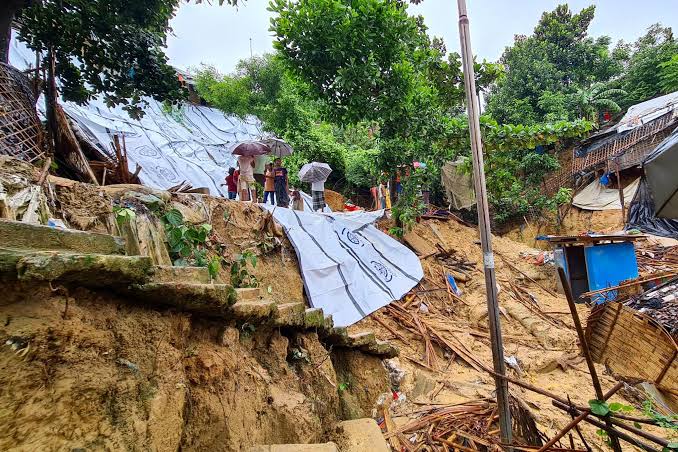
Rohingya refugee camp landslide Bangladesh Cox Bazar 2026 has killed at least eight people including some children and injured several others after heavy monsoon rains triggered multiple landslides at refugee camps in southeastern Bangladesh in the early hours of Monday morning, with the landslides hitting four separate locations across the camps and burying makeshift bamboo and plastic shelter homes under mud and debris while residents were asleep in what has become the recurring human cost of housing more than 1.2 million people on steep deforested hillsides whose structural vulnerability to monsoon-season landslides creates casualties with a predictability that humanitarian organisations and Bangladeshi officials have been documenting and warning about for years without generating the resource commitment and physical relocation needed to eliminate the risk. Cox's Bazar police official Tumpa Das confirmed eight deaths from the landslides caused by heavy rain and warned that continued rainfall had increased the risk of further landslides with thousands of refugees still living on unstable slopes, while Mohammed Mizanur Rahman, the Bangladeshi official responsible for refugee relief and repatriation, confirmed that authorities were moving people out of high-risk areas as quickly as possible to prevent further casualties. A Bangladeshi man was also killed and two family members injured when part of a hillside collapsed onto their house in Cox's Bazar outside the refugee camps, documenting that the monsoon landslide threat extends to the surrounding Bangladeshi community as well as to the refugee population whose specific vulnerability dominates international attention.
The crisis impact of Monday's deaths extends beyond the immediate eight fatalities to the structural humanitarian emergency that the Bangladesh Meteorological Department's forecast of more heavy rain in the coming days represents for a refugee population whose shelter stock cannot be meaningfully improved within the timeframe of a forecast warning, whose population numbers and legal status prevent the kind of permanent physical relocation that would eliminate the slope vulnerability, and whose exposure to monsoon-season landslide risk is compounded by the renewed fighting in Myanmar's Rakhine State that is raising concerns of a fresh influx of Rohingya refugees across the border. The simultaneous monsoon casualty crisis inside the existing camps and the potential new refugee pressure from Myanmar's deteriorating security situation creates the compound humanitarian challenge that Cox's Bazar's already overwhelmed infrastructure and Bangladesh's strained political and financial capacity for refugee management must absorb without the international resettlement or voluntary repatriation solutions that would reduce the camp population's vulnerability to the recurring seasonal disasters whose death toll accumulates year after year.
The physical geography that makes Cox's Bazar's refugee camps so deadly in the monsoon season is not accidental but the product of the specific decisions made about where to locate the refugees who began arriving in 2017, with the available flat land having been occupied by Bangladeshi communities and the expanding refugee population being accommodated on the hillsides that were cheaper and whose slopes were vacant not by chance but because their landslide vulnerability made them unsuitable for permanent settlement. The deforestation of those hillsides to provide shelter construction materials and cooking fuel in the years since the camps' establishment has progressively removed the root systems that provide the soil stabilisation whose presence reduces landslide probability, creating the compounding vulnerability dynamic in which each year's monsoon season tests a hillside that is more denuded and therefore more unstable than the year before. The bamboo and plastic sheet shelters that most families live in cannot withstand a landslide and provide no warning system for residents inside who may have no indication that the slope above them is moving until the mud and debris arrive.
How Cox's Bazar Became the World's Largest Refugee Settlement and Why Its Design Creates Monsoon Deaths
The 2017 Rohingya crisis, in which Myanmar's military conducted what the United Nations and multiple governments characterised as ethnic cleansing operations in Rakhine State driving approximately 700,000 Rohingya across the border into Bangladesh in a matter of months, created the specific emergency settlement conditions that have defined the physical character of Cox's Bazar's camps ever since and that Monday's deaths document the ongoing cost of. An emergency refugee response at that scale and speed does not produce the planned settlement infrastructure that careful humanitarian design would create, instead producing the rapid allocation of whatever available land could absorb the arriving population in conditions of extreme urgency where the alternative to hillside settlement was no shelter at all for hundreds of thousands of people arriving in monsoon conditions with no resources and no legal status in the country that was receiving them. The camp locations were established under crisis conditions whose legacy the current physical geography reflects, and the transformation of emergency settlements into permanent ones while maintaining the emergency settlement's physical character is the specific humanitarian planning failure that the international community's inability to fund meaningful physical upgrading has produced.
The more than 1.2 million Rohingya now living in Cox's Bazar, a figure that has grown beyond the original 2017 influx through natural population increase and additional arrivals, occupy what has become the world's largest refugee settlement in a country that has never formally accepted them as refugees and whose government has consistently maintained that repatriation to Myanmar, conducted safely and voluntarily, is the intended resolution of a population presence that Bangladesh characterises as temporary regardless of how many years have elapsed. This political framing of temporariness has contributed to the specific underinvestment in durable physical infrastructure whose absence the landslide deaths document each monsoon season, because investing in permanent earthquake-resistant or landslide-safe housing for a population whose presence is officially temporary creates the specific political contradiction that Bangladesh's government cannot accept without abandoning the repatriation framework that is its stated policy objective.
Landslides and flooding during monsoon seasons have killed people in the Cox's Bazar camps in every year since the 2017 establishment, creating the accumulated death toll whose year-on-year repetition documents the specific failure to translate the known and predictable risk into the physical intervention that would reduce it. Humanitarian organisations including UNHCR, IOM, MSF, and BRAC have been documenting the monsoon vulnerability, warning about the specific slope locations of highest risk, and advocating for the physical relocation and shelter upgrading that would reduce casualties, but the combination of funding constraints, land availability limitations, and the political framing of temporariness that discourages permanent infrastructure investment has prevented the specific interventions whose implementation would save the lives that each monsoon season claims.
Myanmar's Rakhine Fighting and the Fresh Influx Concern
The renewed fighting in Myanmar's Rakhine State that is generating fresh influx concerns creates the specific compound crisis dimension that makes Monday's landslide deaths more than a recurring seasonal tragedy and situates them in the context of a potential population increase that would add to Cox's Bazar's already overcrowded camps' vulnerability rather than reducing it toward the level where monsoon-season management becomes operationally sustainable. Bangladeshi authorities' stepped-up border monitoring amid reports of people gathering near the frontier seeking to enter the country documents the early-warning indicators of the fresh movement pressure that the Rakhine fighting is generating, with Bangladesh's historically ambivalent approach to new Rohingya arrivals creating the specific tension between the humanitarian obligation to receive people fleeing violence and the domestic political and resource constraints that further camp expansion would impose. The timing of the Rakhine fighting's fresh pressure in the same week that monsoon rains are already killing camp residents creates the specific humanitarian planning challenge of managing the existing population's vulnerability while preparing for potential additional arrivals whose accommodation would require additional hillside settlement in the absence of flat land alternatives.
The Myanmar Rakhine State conflict's current phase reflects the ongoing armed conflict between the Myanmar military and the Arakan Army ethnic armed organisation that has been contesting control of Rakhine State, with the Rohingya civilian population caught between the military's historical violence against them and the conflict's general devastation of the civilian infrastructure that their survival depends on. Reports of Rohingya civilians gathering near the Bangladesh border reflect the specific population movement pattern that conflict intensity and civilian insecurity produce when affected populations calculate that border crossing, despite Bangladesh's unwelcoming policy environment, represents better prospects for survival than remaining in an active conflict zone. Bangladeshi authorities' stepped-up frontier monitoring is not simply a security response to illegal border crossing but the early humanitarian surveillance that determines how quickly and comprehensively any fresh influx is identified, counted, and assessed for the protection and assistance needs that international humanitarian law creates obligations to address.
The Evacuation Operations, Forecast Rain, and What Immediate Protection Requires
Rahman's confirmation that authorities were moving people out of high-risk areas as quickly as possible captures both the genuine emergency response effort and the specific operational constraints that make rapid mass relocation from Cox's Bazar's hillsides more difficult than the statement implies, because the relocation destination question, where exactly are people being moved to when the camps are already at maximum density and the surrounding flat land is occupied by Bangladeshi communities, is the specific logistical problem whose answer determines whether the relocation reduces or simply redistributes the risk. Emergency relocation within the camp system typically moves people from identified highest-risk slopes to lower-risk areas within the same camp geography, reducing but not eliminating exposure in conditions where the Bangladesh Meteorological Department's forecast of more heavy rain means the risk window extends for days rather than being resolved by a single emergency response. Temporary community shelters, concrete buildings within the camp system that can provide refuge during extreme weather, are the most immediately available protection resource whose capacity relative to the population at risk determines how many people can be meaningfully protected during the forecast rain period.
The forecast of more heavy rain in the coming days, with authorities remaining on alert for additional landslides and flash floods, creates the sustained emergency management period that Cox's Bazar's disaster response infrastructure must manage with the resources available rather than the resources required for the population size and vulnerability level the camps represent. International humanitarian organisations' pre-positioned emergency response capacity, including search and rescue equipment, medical supplies, and emergency shelter materials, will be activated across the camp system in response to Monday's deaths and the forecast risk continuation, but the fundamental vulnerability reduction that physical relocation and slope stabilisation would provide cannot be achieved within the forecast rain window regardless of the emergency response's quality.
The deaths of Rohingya children in Monday's landslides creates the specific child protection dimension of the crisis that humanitarian organisations documenting the cumulative impact of Cox's Bazar's annual monsoon casualties on the camp population's most vulnerable members will need to address. Children's disproportionate mortality in natural disasters reflects their physical vulnerability to being buried under debris and their inability to self-rescue, creating the specific child protection obligation that UNHCR and partner organisations' monsoon response protocols prioritise through the targeted protection of families with young children in high-risk slope locations. The children killed on Monday morning while asleep in their shelters are the most visible human cost of the specific combination of displacement, poverty, political limbo, and physical vulnerability that Cox's Bazar's 1.2 million residents navigate every monsoon season without the durable protection solutions whose implementation the international community has not yet delivered.