
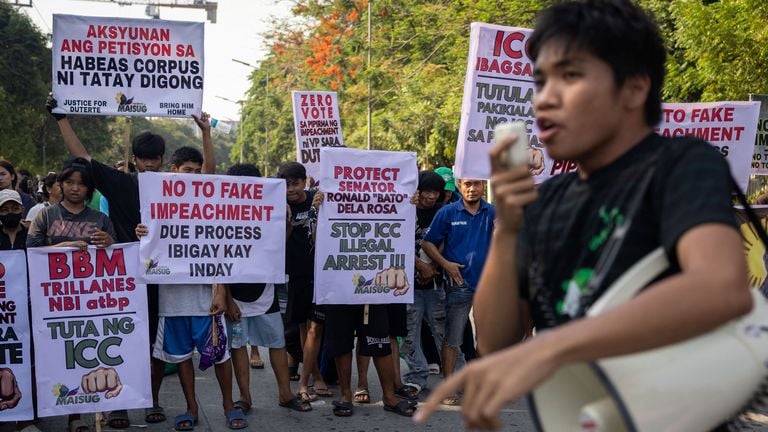
Philippine Vice President Sara Duterte has been impeached by the country's lower house for the second time in just over a year, setting the stage for what could become one of the most consequential political trials in the Philippines' modern democratic history. The new impeachment complaint accuses Duterte of misusing public funds, accumulating unexplained wealth, and making threats against President Ferdinand Marcos Jr, the first lady, and a former House Speaker. Duterte, the daughter of former president Rodrigo Duterte, has denied all accusations against her, with her legal team dismissing the complaints as defective and characterizing the entire impeachment process as a fishing expedition designed to damage her politically rather than pursue genuine accountability. The case now moves to the Senate, where it will be heard as a formal impeachment trial with senators serving as judges.
The renewed impeachment effort comes after an earlier attempt was voided on constitutional grounds, creating a one-year ban on repeat impeachment filings that lawmakers had to wait out before proceeding with a fresh complaint. That waiting period has now elapsed, removing the primary legal obstacle that derailed the first attempt and raising expectations among impeachment supporters that a full Senate trial will finally take place. The political stakes of the proceedings are enormous, touching not only on Duterte's immediate future as vice president but on the broader power struggle between her political camp and the Marcos administration, and on her stated ambition to contest the 2028 presidential election. A conviction would remove her from office and could permanently bar her from seeking any public position, including the presidency she has publicly declared her intention to pursue.
The backdrop to the impeachment is a deepening and increasingly public rift between Duterte and President Marcos, who were once political allies but whose relationship has deteriorated significantly since they took office together following the 2022 elections. The allegations against Duterte, including the extraordinary claim that she threatened the lives of Marcos and the first lady, have transformed what began as a political disagreement into a criminal and constitutional matter of the gravest kind. President Marcos has publicly distanced himself from the impeachment effort, describing it as a matter for Congress rather than the executive branch, but the proceedings are unfolding in a political environment that his administration's relationship with Duterte has fundamentally shaped.
How the Philippine Impeachment Process Works and What the Senate Trial Will Involve
Under the Philippine Constitution, the impeachment process follows a two-stage structure that divides responsibility between the lower house and the Senate. The House of Representatives holds the power to impeach, which means initiating formal charges against a covered official through a majority vote of its members. Once that vote is taken and the articles of impeachment are adopted, the case is transmitted to the Senate, which must then convene as an impeachment court. In this court, all 24 senators serve as judges who will hear evidence, examine witnesses, and ultimately vote on whether the accused official is guilty of the charges brought by the House. The Senate president presides over the proceedings, a role whose significance has become the subject of intense political attention in the current case.
In previous impeachment cases in the Philippines, the Senate trial process has proven far from predictable or straightforward despite its constitutional clarity on paper. The 2001 impeachment trial of then-President Joseph Estrada collapsed dramatically when prosecutors walked out of the proceedings in protest over a Senate majority vote that blocked the opening of key evidence envelopes. That walkout effectively ended the trial and led to Estrada's removal through a different mechanism altogether, the People Power II uprising that saw him lose military and public support and ultimately vacate the presidency. The precedent illustrates that even a constitutionally mandated process can be derailed by political dynamics, procedural disputes, and the fluid loyalties that characterize Philippine legislative politics.
The 2025 episode in which the Senate took the unusual step of returning an earlier Duterte impeachment case to the lower house on constitutional grounds demonstrated that the current Senate is not simply a passive recipient of whatever the House sends it. Senators exercise independent judgment about the procedural validity of impeachment complaints, and that judgment can significantly affect whether a trial proceeds as expected or encounters fresh legal obstacles. With the constitutional barrier of the one-year ban now cleared and the fresh complaint structured to address the deficiencies identified in the earlier filing, the legal pathway to a Senate trial is clearer than it has been, though the political pathway remains deeply complicated.
Senate Leadership Changes and the Political Dynamics That Could Shape the Trial's Outcome
The most immediately significant political development affecting how the Duterte impeachment trial will unfold is the leadership change in the Senate that occurred shortly before the House vote on the new complaint. Duterte allies in the chamber moved to install Alan Peter Cayetano, a staunch loyalist of the Duterte family, as Senate president. Under the Philippine Constitution and Senate rules, the Senate president presides over impeachment trials, meaning Cayetano will be in the chair during the proceedings against Sara Duterte. Political science professor Jean Encinas-Franco of the University of the Philippines noted that whoever holds the Senate presidency has significant political space to maneuver the proceedings in ways that could favor their political patron, making the leadership change a development of enormous practical consequence for how the trial is conducted.
The circumstances surrounding the Senate leadership change added another layer of political drama to an already volatile situation. Senator Ronald dela Rosa, a close ally of the Duterte family who had been absent from Senate sessions for months amid legal pressures connected to an International Criminal Court investigation into the war on drugs he oversaw as police chief, made a sudden and timely return to cast a decisive vote backing Cayetano's installation as Senate president. Dela Rosa's reappearance at such a politically critical moment underscored the degree to which the Duterte camp was actively working to shape the institutional environment within which the impeachment trial would take place, rather than simply waiting to respond to whatever process the Marcos-aligned majority might construct.
Whether these Senate dynamics will translate into sufficient votes to prevent a conviction remains genuinely uncertain. Securing a conviction requires a two-thirds majority vote of the Senate, meaning at least 16 of the chamber's 24 senators must vote guilty for Duterte to be removed from office. Analysts tracking Philippine legislative politics note that while Duterte allies are believed to hold significant influence in the Senate, political loyalties in the Philippines are notoriously fluid, particularly when senators are calibrating their positions with an eye toward their own electoral futures. The 2028 presidential election, which Duterte has publicly said she intends to contest, looms over every calculation, as senators must weigh their current political alliances against the possibility that Duterte could emerge as a powerful future president capable of rewarding or punishing their choices today.
What Conviction Would Mean for Sara Duterte and Philippine Democracy
A guilty verdict from the Senate would carry consequences for Sara Duterte that are both immediate and potentially permanent. Conviction in an impeachment trial under the Philippine Constitution results in removal from the vice presidency and can include disqualification from holding any public office in the future. If that disqualification is imposed alongside removal, Duterte's stated intention to run for president in 2028 would be constitutionally foreclosed, ending a political ambition that has been a central organizing principle of her camp's strategy since she and Marcos parted ways. The combination of removal and disqualification would represent one of the most complete political eliminations of a major Philippine political figure in the democratic era, with implications for the Duterte family's broader hold on influence in southern Philippines and nationally.
For Philippine democracy more broadly, the outcome of the Duterte impeachment trial will be read as a test of whether the country's constitutional accountability mechanisms can function effectively when they are applied to a figure with significant popular support, powerful family connections, and a demonstrated willingness to contest the legitimacy of the proceedings against her. The fact that a previous impeachment was voided on constitutional grounds, that Senate leadership has shifted in ways favorable to the accused, and that the presiding officer has declared loyalties to the Duterte family all create conditions under which a fair and transparent trial will require active and visible commitment from senators who might otherwise prefer to navigate the situation through procedural maneuvering rather than a clear verdict on the merits.
If Duterte is removed and disqualified, a successor to the vice presidency would be nominated by President Marcos from among members of Congress, subject to majority confirmation by both chambers voting separately. That process would give Marcos another opportunity to shape the country's leadership succession landscape, though it would also require navigating the same fractious congressional dynamics that have characterized his relationship with the legislative branch throughout his presidency. The resolution of the Duterte impeachment, whatever form it takes, will significantly define the political landscape within which the Philippines approaches its 2028 electoral cycle and the next chapter of its democratic development.