
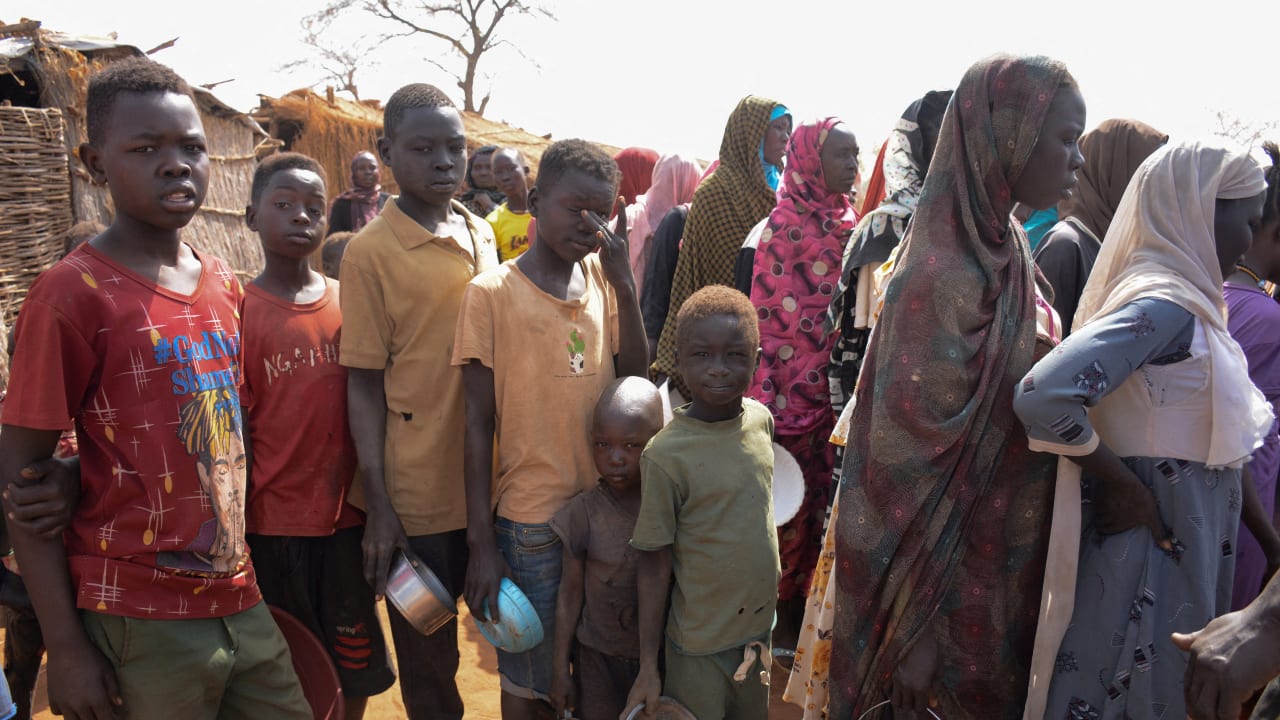
Sudan food crisis one meal day reality has been documented in stark and specific detail by a joint report published Monday by five major non-governmental organisations, finding that in the two areas worst hit by the country's civil war, North Darfur and South Kordofan, millions of families can only access one meal a day and often miss meals for entire days, with many having resorted to eating leaves and animal feed to survive. The report, produced by Action Against Hunger, CARE International, International Rescue Committee, Mercy Corps, and the Norwegian Refugee Council, arrives as Sudan's war between the Sudanese army and the paramilitary Rapid Support Forces enters its third year on Wednesday, a conflict the United Nations has documented as producing one of the world's largest humanitarian crises through widespread atrocities, ethnically charged violence, and the deliberate use of starvation as a weapon of war. Some 61.7 percent of Sudan's population, equivalent to 28.9 million people, is now acutely food-insecure according to the 2026 Humanitarian Needs and Response Plan, a figure that represents not a future warning but a present catastrophe that is deepening with each passing week.
The scale of what the report documents goes beyond the standard vocabulary of food insecurity into conditions that most people in the world associate with historical atrocities rather than ongoing crises receiving inadequate international attention. People eating leaves and animal feed to survive are not experiencing food insecurity in any clinical sense but starvation, and the families who miss meals for entire days are not managing a tight food budget but confronting the possibility that they will not eat at all. The global hunger monitor confirmed famine conditions in al-Fashir and Kadugli in November 2025, and in February 2026 the UN-backed Integrated Food Security Phase Classification found that famine thresholds for acute malnutrition had been surpassed in Um Baru, where the rate of acutely malnourished children under five was nearly double the famine threshold, and in Kernoi. These are not preliminary warning signs but confirmed catastrophic outcomes whose documentation has not produced the international response that the severity of conditions demands.
The report's findings on the specific vulnerability of women and girls add a dimension to the food crisis that the aggregate statistics cannot fully capture. Female-headed households are three times more likely to experience food insecurity than male-headed households, a disparity that reflects the intersection of the conflict's gender-based violence with its economic disruption. Women and girls face high risks of rape and harassment when going to fields, visiting markets, or collecting water, the essential activities of food production and acquisition that the war has turned into personal safety threats rather than routine household tasks. The practical consequence is that the women and girls most dependent on food access are simultaneously most endangered by the act of trying to obtain it, creating a compounded vulnerability whose human cost is measured in hunger, trauma, and the long-term developmental damage of childhood malnutrition.
How Sudan's War Created the World's Largest Hunger Crisis
Sudan's civil war between the Sudanese Armed Forces and the Rapid Support Forces began in April 2023 when the fragile political transition following the 2019 removal of longtime dictator Omar al-Bashir collapsed entirely into armed conflict between the two military power centres that had jointly managed that transition. The RSF, a paramilitary organisation descended from the Janjaweed militias responsible for the Darfur genocide of the early 2000s, had been incorporated into Sudan's formal security architecture but never genuinely subordinated to civilian or army control, and the conflict that erupted in April 2023 quickly spread from Khartoum across multiple states as both forces sought to control territory, resources, and civilian populations. The United Nations documented widespread atrocities and waves of ethnically charged violence from the conflict's earliest months, with Darfur experiencing patterns of mass killing and displacement that drew explicit comparisons to the genocide of twenty years earlier.
The food crisis that has developed alongside the military conflict reflects both the direct destruction of Sudan's agricultural economy by the fighting and the deliberate use of starvation as a weapon by both parties to the conflict. The NGO report documents how the war is driving communities toward famine conditions through two distinct mechanisms: disruptions to farming created by conflict, displacement, and insecurity that prevent farmers from planting, tending, and harvesting their crops, and the deliberate destruction of farms and markets by armed actors who understand that denying food to civilian populations is an effective method of controlling and punishing communities associated with the opposing side. The second mechanism is not a collateral consequence of the fighting but an intentional strategy that international humanitarian law explicitly prohibits, and its documentation in the NGO report adds to the body of evidence about war crimes that the International Criminal Court and UN human rights bodies have been accumulating since the conflict began.
North Darfur and South Kordofan's designation as the two areas worst hit by the conflict reflects the specific geography of the war's most intense phases, where fighting over Khartoum's fall and the RSF's consolidation of control in Darfur produced the most severe civilian displacement, agricultural disruption, and deliberate food system destruction. Al-Fashir, North Darfur's capital and the last major city in the region not under RSF control as of the report's writing, has been under effective siege conditions whose humanitarian consequences were severe enough to produce the November 2025 famine declaration. The confirmation of famine in al-Fashir by the global hunger monitor was a specific and significant milestone, because famine declarations require meeting extremely high evidentiary thresholds about mortality rates, malnutrition prevalence, and food access that distinguish famine from severe food insecurity. Meeting that threshold in al-Fashir documented that conditions had deteriorated beyond even the severe levels that preceding monitoring had established.
The Collapse of Food Systems and the Role of Deliberate Destruction
The report's foundation in interviews with farmers, traders, and humanitarian actors across Sudan provides the on-the-ground evidentiary basis for its finding that food system destruction in Sudan is not simply a consequence of conflict-related disruption but includes deliberate targeting of the agricultural and commercial infrastructure that civilian populations depend on for food. Farmers interviewed for the report described destruction of their crops and equipment by armed actors, traders described market disruptions that were not random consequences of insecurity but specifically targeted commercial facilities, and humanitarian actors described systematic obstruction of aid delivery that went beyond the general challenges of operating in conflict environments into deliberate impediment. The pattern documented across these interviews is consistent with the international humanitarian law violation of using starvation as a weapon of war, a war crime that carries specific legal consequences for those who order or execute it.
The communal kitchens that have emerged as a survival mechanism in the worst-affected areas, providing collective food preparation for communities that lack the resources for household-level cooking, are increasingly unable to meet the rising needs of the populations they serve, the report found. Communal kitchens require food supplies, fuel, cooking equipment, and the physical security to operate, all of which the conflict conditions of North Darfur and South Kordofan make increasingly difficult to maintain. When communal kitchens fail, the populations that depend on them have no fallback beyond the foraging for leaves and animal feed that the report documents as a last resort already being practised. The gap between the communal kitchen system's capacity and the demand it faces is one of the most direct measures of the crisis's severity, because communal kitchens represent a community's attempt to pool its last resources against starvation rather than a normal food distribution mechanism.
Major donor funding cuts are identified in the report as a significant impediment to aid agencies' ability to respond to the deepening crisis, a finding that sits against the backdrop of the broader international humanitarian funding environment that has seen multiple major donor countries reduce their overseas development and humanitarian aid allocations in recent years. The specific connection between donor funding reductions and reduced aid agency capacity in Sudan is not abstract: it translates directly into fewer food distributions, fewer therapeutic feeding programmes for severely malnourished children, fewer non-food item distributions, and reduced humanitarian protection services for civilians in the most dangerous areas. When donor funding falls and humanitarian needs rise simultaneously, the gap between capacity and need grows on both sides of the equation, producing exactly the conditions where famine thresholds are crossed and the window for preventing catastrophic outcomes closes before the international response can be mobilised.
Women and Girls at the Intersection of Conflict, Food Insecurity, and Violence
The finding that female-headed households are three times more likely to experience food insecurity than male-headed households is the aggregate statistical expression of a vulnerability whose causes are specific and interconnected in ways that the statistic alone cannot fully convey. Women head households in Sudan's conflict zones most commonly because their male partners have been killed, have fled, or have been displaced by the fighting, meaning that female-headed households are disproportionately households that have already experienced the most severe direct impacts of the conflict. These households lack the labour power for agricultural production that male presence provides, may lack the physical security for market access that male accompaniment offers in areas where gender-based violence is prevalent, and may face specific discrimination in aid distribution systems that have not been designed with female household heads' access constraints in mind.
The specific risks that women and girls face when going to fields, visiting markets, or collecting water represent the operational barriers to food access that transform food insecurity from an economic problem into a physical safety problem. A woman who cannot go to her field because the path is controlled by armed actors who have threatened or perpetrated sexual violence faces a food production barrier that no amount of seed distribution or agricultural rehabilitation programming can address without also addressing the protection environment that makes field access dangerous. The intersection of gender-based violence and food insecurity documented in the report is not coincidental but structural, reflecting how the deliberate weaponisation of sexual violence against women and girls serves military and political objectives while simultaneously destroying civilian food production and household economic capacity.
Sudan's conflict has produced displacement at a scale that qualifies it as one of the world's largest displacement crises, with millions of people forced from their homes and communities and unable to engage in the agricultural production and market participation that sustained their food security before the conflict. Displaced people face specific food insecurity challenges that differ from those of conflict-affected people who remain in their communities: they have lost access to their agricultural land and food storage, they may lack documentation needed to access aid distributions, they are dependent on host community generosity that has its own limits, and they face the health and nutritional vulnerabilities associated with the living conditions of displacement. The accumulation of displaced populations in areas that were already food insecure before the war compounds both the humanitarian need and the political and logistical complexity of the response.
Confirmed Famine, Government Denial, and the International Response Gap
The Sudanese government's denial of famine's existence, even as the global hunger monitor has confirmed famine conditions in al-Fashir and Kadugli and as the IPCC has documented famine threshold exceedance in Um Baru and Kernoi, represents one of the most consequential disconnects between official position and documented reality in any current humanitarian crisis. Government denial of famine conditions is not merely a rhetorical position but has operational consequences, because it creates obstacles to aid access, impedes humanitarian organisations' ability to publicly describe conditions accurately without risking their operational relationships with the government, and prevents the political mobilisation that acknowledged famine would generate among international donors and governments. The denial reflects both the government's reluctance to acknowledge the humanitarian failure that confirmed famine represents and the war's political dynamics, in which acknowledging famine in RSF-controlled or contested areas could be read as acknowledging the RSF's military successes.
The RSF's parallel denial of responsibility for food insecurity conditions in areas under its control adds a symmetrical obstruction to the accountability framework that famine documentation is supposed to create. When both parties to a conflict deny responsibility for the conditions that are killing civilians through starvation, the legal and political pressure that international humanitarian law is supposed to generate against those responsible for using hunger as a weapon is diffused rather than focused. The NGO report's documentation of deliberate farm and market destruction as a driver of food insecurity is specifically designed to provide the evidentiary basis for accountability that denials are intended to prevent, and its findings will feed into the documentation processes of the ICC, UN human rights mechanisms, and international advocacy organisations that are building the accountability record for Sudan's conflict.
The confirmation of famine conditions in specific locations within Sudan by the global hunger monitor, using the rigorous evidence standards that famine declarations require, transforms the international community's obligations from responding to a food emergency to responding to an acknowledged famine. Under international humanitarian law and established humanitarian norms, confirmed famine conditions generate specific expectations of access provision, aid mobilisation, and international response that the current scale of the international community's Sudan engagement does not appear to be meeting. The gap between the confirmed famine declaration and the international response visible in the Sudan crisis is itself a documentation that the global humanitarian system's capacity to respond to the scale of needs in Sudan, particularly given the donor funding reductions the report identifies, falls short of what the system's own norms and principles require.
The Funding Crisis and What Donor Cuts Mean for Millions of People
The report's identification of major donor funding cuts as a significant impediment to humanitarian response in Sudan connects the food crisis to a broader shift in international development assistance whose consequences are being felt most acutely by the people in greatest need. The humanitarian funding environment for Sudan was already inadequate relative to the scale of needs documented in successive UN appeals, and reductions from a baseline that was itself insufficient compound the impact in ways that translate directly into programme closures, reduced food distributions, and service gaps that affect the most vulnerable populations disproportionately. Funding cuts to humanitarian programmes during an acknowledged famine are not budget decisions with abstract consequences but choices that will be measurable in child mortality rates, acute malnutrition prevalence, and the long-term developmental damage of children whose critical growth periods are marked by severe food deprivation.
Communal kitchens' inability to meet rising needs, documented in the report, is one of the most direct expressions of the funding gap's operational consequences, because communal kitchens are among the lowest-cost, highest-impact food assistance mechanisms available in conflict settings where household-level food security has collapsed. The food inputs that keep a communal kitchen operating are a small fraction of the cost of therapeutic feeding programmes for children who have already become severely malnourished, meaning that funding cuts to communal kitchen operations are economically counterproductive as well as morally indefensible. The report's documentation of communal kitchens' struggles to meet demand is therefore both a humanitarian finding and an economic argument for why front-loaded investment in food access prevention is cheaper than back-loaded investment in treating the acute malnutrition that results from its absence.
The NGO coalition behind the report, representing five of the world's most experienced and credible humanitarian organisations, brings specific institutional authority to its findings that individual agency reports cannot match. Action Against Hunger, CARE International, International Rescue Committee, Mercy Corps, and the Norwegian Refugee Council collectively have decades of experience in Sudan and across the world's most complex humanitarian crises, and their joint publication of findings based on interviews with farmers, traders, and humanitarian actors reflects both the depth of their collective field presence and the seriousness with which they view the responsibility of documenting conditions that their presence in the field gives them unique standing to describe. The report's simultaneous release as Sudan's war enters its third year is a deliberate act of accountability documentation designed to ensure that the international community cannot claim ignorance of what is happening, only the choice of how to respond to it.