
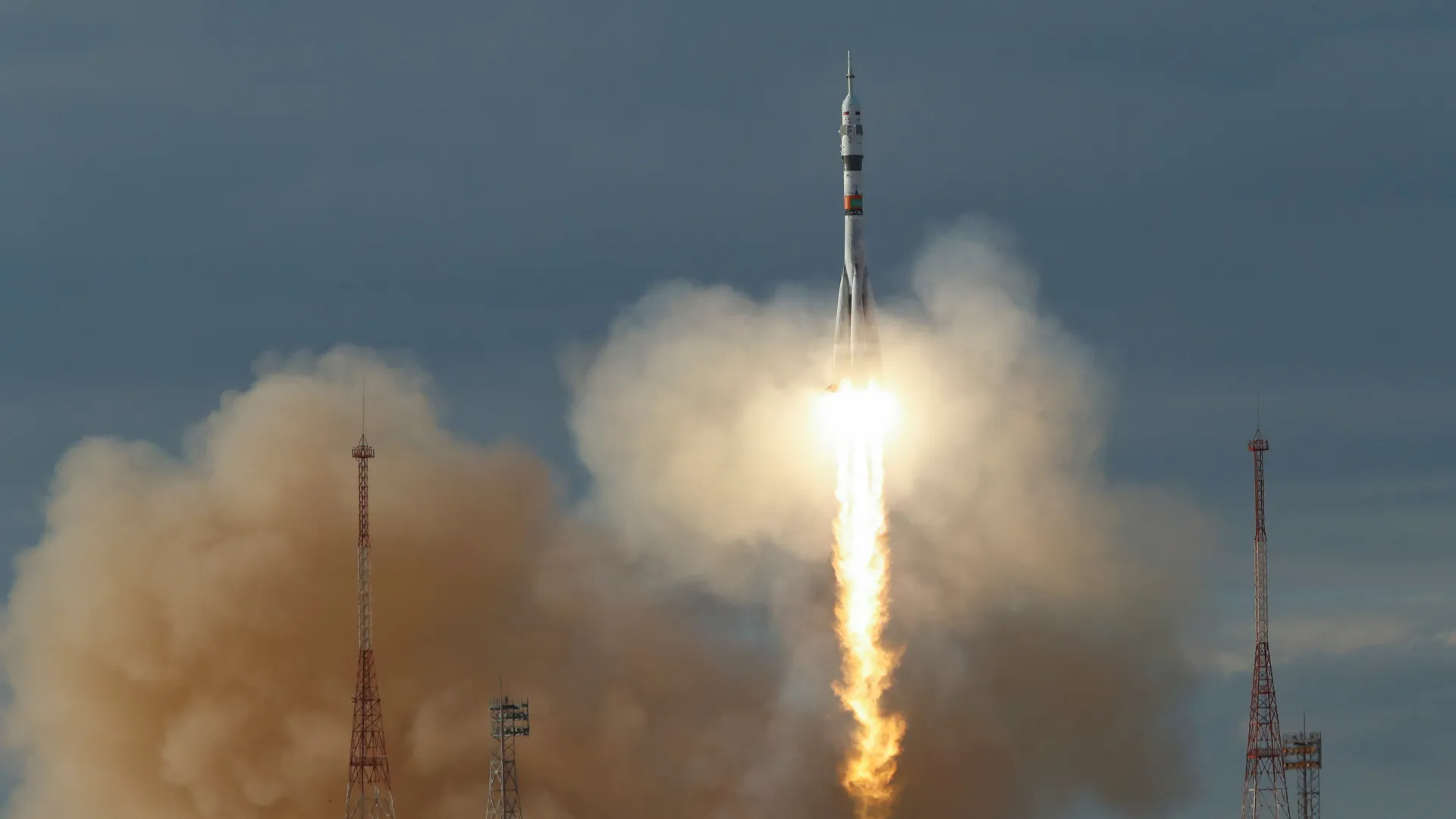
A Russian Spacecraft Manual Docking ISS cargo spacecraft is heading toward the International Space Station with a malfunctioning antenna, forcing mission controllers to abandon the automated docking procedure and hand control to a cosmonaut aboard the station itself. Roscosmos confirmed that the Progress MS-33 cargo ship, launched Sunday on a Soyuz-2.1a rocket from the Baikonur Cosmodrome in Kazakhstan, developed a fault in one of its KURS automated rendezvous antennas shortly after launch the critical system that normally guides the vehicle to a precision docking without human intervention.
Russian cosmonaut Sergei Kud-Sverchkov, currently serving as ISS commander, will take manual control and dock the cargo spacecraft on Tuesday at approximately 13:35 GMT. Roscosmos and NASA have both confirmed that all other systems aboard Progress MS-33 are functioning normally, and NASA stated that Roscosmos engineers are continuing to troubleshoot the antenna fault in parallel. The spacecraft is carrying approximately 2.5 tonnes of essential supplies food, water, fuel, and oxygen for the seven-person crew currently living and working aboard the station.
The situation, while requiring an unplanned change to mission procedures, does not represent a crisis. Manual docking is a practised and well-rehearsed capability within the Russian cosmonaut programme, and Kud-Sverchkov is an experienced operator. But the antenna failure on a brand-new spacecraft raises questions worth examining about the KURS system, about the redundancies built into cargo missions, and about what manual docking actually demands from the crew member performing it under the unique physical conditions of orbital spaceflight.
The History of Russian Cargo Missions and the KURS Docking System
The Progress spacecraft has been the workhorse of Russian space logistics for nearly five decades, first flying in 1978 as an unmanned derivative of the Soyuz crew vehicle designed to ferry supplies to the Soviet Salyut space stations. The basic concept has remained remarkably consistent across that entire period an expendable, automated cargo ship launched on a proven rocket, filled with consumables and equipment, docked to the station, unloaded over weeks, then filled with waste and deorbited to burn up in the atmosphere. What has evolved is the sophistication of the systems guiding the vehicle through rendezvous and docking.
Progress missions have supported continuous human presence in low Earth orbit across three different station programmes Salyut, Mir, and now the ISS accumulating a safety and reliability record that forms the foundation of confidence mission controllers place in each successive launch. The MS designation on Progress MS-33 refers to the modernised series introduced in 2015, which incorporated upgraded navigation computers, improved solar panels, enhanced telemetry systems, and updated docking equipment compared to the earlier M-series vehicles. Each incremental improvement was designed to increase the reliability and automation of a mission profile that the Russian programme has executed more than 90 times since the ISS partnership began.
The Soyuz-2.1a rocket that launched Progress MS-33 from Baikonur is itself one of the most extensively flown launch vehicles in history, derived from the original R-7 design that launched Sputnik in 1957. The fact that the fault identified on this mission is in the docking antenna rather than in the launch vehicle or propulsion system reflects the reality that even the most mature and proven hardware operates in an environment the thermal cycling, vibration, and vacuum of spaceflight that can stress individual components in ways ground testing does not always anticipate. A single antenna fault on an otherwise healthy spacecraft is a manageable anomaly, not a systemic failure.
The KURS Automated Rendezvous System: How Spacecraft Find the Station
KURS is the radio-frequency based automated rendezvous and docking system that Soviet and Russian mission designers developed in the 1980s, originally for use with the Mir space station, and which has been the primary guidance mechanism for both Progress cargo ships and Soyuz crew vehicles ever since. The system works by exchanging signals between antennas on the approaching spacecraft and corresponding equipment on the station itself, using those signals to compute the relative position, velocity, and orientation of the two vehicles in real time. As the spacecraft closes the distance from kilometres out to mere centimetres KURS progressively refines its guidance commands until physical contact is made and the docking latches engage.
The system is designed with redundancy in mind, which is why a single antenna fault does not automatically terminate the mission. KURS uses multiple antennas operating across different functions some handle long-range acquisition, others manage close-approach guidance and engineers work to determine whether the fault is limited to one antenna or affects the broader system. In the case of Progress MS-33, Roscosmos determined that the fault was significant enough to require shifting to manual docking rather than relying on the automated system to perform reliably through the full rendezvous sequence.
KURS has an extensive operational history with a strong reliability record, but it has experienced anomalies before, and the Russian programme's response has always been to maintain manual docking as a trained and practised alternative. This philosophy that automation should be backed by human capability rather than replacing it is embedded deeply in Russian space programme culture and reflects lessons learned through decades of operational experience with both successful missions and the handful of incidents, including a 1997 Progress collision with Mir, that shaped how risk is managed in orbital rendezvous operations.
Manual Docking in Space: A Skill Rooted in Soviet Engineering Philosophy
The decision to have Kud-Sverchkov manually dock Progress MS-33 draws on a tradition of manual spaceflight capability that the Soviet and Russian programmes have maintained as a philosophical and practical commitment throughout their history. Where American programme culture has tended to trust automation and computer systems as primary, Soviet designers from the earliest era maintained that cosmonauts must be able to fly and dock their vehicles by hand, treating human skill as a genuine backup rather than a theoretical last resort. That philosophy produced training regimes of considerable rigour that have persisted into the modern Roscosmos era.
Manual docking of a Progress cargo ship from the ISS is performed using the TORU system Teleoperated Control of Rendezvous a remote control interface inside the station that allows a cosmonaut to take over guidance of an approaching spacecraft using a joystick controller and a video feed from the cargo ship's cameras. The cosmonaut is essentially flying the approaching vehicle from inside the station, watching its camera view and making corrections to bring it into alignment with the docking port. Oleg Kononenko, head of Russia's Cosmonaut Training Centre, confirmed that manual ISS approach procedures are regularly practised during cosmonaut training, underlining that this is a rehearsed skill rather than an emergency improvisation.
Kud-Sverchkov's background makes him well suited to the task. As the current ISS commander, he holds the operational authority over the station's Russian segment and has accumulated the flight experience and simulator hours that manual docking requires. The fact that Roscosmos announced the manual docking plan promptly and with clear confidence reflects institutional trust in the process this is an organisation that has performed manual dockings before, that knows what the procedure requires, and that treats it as a routine contingency rather than a cause for alarm.
Tuesday's Manual Docking and the Crew Awaiting Supplies
The seven men and women currently living and working aboard the International Space Station represent one of the most internationally diverse crews in the programme's history, drawn from three space agencies across two continents. On the Russian side, Sergei Kud-Sverchkov serves as station commander alongside fellow cosmonauts Sergei Mikayev and Andrei Fedyaev. NASA has three crew members aboard Christopher Williams, Jessica Meir, and Jack Hathaway. France's Sophie Adenot, flying under the European Space Agency programme, completes the seven-person complement currently occupying the orbital laboratory approximately 400 kilometres above Earth.
Progress MS-33 is carrying approximately 2.5 tonnes of supplies that this crew depends on for continued operations, including food, drinking water, fuel for orbital reboost manoeuvres, and oxygen for the station's atmosphere. These are not optional or supplementary resources they are the consumables that sustain human life and station functionality in an environment where resupply is the only alternative to depletion. The ISS maintains buffer stocks specifically to handle delays in cargo arrivals, so Tuesday's manual docking procedure does not place the crew in any immediate resource stress, but timely delivery of supplies is always a logistical priority in station operations.
The crew's awareness of the antenna situation and the planned manual docking procedure will have been communicated through regular ground-to-station communications, and from Kud-Sverchkov's perspective the preparation for Tuesday's docking began the moment Roscosmos identified the KURS fault and made the decision to switch to TORU. Station operations have enough planned activity at any given time that a manual docking adds complexity to the schedule rather than disrupting it the procedures are known, the equipment is ready, and the crew is trained. The ISS is, in many respects, specifically designed to handle exactly this kind of technical contingency without losing operational continuity.
What Actually Happens During a Manual Docking at the ISS
Tuesday's docking procedure will unfold across a carefully sequenced approach that begins when Progress MS-33 is still several kilometres from the station and closes over a period of roughly 30 minutes as Kud-Sverchkov monitors the spacecraft's approach using TORU's camera feeds and makes real-time corrections. The cargo ship's own propulsion system executes each correction command relayed through the TORU interface, slowing and aligning as it closes the final distance. Throughout the approach, Kud-Sverchkov will be monitoring relative velocity, alignment with the docking port axis, and any lateral drift that requires correction — a three-dimensional coordination task that demands sustained concentration and precision.
Ground controllers in Moscow at the Mission Control Centre will be monitoring every parameter of the approach in real time, providing data and voice communications to support Kud-Sverchkov throughout the procedure. The parallel team of engineers working on the KURS antenna fault will continue their troubleshooting during this period if a fix is identified before docking, it would theoretically allow a switch back to automated guidance, but at this stage the manual approach is the confirmed plan and the crew and ground are prepared to execute it. The 13:35 GMT docking time announced by Roscosmos reflects the orbital mechanics of when the geometry between the approaching cargo ship and the station is optimal for the procedure.
NASA's confirmation that all other systems on Progress MS-33 are operating normally is important context for understanding the scale of the problem. The antenna fault is real and significant enough to change the docking approach, but it has not compromised the cargo ship's propulsion, power, navigation, or life support systems. The spacecraft that Kud-Sverchkov will dock on Tuesday is healthy in every dimension except for the one antenna that would have guided it in automatically and the human substitute for that antenna is an experienced ISS commander with a joystick, a camera feed, and a training programme that prepared him for exactly this moment.
What the Antenna Fault Reveals About Space Hardware Reliability
Every anomaly on a spacecraft in flight, however well managed, is a data point that engineers study carefully to understand whether it reflects a random component failure, a design vulnerability, or a manufacturing or testing gap that needs to be addressed in future vehicles. The KURS antenna failure on Progress MS-33 will be subjected to exactly that kind of root-cause investigation not in a spirit of alarm, but in the methodical continuous improvement culture that has kept Russian cargo missions operating reliably across five decades of spaceflight. Roscosmos engineers are already troubleshooting, and the data from this mission will feed directly into quality assurance processes for subsequent Progress and Soyuz vehicles.
The broader lesson the anomaly reinforces is one that experienced space operations professionals already know: spaceflight hardware operates in an environment extreme enough that component failures will occur across a large enough fleet and long enough timeline, and the measure of a mature programme is not the absence of failures but the depth of its contingency preparation. Manual docking capability, redundant systems design, trained crew responses, and real-time ground support are all expressions of that preparation. The Russian programme's ability to pivot from automated to manual docking within hours of identifying the fault, without drama and without endangering the spacecraft or its cargo, is itself evidence of a programme that takes contingency management seriously.
The ISS partnership between NASA, Roscosmos, ESA, JAXA, and CSA has operated for over two decades in part because each agency brings different strengths and different redundancies to the shared enterprise of keeping humans in space continuously. Russian manual docking capability is one of those strengths — a human skill embedded in a programme culture that treats automation as a tool and the trained human as the ultimate backstop. Tuesday's docking will demonstrate that principle in practice, 400 kilometres above the surface of the Earth, at 13:35 GMT.