
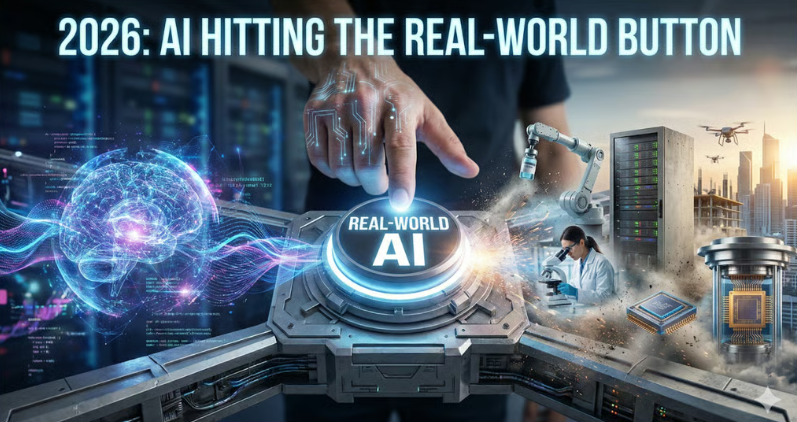
Tech Trends 2026 marks a defining moment for global enterprises, as organizations move beyond pilot projects to generate measurable business impact from artificial intelligence and advanced technologies. New global analyses, led by Deloitte’s 17th Annual Tech Trends report, show that innovation is accelerating faster than ever, with enterprises shifting their focus from experimentation to deep, strategic transformation.
“This is the year AI stops being an experiment and starts becoming infrastructure,” the report notes, emphasizing outcome-driven adoption across industries.
A New Era for Enterprise Technology
The defining narrative of Tech Trends 2026 is not about adopting more tools, but about fundamentally redesigning how work gets done. Deloitte’s research highlights a critical shift in organizational mindset: rather than layering AI onto legacy systems, leading businesses are rebuilding processes and technology foundations to unlock genuine value.
This strategic reset is reshaping operations across manufacturing, finance, healthcare, logistics, and professional services.
Five Trends Defining Tech Trends 2026
1. AI Goes Physical Robots Leave the Lab
AI is no longer confined to digital environments. Intelligent robots and autonomous systems are now operating in real-world settings, learning and adapting in complex physical environments from factory floors to supply chains.
This convergence of AI and robotics represents a new phase of automation, moving well beyond pre-programmed task execution.
“AI systems are increasingly interacting with the physical world, not just analyzing data,” the report highlights.
2. The Rise of the Agentic Workforce
Another major insight from Tech Trends 2026 is the emergence of AI agents as active participants in work. While many organizations are experimenting with AI agents, only a small percentage have scaled them into production environments.
Leading enterprises are redesigning workflows to support hybrid human-machine collaboration and establishing governance frameworks for these digital counterparts.
3. An AI Infrastructure Reckoning
As AI deployments grow, traditional cloud-centric infrastructure models are proving expensive and inefficient. Deloitte finds that enterprises are shifting toward hybrid architectures that combine cloud flexibility, on-premises reliability, and edge computing responsiveness.
This balanced approach helps organizations manage performance, cost, and scalability for AI workloads.
4. Rebuilding Technology Organizations
AI is also transforming the structure of IT and technology teams. Traditional roles focused on maintenance and support are evolving into strategic leadership functions.
Technology leaders are reorganizing around modular, outcome-oriented architectures, prioritizing measurable business results and human-AI collaboration over incremental process improvements.
5. The AI Cybersecurity Paradox
While AI enhances productivity and innovation, it also introduces new security risks. Cyber threats now operate at machine speed, outpacing traditional defense models.
Deloitte emphasizes the need to embed AI-driven security measures including automated threat detection and adversarial training directly into enterprise cybersecurity strategies.
Why Tech Trends 2026 Matters
According to Deloitte, innovation timelines are shrinking dramatically. Technologies that once took decades to reach scale are now achieving global adoption in months.
This compounding effect means organizations that adapt quickly can redefine their industries, while those that delay risk falling permanently behind.
External industry surveys reinforce this outlook, showing growing confidence among CFOs and executives, with most firms planning increased investment in AI and advanced technologies to drive productivity.
From Pilots to Purpose
In Tech Trends 2026, the conversation has fundamentally changed. Leaders are no longer asking what AI can do they are asking how it delivers measurable impact.
The organizations that succeed will be those that align AI investments with real business outcomes, redesign processes for AI-native operations, and build resilient, adaptable infrastructures capable of evolving alongside rapid technological change.