
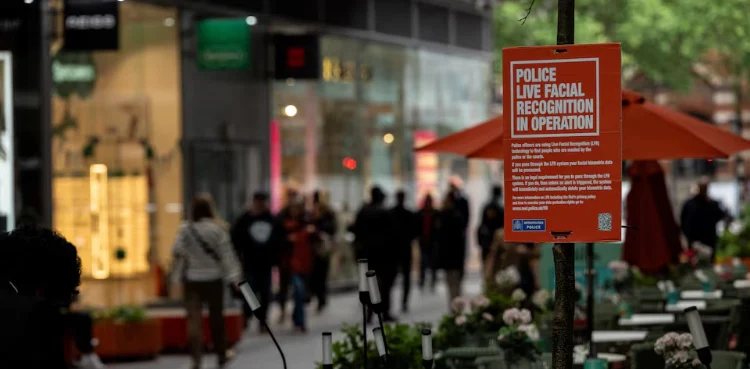
London facial recognition police live surveillance 2026 has become one of the most contested frontiers in the debate between public safety and civil liberties, with the Metropolitan Police reporting that live facial recognition cameras scanning faces against a police watchlist have helped officers arrest approximately 2,500 wanted people since the start of 2024, including suspects accused of violent and sexual offences, while civil liberties campaigners warn that the technology is creating a nation of suspects tracked from the moment they leave their homes with profound consequences for privacy, free speech, and freedom of association. The deployment is now routine in busy London streets, with tourists, shoppers, and office workers in Victoria and other central London locations finding themselves part of digital identity checks without any individual suspicion being required, and a recent operation in Victoria resulting in six arrests for offences including threats to kill, a breach of a court order, and possession of a lock knife. The technology's expansion received legal validation last month when a High Court judge rejected a judicial review challenge brought by civil liberties group Big Brother Watch, ruling its use lawful and clearing the way for expanded deployment including the first use of live facial recognition at a protest, which campaigners described as an Orwellian development with alarming implications for democratic rights.
Met Police director Lindsey Chiswick, the national and Metropolitan lead for live facial recognition, called the technology's impact groundbreaking for policing in London, citing a case in which a convicted paedophile was identified as he walked along the street holding hands with an eight-year-old girl, resulting in his return to prison. Chiswick defended the accuracy and proportionality of the system, which converts faces into biometric data and compares them against a watchlist of approximately 17,000 people compiled mainly from custody images, noting that of the more than 3 million faces scanned in the 12 months to last September, the system generated just 10 false alerts, all of which officers determined were incorrect before any arrest was made. She also cited polling suggesting that 80 percent of Londoners support the Met's use of the technology in quarterly surveys, framing public backing as validation of a policing approach that critics characterise as fundamentally incompatible with the presumption of innocence that underpins British law.
The civil liberties concern is not primarily about the system's accuracy but about the principle it embodies, with Big Brother Watch's senior legal and policy officer Jasleen Chaggar arguing that biometric identity checks cannot become a prerequisite for free speech and that the technology is normalising mass surveillance in public spaces. The deployment at an anti-immigration march in central London last weekend, the first time live facial recognition had been used at a protest, crystallised the civil liberties concern most sharply because it created the direct connection between the surveillance technology and the exercise of democratic rights that protest represents, rather than limiting its use to the crime detection context in which public support is strongest. The Met said it had deployed the system at approach points to the march rather than on the route itself after receiving intelligence of a possible safety threat, but Big Brother Watch argued the distinction was insufficient to address the chilling effect that biometric screening has on people's willingness to exercise their right to peaceful assembly.
How Live Facial Recognition Came to London's Streets and the Legal Battles That Shaped Its Deployment
Britain's long history as one of the world's heaviest users of CCTV cameras in public spaces provided the cultural and institutional foundation for the Metropolitan Police's adoption of live facial recognition as a natural extension of the surveillance infrastructure that Londoners have been living within for decades. With individuals potentially being captured on film up to several hundred times a day moving around London, the addition of a system that converts those camera feeds into active identity checks against a watchlist of wanted individuals represents a qualitative rather than simply quantitative change in the surveillance relationship between the state and its citizens, because the CCTV footage was previously recorded and reviewed retrospectively while live facial recognition creates real-time identification and intervention capability. The technological shift from passive recording to active biometric matching is the specific change that civil liberties groups argue fundamentally alters the character of public space surveillance in ways that the volume of cameras alone did not.
The watchlist of approximately 17,000 people against which the system compares scanned faces is compiled mainly from custody images, a specific evidentiary basis that connects the targeting to the established criminal justice process rather than to entirely speculative threat assessment, but whose 17,000-person scale means that any individual street in London is being scanned for presence of a person from this substantial database on each LFR deployment. The system's specific technical design, which Chiswick described as a very fleeting engagement of two biometric templates that is then destroyed forever, is intended to address privacy concerns by ensuring that the biometric data generated from faces that do not match the watchlist is not retained, but civil liberties groups argue that the scanning itself constitutes a search of sorts and that the destruction of non-matching data does not undo the intrusive character of a biometric check applied to every person who passes the camera without any suspicion specific to that individual.
The accuracy statistics that Chiswick cited, 10 false alerts from more than 3 million scanned faces over 12 months, represent a false positive rate of approximately 0.0003 percent that is extraordinarily low for a biometric identification system deployed in real-world conditions and reflects significant technological improvement from the earlier generation of facial recognition systems that produced much higher error rates and that generated the most damaging examples of misidentification used in early civil liberties challenges to the technology. The absence of any arrest based on a false alert is the strongest specific rebuttal to the wrongful arrest concern that accuracy-focused critics have raised, though the one case in Victoria where a man was stopped and questioned before being released indicates that false alerts can still produce liberty-restricting encounters even when thFacial recognition cameras on London streets raise concerns over security and civil liberties.ey do not result in arrest.
The Legal Battle and What the High Court's Ruling Established
Big Brother Watch's judicial review challenge, which a High Court judge rejected last month, was the most significant legal test of live facial recognition's lawfulness in Britain to date, and its failure has cleared the legal path for the expanded use that the Met has been pursuing and planning. The challenge argued that the deployment of live facial recognition without individual suspicion violated privacy rights protected by the Human Rights Act and the Data Protection Act, with particular focus on the proportionality of scanning millions of innocent people's faces to identify a small number of wanted individuals. The High Court's rejection of this challenge established that within the current legal framework the technology's use is lawful, while simultaneously prompting the government to develop a new legal framework that will presumably provide more specific legislative authorization and regulatory oversight for the technology's continued and expanded use.
The case of the community worker who was wrongly identified in an earlier LFR deployment, whose inclusion in the legal challenge represented the human face of the misidentification concern, was part of a broader pattern of wrongful identification cases in LFR's earlier deployment history that generated significant civil liberties attention and political controversy. The improvement in the system's accuracy statistics since those earlier cases reflects both technological improvement and the operational protocols that the Met has developed through its deployment experience, but the wrongful identification concern extends beyond accuracy to the question of what interactions police can legitimately initiate with individuals based solely on a biometric alert from a surveillance system. An individual who is stopped, questioned, or briefly detained based on a facial recognition alert that turns out to be incorrect has experienced a liberty-restricting police interaction that would not have occurred without the technology, regardless of whether the interaction resulted in arrest.
The Protest Deployment, the Government's Framework, and the Liberty Debate's Next Phase
The first deployment of live facial recognition at a protest, used at an anti-immigration march in central London last weekend, represents the most consequential expansion of the technology's scope since its initial deployment in crime detection contexts, because it creates the direct intersection between biometric surveillance and the exercise of democratic rights that civil liberties groups have been warning would eventually occur. The Met's justification that intelligence indicated a possible safety threat from someone attending the march is consistent with the lawful use parameters established by the High Court ruling and with the general principle that specific threat intelligence can justify more intrusive policing measures, but Big Brother Watch's argument that biometric identity checks cannot become a prerequisite for free speech addresses a more fundamental concern about the chilling effect that surveillance has on political participation regardless of whether the individual being scanned poses any threat.
The distinction the Met drew between deploying LFR at approach points to the march rather than on the route itself may be operationally significant but is not politically satisfying to protest organisers and civil liberties groups who argue that the scanning of people as they approach a demonstration creates the deterrent effect on participation that any person concerned about their biometric data being checked against a police database would feel. The chilling effect on political assembly is not limited to people who are on police watchlists and therefore face the risk of arrest, but extends to the population of entirely innocent people who may choose not to attend a demonstration they would otherwise have participated in because they do not want their biometric data involved in a police check. This chilling effect on legitimate democratic participation is the harm that Big Brother Watch characterises as profound for rights to privacy, free speech, and freedom of association.
The government's work on a new legal framework for live facial recognition, announced in the wake of the High Court ruling that validated the current deployment while suggesting the need for more specific legislative guidance, represents the legislative opportunity to establish clear boundaries for the technology's use that could address some civil liberties concerns while preserving the crime detection capability that the Met cites as groundbreaking. The framework's design will determine whether LFR deployment at protests becomes a standard option available on the basis of any threat intelligence, or whether political assembly receives specific additional protection that limits biometric surveillance in the context of democratic participation in ways that other public space deployments do not require. Civil liberties groups, policing representatives, parliamentary committees, and the government's own human rights advisers will all be stakeholders in a framework design process whose outcome will shape the relationship between biometric surveillance and civil liberties in Britain for years.