
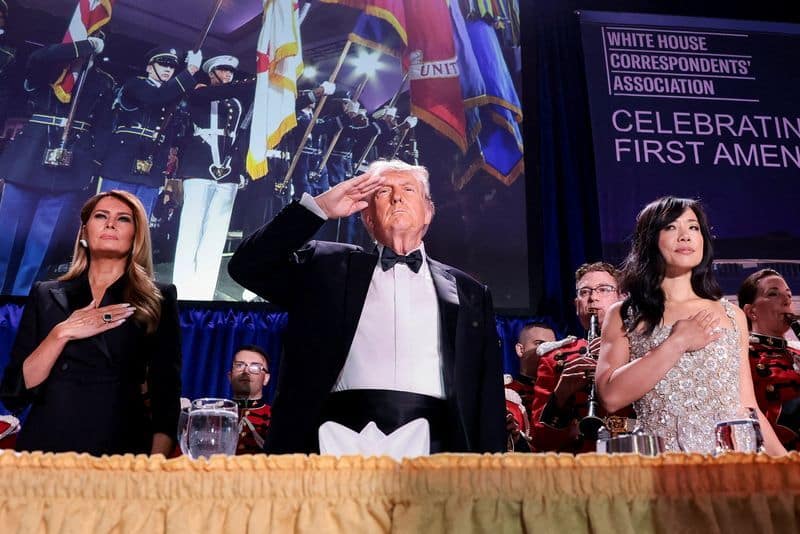
For the first time in his presidency, Donald Trump sat at the White House Correspondents' Association dinner and delivered a speech to the journalists, politicians, and administration officials whose relationship with him has been one of the defining tensions of his political career. The event, a Washington institution for more than a century, finally received its presidential guest on Friday at the Waldorf Astoria hotel, three months after the original April 25 gathering at the Washington Hilton was abandoned when a man fired a shotgun outside the ballroom as Trump White House and members of his cabinet were taking their seats.
What followed on Friday was a more than hour-long speech that mixed the self-deprecating humor that the dinner's tradition requires with the political attack lines that have characterised Trump's rallies for nearly a decade, producing the specific combination of entertainment and provocation that defines his public performance style and that made his first presidential WHCA appearance simultaneously more conventional and more combative than either his supporters or his critics anticipated.
The evening matters beyond the jokes and the barbs. It sits at the intersection of several significant American political and media dynamics whose tension the WHCA dinner has historically embodied more clearly than any other annual Washington event: the First Amendment's guarantee of press freedom versus a president who has sued media organisations and restricted journalist access, the tradition of presidential accountability through humor versus the normalisation of political grievance through a prestigious platform, and the fundamental question of whether a democracy's annual celebration of press freedom has the same meaning when the president attending it has been accused by hundreds of journalists of systematically undermining the freedoms the event celebrates.
An Hour of Humor, Attacks, and the Defiance That Defined the Night's Tone
The rescheduled dinner was held under heightened security at the Waldorf Astoria rather than the Washington Hilton, a venue change whose practical necessity reflected a security threat assessment but whose symbolic dimension of a scaled-down event at a more controlled location was not lost on the journalists and press freedom advocates who had urged the correspondents association to use the occasion to explicitly condemn what they characterised as Trump's First Amendment attacks.
The evening opened with defiance. Trump's statement that we do not yield to political violence and that no deranged loser with a gun will ever change that was one of the night's genuinely unifying moments, expressing a sentiment shared across the political spectrum and giving the event an emotional grounding that transcended the partisan divisions the subsequent speech would return to. The honoring of Secret Service officer Victor Gonzales, who was shot at the security checkpoint while wearing a protective vest and is credited with stopping the attack, and the Waldorf Astoria and Washington Hilton staff who assisted guests in April, provided the specific human acknowledgment of individual courage that the evening required before moving into its more contested territory.
Trump's claim to believe in the free press more than anyone in the room, paired immediately with his acknowledgment that maybe not quite, established the self-aware ironic mode that the speech opened in before its shift toward more familiar attack territory. His observation that he considered himself the most open and transparent president in history, noting they call me that without specifying who they might be, was the specific kind of factually contestable self-characterisation delivered with the wink of self-awareness that makes Trump's humor at its most effective simultaneously funny and provocative.
The substance of the access argument he made deserves separate consideration from the rhetoric that surrounded it. Trump argued, with genuine factual basis, that his practice of engaging in frequent question-and-answer sessions with reporters and personally taking phone calls from many of them represents a form of presidential press access that contrasts with more media-controlled approaches. The transactional reasoning he articulated, that engaging with the press gives you a shot at a good story while silence guarantees a bad one, is the specific media strategy logic of someone who has spent four decades managing his relationship with journalism and whose assessment of the transactional character of that relationship is more accurate than the mutual antagonism narrative that his public posture and the press freedom advocates' criticism both suggest.
The April Shooting, the Rescheduling, and What This Dinner Represents
To understand why Friday's event carries the weight it does, the April 25 shooting requires direct engagement. Cole Allen, the suspect, pleaded not guilty in May to charges including attempting to assassinate the president after trying to force his way through a security checkpoint and firing a shotgun outside the ballroom where Trump and his cabinet were seated. The attack represented the specific category of political violence whose occurrence at an event celebrating press freedom created the compound symbolism that security officials, WHCA leadership, and the administration all had to manage in deciding how to reschedule.
The decision to reschedule rather than cancel entirely was itself significant. WHCA could have determined that the security risk, the political controversy, or the complications of rescheduling made a 2026 event impossible and waited for 2027. The decision to proceed, at a smaller venue with heightened security and a changed entertainment format, represented a specific institutional commitment to the event's meaning that the opening defiance statement articulated. Journalism organizations use the phrase we do not yield to political violence in full awareness of both its literal truth and its symbolic significance as a statement about institutional resilience.
The hundreds of veteran journalists and eight professional journalism organizations who signed a letter urging the correspondents association to use the dinner to condemn Trump's First Amendment attacks created the specific internal pressure within the journalism community that the WHCA had to navigate. The decision not to make explicit condemnation the event's centerpiece, but instead to proceed with the traditional format that includes a presidential speech, was the WHCA's specific institutional choice whose rationale, preserving the dinner as a genuine press-president encounter rather than converting it into a protest event, is legitimate even as it disappointed the letter's signatories.
Trump's own decision to attend, having boycotted the event during all four previous years of his presidency, is significant regardless of how the speech itself is evaluated. Boycotting the correspondents' dinner had been Trump's specific signal of contempt for the event's premise, a refusal to participate in what he clearly viewed as a Washington establishment ritual whose celebration of press freedom he did not endorse. Attending the rescheduled event, with the promise to return next year, represents a different signal even if the speech's content recycled many of the attack lines whose rallying-cry character was not softened for the black-tie audience.
The WHCA Dinner's History and How 2026 Fits Into a Long Story
1914: The White House Correspondents' Association is founded, creating the first formal organization of White House press corps journalists. The annual dinner begins its more than century-long tradition of gathering journalists, politicians, and the president for an evening that combines scholarship fundraising with the specific Washington ritual of powerful people laughing at themselves.
1924: Calvin Coolidge becomes the first president to attend the dinner, establishing the presidential participation tradition that has continued through every administration, with varying degrees of presidential enthusiasm, until Trump's four-year boycott in his first term.
1983 to 2011: The dinner expands into a major Washington event with celebrity attendance, sponsor tables, and the post-dinner party circuit that gives it the nickname nerd prom and makes it both more commercially significant and more culturally complicated as a press freedom celebration whose celebrity glam can overshadow its journalistic purpose.
2011: President Obama delivers the correspondents' dinner speech that directly mocks Donald Trump, who is seated in the audience, in an exchange that multiple reporting accounts have identified as a formative moment in Trump's decision to run for president.
2017 to 2024: Trump boycotts the White House Correspondents' Dinner during all four years of his first term, instead holding campaign-style rallies on the same evenings in an explicit counter-programming choice that expressed his contempt for the event while maintaining the political energy of his base.
April 25, 2026: The original rescheduled dinner at the Washington Hilton is abandoned when Cole Allen fires a shotgun at a security checkpoint outside the ballroom. Victor Gonzales is wounded. Trump and his cabinet are escorted from the venue. The attack creates the specific security and political challenge whose management the WHCA and the administration must navigate in the following months.
May 2026: Cole Allen pleads not guilty to charges including attempting to assassinate the president.
July 25, 2026: The rescheduled dinner is held at the Waldorf Astoria under heightened security. Trump delivers his first-ever presidential appearance at the WHCA dinner in a speech lasting more than an hour. Entertainment is provided by mentalist Oz Pearlman rather than the traditional stand-up comedian.
What Trump's WHCA Attendance Signals About His Second Term Media Strategy
Trump's decision to attend the correspondents' dinner after four years of boycott in his first term reflects the specific evolution in his administration's media strategy that his more frequent direct press engagement in the second term has expressed through other channels as well. The argument he made at the dinner, that engaging with the press gives you a shot at a good story, is not new but its articulation in the correspondents' dinner context represents a more strategic framing of press relations than the pure adversarialism that characterised much of his first term's public posture.
Press freedom advocates' criticism of the Trump administration rests on specific documented actions: lawsuits filed against media organisations including ABC News and CBS News, restrictions on some journalists' access to White House briefings and events, and threats of regulatory action against broadcasters whose licence renewals the administration has indicated could be challenged. These are not rhetorical attacks but institutional actions whose cumulative effect on media organisations' editorial independence is a legitimate subject of public concern regardless of the administration's framing of each individual action as accountability enforcement rather than press suppression.
Trump's counter-framing, that his engagement through press conferences, phone calls to journalists, and general accessibility represents unprecedented transparency, contains specific factual elements that his critics' dismissal of his press freedom record tends to underweight. Modern presidents' press access records are legitimately complicated, with the frequency of formal press conferences, informal gaggles, pool spray participation, and journalist phone call practices all contributing to the total access picture whose evaluation requires more granular analysis than the press freedom versus press suppression binary that the WHCA dinner context tends to produce.
The specific targets of Trump's attacks at the dinner, journalists Don Lemon and Lawrence O'Donnell, politicians Chris Christie and Adam Schiff, and celebrities Bruce Springsteen and Jane Fonda, represent a mix whose combination is revealing. Attacking journalists by name at a journalism event is the specific provocation whose inclusion in a WHCA speech is unusual enough that its presence is itself a statement about how Trump views the event's audience. The politician and celebrity attacks represent the standard rally attack line inventory whose deployment at the correspondents' dinner treats the event as an extension of the political campaign rather than as the distinct institutional occasion it nominally represents.
What Press Freedom Attacks Mean for the Media Business
The economic impact of the Trump administration's press freedom record, as criticism characterises it, operates through several channels that affect the media industry's business environment in ways that go beyond the immediate financial costs of individual lawsuits.
The ABC News and CBS News settlements with the Trump administration, reached under the pressure of regulatory threat combined with the legal costs of prolonged litigation, represent the specific economic mechanism through which governmental pressure on media organisations translates into financial outcomes whose deterrent effect on editorial decision-making is the ultimate concern for press freedom advocates. A media organisation that settles a lawsuit brought by the administration it covers, on terms that include charitable donations to the administration's preferred causes, has made an economic decision whose editorial independence implications are difficult to quarantine from the reporting decisions that the same organisation's newsroom makes in the following months and years.
The advertising revenue dimension of political controversy around media organisations is an additional economic pressure whose effect on the media business model is significant. Advertiser concern about brand safety in politically controversial editorial environments has been a growing feature of the digital media landscape, with the specific targeting capability of digital advertising allowing advertisers to avoid individual articles or publishers associated with political controversy in ways that print advertising's placement limitations did not permit. Media organisations that are perceived as excessively combative toward the Trump administration face the specific advertiser concern that their editorial positioning reduces their advertising value.
What American Press Freedom Means for Democratic Norms Globally
The state of press freedom in the United States is not merely an American domestic concern. The US has historically positioned itself as a global advocate for press freedom, using its diplomatic relationships and aid programmes to press for journalist protection in countries whose governments suppress reporting, imprison journalists, and restrict information flows that democratic accountability requires. The credibility of that advocacy depends on the domestic press freedom environment whose standard the US projects internationally.
Reporters Without Borders ranks countries' press freedom environments annually, and the United States' position in those rankings has been falling for years, reflecting the assessed impact of both first and second Trump term press freedom conditions. When the US government makes representations to authoritarian governments about journalist protection and press freedom, those representations carry less weight to the extent that the US's own press freedom record is credibly criticised by the same international organisations whose standards the diplomatic arguments invoke.
The WHCA dinner's century-old tradition of celebrating the First Amendment and the press's role in democratic accountability has global resonance specifically because it represents the specific institutional expression of American democratic press culture. Foreign journalists and media organisations watch the event as a barometer of American press freedom health, and an event at which the president spends more than an hour recycling political attack lines while the journalism organisations that should be the event's institutional voice have publicly called for explicit First Amendment condemnation that the event's format did not deliver presents a complicated picture of that health.
What Press Freedom Specialists Say About Trump's WHCA Attendance
Media freedom specialists and First Amendment scholars have consistently distinguished between the forms of governmental press hostility whose legal and institutional consequences are most severe and the rhetorical adversarialism whose political function is different from its legal impact.
Calling journalists enemies of the people, attacking individual reporters by name at rallies, and characterising mainstream media coverage as fake news are all forms of press hostility whose democratic health implications are serious but whose direct legal and institutional impact on journalism's ability to function is limited compared to the economic pressure of lawsuits, the chilling effect of licence threat investigations, and the access restrictions that prevent specific journalists from covering the White House at all.
The WHCA dinner's specific significance in this analysis is what it reveals about the institutional relationship between the Trump administration and the journalism community. An administration that simultaneously attends the press freedom dinner and pursues regulatory and legal actions against media organisations is communicating through its actions a more complex message than the simple media antagonism that its rhetoric suggests, one whose specific implications for editorial independence require the kind of ongoing monitoring that press freedom organisations provide but that a single evening's event, however symbolically significant, cannot resolve.
Trump's Promised Return and What 2027's WHCA Dinner Will Look Like
Trump's promise to return to the correspondents' dinner next year creates the specific expectation that his 2026 attendance was not a one-time exception but the beginning of a regular presidential engagement with the event that his first-term boycott had suspended. What next year's dinner looks like will depend on the state of the administration's press freedom record, the journalism community's response to that record, and whether the specific moments of genuine connection that the 2026 dinner produced in the political violence defiance and the Victor Gonzales honoring can be sustained or whether the event reverts to the pure antagonism that its more contentious moments expressed.
For the WHCA itself, the 2026 dinner's mixed legacy, genuine moments of institutional significance alongside an hour of political attacks whose deployment at a press freedom event is inherently complicated, creates the specific programming and format questions that the organisation will need to address before 2027. The choice of a mentalist over a comedian reflects the specific post-April-shooting mood management calculation that avoided the traditional comedy format whose attack-on-the-president convention would have added another layer of political edge to an already charged evening. Whether 2027's entertainment returns to the comedy tradition or maintains a different format is among the organisational decisions whose outcomes will help define what the correspondents' dinner means in the Trump era.
What to Watch Next
Watch for the journalism community's assessment of the dinner's significance for the ongoing press freedom debates, including whether the WHCA's decision not to make explicit First Amendment condemnation the event's centerpiece satisfies, disappoints, or further motivates the hundreds of journalists who had called for a stronger institutional statement.
Watch for the Cole Allen assassination attempt prosecution's progress, whose legal proceedings will determine the specific accountability for the April shooting that disrupted the original event and whose case details may reveal additional information about the attack's circumstances and motivations.
Watch for the Trump administration's media relationship in the months following the dinner, including whether the specific access patterns that Trump cited as evidence of his transparency continue, and whether the lawsuits and regulatory actions that press freedom advocates have identified as their primary concerns advance, settle, or are dropped.
Watch for the 2027 correspondents' dinner planning, including the WHCA's decisions about venue, format, entertainment, and presidential engagement, whose choices will signal how the organisation has assessed the 2026 event's legacy and what adjustments the specific challenges of hosting a president who uses the platform as a political rally rather than a press freedom celebration require.