
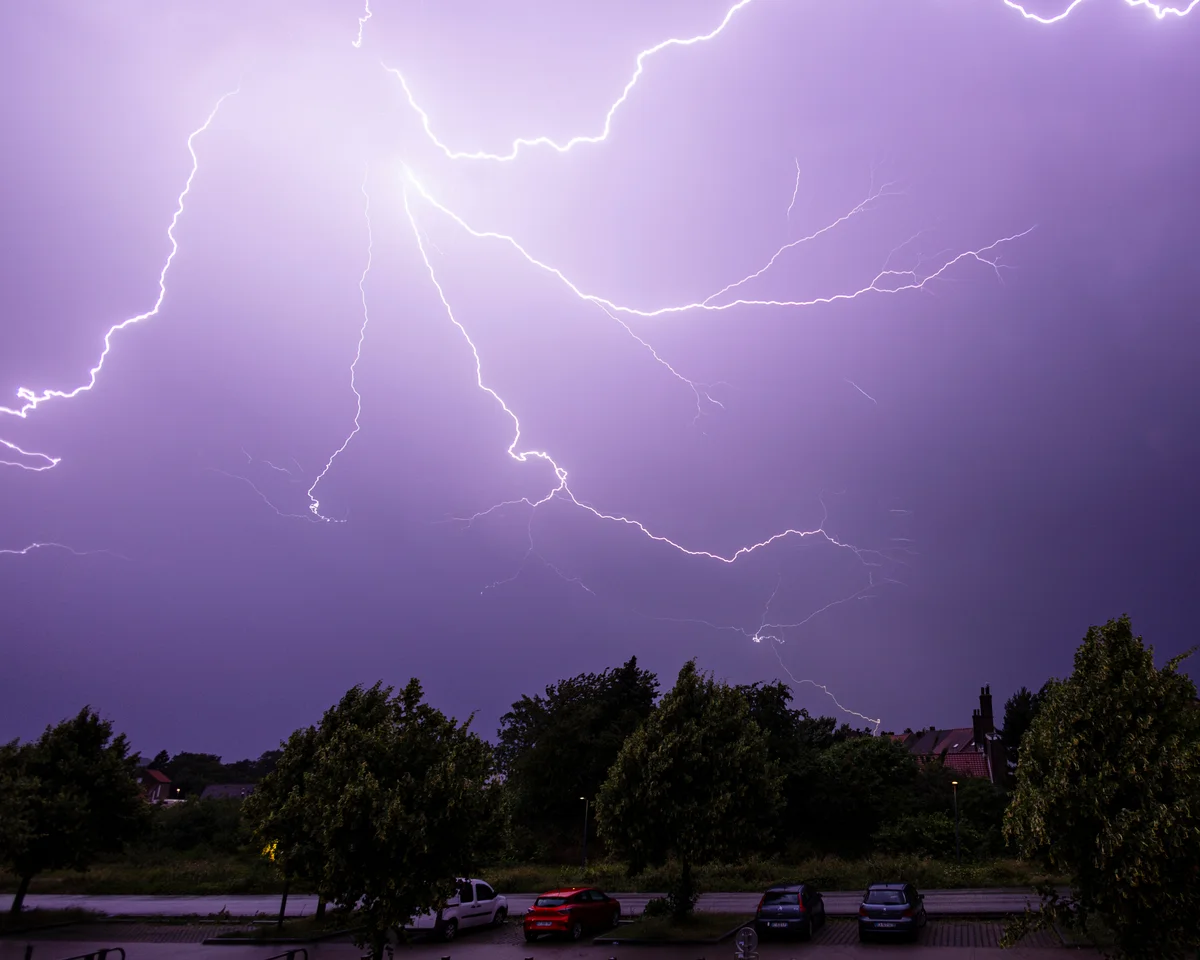
Violent thunderstorms swept across France thunderstorms overnight on Thursday, killing at least two people in separate incidents and leaving 53,000 households without power by Friday morning, according to French media reports and grid operator Enedis. The storms arrived after a prolonged period of heat across the country, a pattern in which trapped warm air eventually produces intense convective storm activity when the atmospheric conditions shift, bringing the kind of sudden and severe weather that causes disproportionate damage because communities have spent days in heat rather than preparing for violent wind and rain.
The first fatality occurred in Saint-Victurnien, in the central Haute-Vienne department, where a woman died after a tree fell on her on Thursday evening. Tree falls during storm events account for a significant share of weather-related fatalities in France each year, particularly when storms follow extended dry and hot periods during which root systems weaken and soil loses the moisture that anchors trees against high winds. The second death was reported in Dolomieu, to the east, where a man was found burned to death in a workshop that had caught fire after being struck by lightning. AFP reported both fatalities on Friday.
The two deaths, while individually tragic, also illustrate the two most common lethal mechanisms in summer thunderstorm events in France: structural damage from falling trees and wind-driven debris, and fire triggered by lightning strikes on buildings. Both risks are amplified when storms break suddenly after extended hot dry periods, because dry timber and vegetation ignite more readily and trees weakened by heat stress are more likely to fail under wind loading. The fact that both incidents occurred on the same night, in different regions of the country, reflects the broad geographic reach of the storm system that moved across France on Thursday.
Grid operator Enedis reported 53,000 households without power, with outages concentrated in Auvergne Rhone-Alpes and Nouvelle Aquitaine
Grid operator Enedis confirmed on Friday that 53,000 households had been left without electricity following the overnight storms. The power cuts were concentrated in two regions: Auvergne Rhone-Alpes in the southeast and Nouvelle Aquitaine in the southwest. These are large and geographically varied regions, and the distribution of outages across both the southeastern and southwestern parts of France reflects the scale of the storm system that passed through, which was not confined to a single corridor but affected a wide area from the Massif Central westward toward the Atlantic coast and eastward toward the Alps.
Power outages on this scale following summer storms are a familiar consequence of the French electricity network's exposure to falling trees and wind-damaged infrastructure. Overhead power lines running through forested and semi-rural areas are particularly vulnerable to storm damage, and the combination of post-heatwave weakened trees and sudden high winds creates conditions in which a large number of line faults occur in a short period. Enedis, which manages the distribution network, will have had repair crews working across both regions simultaneously to restore supply to the 53,000 affected households.
For the households affected, a power cut following a heatwave carries specific complications. Refrigerated food spoils more quickly in ambient temperatures elevated by days of heat, and those reliant on electrically powered cooling face an immediate welfare concern when supply is lost at the end of a hot period. The timing of the outage, overnight on Thursday into Friday, meant that repair and restoration efforts would have been conducted at least partly in darkness and potentially in continuing stormy conditions, adding to the logistical complexity facing grid engineers on the ground.
Météo-France had warned of large hailstones and wind gusts from the Massif Central to the Alps before lifting all orange alerts across southeastern departments on Friday.
Météo-France lifted all orange thunderstorm alerts across southeastern France on Friday after earlier warnings of large hailstones and severe gusts
France's national weather service, Météo-France, lifted the orange alert for thunderstorms across all the southeastern departments that had been subject to the warning on Friday. The lift followed the passage of the storm system through the region and indicated that the most severe weather had moved on. The orange alert level in France's colour-coded warning system indicates dangerous weather requiring heightened vigilance. Its application to the affected southeastern departments had followed Météo-France warnings of large hailstones and wind gusts affecting the area from the Massif Central to the Alps.
Large hailstones represent a distinct hazard category from wind and lightning, capable of damaging crops, vehicles and structures across wide areas in a short time. The combination of hail risk and wind gusts in the Météo-France warning indicated a storm system of significant intensity, consistent with the kind of convective weather that develops along the eastern flank of the Massif Central when humid Atlantic air meets the elevated terrain and triggers rapid upward movement of warm surface air. The lifting of the alert on Friday confirmed that the acute phase of the event had concluded, though the consequences in terms of deaths, power outages, and physical damage remained ongoing.
The broader context of the storms following a prolonged heatwave is significant for understanding both their intensity and their impact. Extended hot dry periods in France and across southern Europe have become more frequent in recent decades, and the storms that break them tend to be more violent than typical summer convective events because the accumulated heat energy in the lower atmosphere provides more fuel for rapid storm development. The sequence of heatwave followed by violent thunderstorm, with the associated casualties and infrastructure disruption, is a pattern that emergency services, grid operators, and regional governments across France have had to plan for with increasing regularity.