
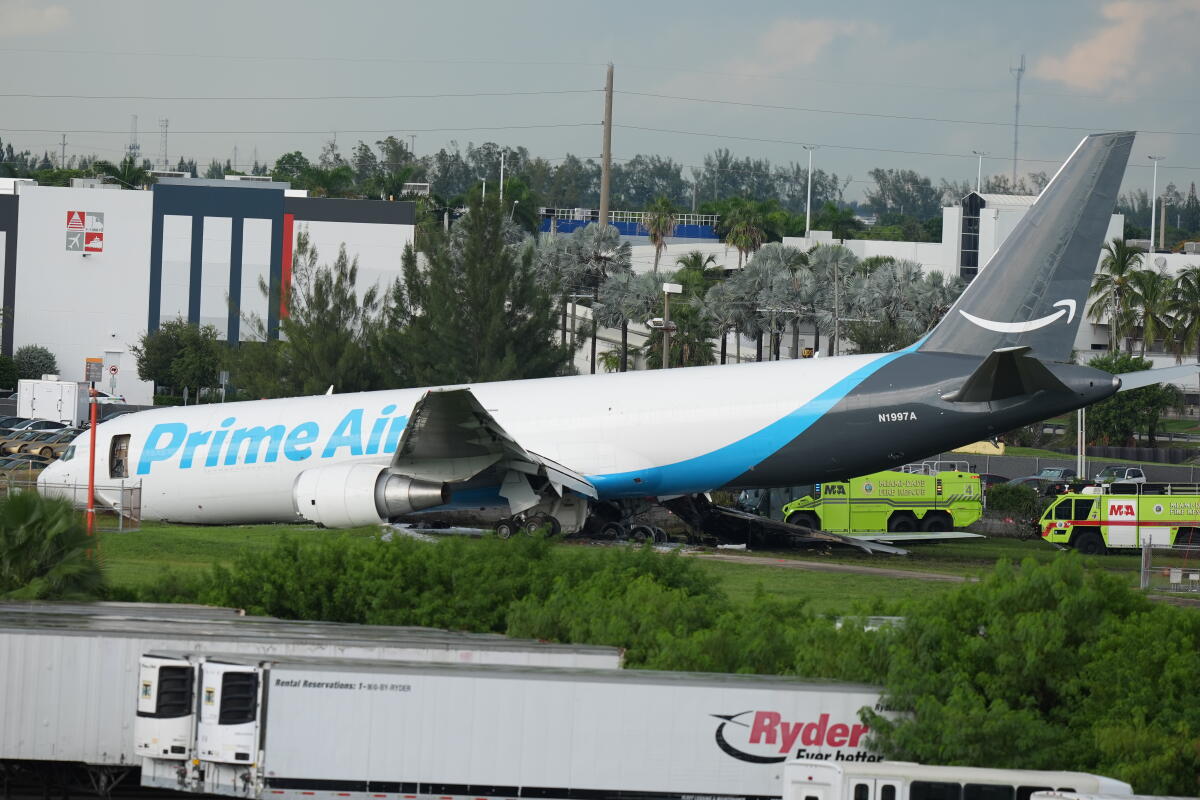
The amazon cargo plane crash that shook Miami International Airport on the afternoon of Sunday September 6, 2026, happened in seconds but will be felt for years. Five people are dead and five people are injured after an Amazon Air cargo plane from Puerto Rico overran a runway at Miami International Airport, Miami-Dade County Mayor Daniella Levine Cava said in a news conference Sunday evening. The images that emerged within minutes, thick black smoke rising above one of America's busiest airports, emergency vehicles surrounding a Boeing 767 that had come to rest in a field at the northwest end of the airport, personnel in hazmat suits working around the aircraft's leaking fuel, were not the images that thousands of Sunday afternoon travelers expected to see when they looked out of terminal windows and found their flight suddenly delayed, their plans suddenly secondary to someone else's catastrophe. This was not a distant aviation statistic. This was a runway in Miami, a Sunday afternoon, and five people were alive at 1:57 PM and were not alive an hour later.
What Happened: The Final 90 Seconds of Flight 7598
The Federal Aviation Administration said Prime Air Flight 7598 overran the runway while landing around 2 p.m. after departing from Luis Munoz Marin International Airport in San Juan, Puerto Rico, earlier Sunday. The Boeing 767-300, one of the workhorses of cargo aviation whose reliability record across commercial and freight operations has been one of aviation's benchmarks, came in from the Caribbean and never made it to a full stop.
The plane overran Runway 30, struck multiple vehicles and came to rest at a field next to the airport. Preliminary data from Flightradar24 shows the plane was going approximately 128 mph as it went off the runway. That speed, for a cargo aircraft at the point where it should have been decelerating toward a complete stop, is the specific number that investigators will be studying alongside the flight data recorder and cockpit voice recorder whose contents will eventually tell the story of what happened inside that cockpit in the final 90 seconds of the flight. Think about what 128 miles per hour feels like. Think about a vehicle that size moving at that speed and running out of runway. And then hitting vehicles. And then coming to rest in a field with fuel leaking and flames starting and emergency services racing to reach people who were trapped, injured, or already gone.
Miami-Dade Fire Rescue said Sunday that around 200 personnel responded to the incident and worked quickly to both conduct search and rescue and extinguish flames caused by the crash. "One person was trapped under one of the involved vehicles and had to be extricated by specialized MDFR technical rescue personnel," the department said in a statement. "Specialized MDFR hazardous materials units safely shut down the aircraft's engine and worked to mitigate a fuel leak."
Two hundred people responded to a single incident. That is the scale of what Sunday afternoon produced at Miami International Airport.
Who Operated the Aircraft: Amazon, 21 Air, and the Contractor Chain
One of the first questions that always follows a branded aircraft crash is the one about who was actually flying the plane. The Amazon branding on the fuselage is what the cameras captured and what the headlines reflect. The operational reality is more layered.
Amazon spokesperson Kelly Nantel said the flight was operated by 21 Air and was coming in to land when the incident occurred. The FAA confirmed that a Boeing 767-300 that departed from San Juan, Puerto Rico, was involved in the crash. The 767 is 32 years old and had originally flown as a passenger plane for several airlines before it was converted into a cargo plane in 2015, according to Flightradar24. A 32-year-old aircraft. Originally a passenger plane. Converted to cargo in 2015. Operating under contract to Amazon Air. Flying a Puerto Rico to Miami route on a Sunday afternoon in September.
21 Air CEO Keith Winters said the crash has left the company "devastated" and that it is cooperating with federal investigators. "Our deepest condolences are with the families and loved ones affected by this tragedy," Winters said.
The contractor model that Amazon uses for its Air cargo network, in which third-party carriers operate Amazon-branded flights under contract rather than Amazon directly employing the crews and maintaining the aircraft, is a standard industry arrangement whose regulatory and liability implications will be among the dimensions that NTSB investigators examine as part of their comprehensive review of what happened. When a branded plane crashes, the question of who bears operational responsibility, the brand or the contractor, is never answered simply.
Casualties and Emergency Response: The Human Cost
Five people are dead and five others are injured, three of them critically, Miami-Dade Fire Rescue said. There were a total of 10 patients, and MDFR transported five patients by ground. Three were transported to a local trauma center. The people who died on Sunday afternoon were not all on the aircraft. The plane struck multiple vehicles when it overran the runway, meaning that people on the ground, in those vehicles, at the edge of a runway they had no reason to believe was dangerous that Sunday afternoon, are among the dead. That specific dimension of the crash, the ground-level casualties whose presence transforms a runway overrun from an aviation incident into a collision disaster, is one of the elements that investigators will examine carefully in assessing the crash's full causal chain.
The Miami-Dade County Sheriff Rosie Cordero-Stutz was among the first senior officials to arrive at the scene. She confirmed the plane overran the runway at approximately 1:58 PM. What she saw at the scene is the specific kind of experience that first responders and senior officials carry with them long after the press conferences are over and the news cycle has moved on.
Two hundred emergency personnel. Fire. Fuel leak. People trapped under vehicles. Three in critical condition at the trauma centre. Two more at a local hospital. And five families who by Sunday evening had received the specific phone call that no family should ever receive.
What Amazon Said: The Statement That Carried the Weight of Loss
Corporate statements following disasters are often measured against the specific authenticity test of whether they sound like human beings or like liability management. Amazon's statement, delivered by spokesperson Kelly Nantel, passed that test.
"We're heartbroken to learn that five people lost their lives in today's incident at Miami International Airport," Kelly Nantel, a spokesperson for Amazon, said in a statement. "We're working closely with local authorities and officials to understand exactly what happened. Right now, our absolute priority is the safety, well-being, and care of everyone involved. We're doing everything we can to support those affected." Amazon will "cooperate fully with any investigation," Nantel added.
Heartbroken. It is the right word. Five people dead on a Sunday afternoon at a cargo airline hub is a specific tragedy whose human weight the word acknowledges. The commitment to full cooperation with the investigation is the correct institutional commitment. Whether Amazon's cooperation extends to the specific questions about contractor oversight, aircraft age, and maintenance records that the investigation will generate is the accountability test that will be measured against this initial statement over the coming months.
The Airport Shutdown: Miami International Paralysed
The Air Traffic Control System Command Center, part of the Federal Aviation Administration, issued the ground stop around 2:30 PM ET. Two of the airport's runways have since been reopened, according to Greg Chin, the communications director for the Miami-Dade Aviation Department. The ground stop was canceled after about three hours, but as of Sunday night, the average delay for a flight into the airport was about six and a half hours.
Six and a half hours of average delay. Miami International is one of the busiest airports in the United States, handling tens of thousands of passengers on a normal Sunday. A three-hour ground stop followed by hours of cascading delays affected not just the passengers already in the airport but the passengers on planes diverted or delayed across the eastern seaboard, creating the ripple of disruption that a single runway incident at a major hub produces across an interconnected air traffic network whose interdependence is invisible to most travellers until something goes wrong.
Transportation Secretary Sean Duffy said the ground stop was ordered so that first responders could assess the scene and warned travellers of "significant delays and potential cancellations."
He was right. Sunday evening in Miami's terminals was the specific experience of thousands of people managing itinerary collapses while, somewhere beyond their gate windows, investigators in high-visibility vests were beginning the long, careful work of documenting exactly what had happened on Runway 30.
What Investigators Know and What They Are Looking For
Both the FAA and the National Transportation Safety Board are investigating. The NTSB's investigation will be the definitive one whose findings, expected in a preliminary report within 30 days and a full report within one to two years, will establish the factual record of what caused the crash.
The specific questions that investigators will be pursuing include why the aircraft was travelling at approximately 128 miles per hour at the point where runway overrun occurred, what the aircraft's braking system performance record shows, what weather conditions existed at Miami International at 1:58 PM on September 6, whether the crew received any instrument or indicator warnings before the overrun, and what the 32-year-old aircraft's maintenance history reveals about its condition on the day of the crash.
The aircraft's age is a specific investigative focus not because age alone determines airworthiness but because the specific maintenance requirements, systems upgrades, and component replacement schedules that a 32-year-old converted aircraft requires are precisely the documentation whose examination reveals whether the aircraft was in the condition its airworthiness certificate assumed it to be.
The plane crash miami investigation will also examine the specific contractor oversight mechanisms that Amazon Air applies to its third-party operators, asking whether 21 Air's operational standards, training protocols, and maintenance practices met the specific requirements that flying Amazon-branded missions under the Amazon Air certificate requires.
Conclusion: From the Wreckage, the Work of Understanding Begins
The miami amazon plane crash of September 6, 2026, killed five people, injured five more, shut down one of America's busiest airports for hours, and raised the specific questions about cargo aviation safety, contractor oversight, and aircraft age management that every fatal aviation incident demands be asked honestly and answered completely.
The plane crash today search that millions of Americans ran on Sunday afternoon led them to images of smoke, emergency vehicles, and a Boeing 767 that had run out of runway and out of options at 1:58 PM on a Sunday afternoon in Miami. Those images will be part of the NTSB investigation's documentary record, part of the families' grief, and part of the specific public reckoning with aviation safety whose honesty depends on asking the uncomfortable questions that disaster always generates.
The amazon cargo plane crash happened. The five people who died cannot be brought back. The five who were injured are in hospital receiving the care that 200 emergency responders arrived in minutes to provide. The investigation has begun. The black boxes are being analysed. The maintenance records are being reviewed. The flight data is being processed.
What comes next is not closure. Closure is rarely what aviation investigations deliver to the families of the dead. What comes next is understanding. And from understanding, if the process works the way it is supposed to, comes the specific changes in regulation, oversight, maintenance standards, and operational protocols whose implementation makes the next Sunday afternoon at Miami International Airport safer than this one was.
Five people died. The investigation will ensure their deaths were not in vain.
Relevant Content For More Read...