
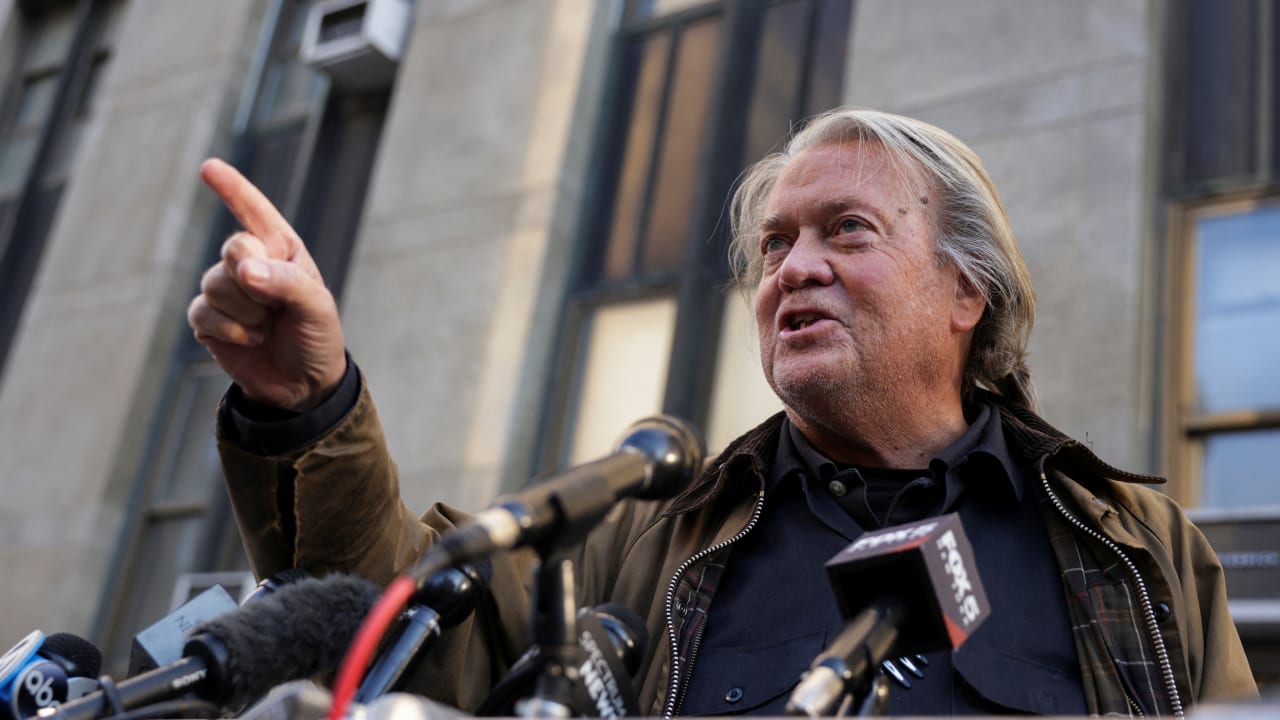
The US Supreme Court has cleared the way for the Justice Department to formally dismiss the criminal contempt of Congress case against Steve Bannon, one of President Donald Trump's most powerful, most controversial, and most politically influential allies in American public life. The Supreme Court issued its decisive order on Monday, throwing out a lower court ruling that had previously upheld Bannon's 2022 conviction on two separate counts of contempt of Congress stemming directly from his refusal to cooperate with the congressional investigation into the January 6, 2021 attack on the United States Capitol. The court's action allows the Justice Department to proceed with dropping the charges entirely, representing one of the most consequential and politically charged legal reversals to benefit a Trump ally since the president returned to power following his victory in the November 2024 presidential election. For tens of millions of Americans who have been following this case since the original subpoena was issued, the Supreme Court's order raises deeply serious and legitimately troubling questions about the independence of the federal justice system and the extent to which presidential influence can reshape legal outcomes for political allies.
The Justice Department under Trump's second administration had formally urged the Supreme Court to throw out the lower court ruling, arguing in official court filings that dismissing Bannon's contempt conviction was squarely in the interests of justice. That argument was met with immediate and pointed criticism from legal scholars, former federal prosecutors, and Democratic lawmakers across the country who characterized the department's position as a politically motivated intervention rather than a principled legal determination grounded in facts or law. The department had already filed a separate motion to dismiss the case at the trial court level before escalating its argument to the nation's highest court. The Supreme Court responded with a brief unsigned order that returned the case to the lower court for further consideration in light of that pending dismissal motion, effectively clearing the legal pathway for the charges to be dropped without the court issuing any substantive ruling on the underlying merits of the original conviction or the legal arguments that Bannon's defense team had advanced throughout years of litigation.
Steve Bannon's attorney, M. Evan Corcoran, greeted the Supreme Court's action with forceful and carefully chosen language that framed the entire prosecution from beginning to end as a partisan political attack disguised as legitimate law enforcement activity. Corcoran publicly stated that after five years of continuous legal battles, the Supreme Court had vacated what he described as an unjust conviction and in doing so had validated the fundamental principle that politics and prosecution cannot coexist without corrupting the integrity of the justice system itself. Bannon had advanced that same argument consistently and loudly throughout every stage of his legal ordeal, characterizing the contempt charges brought against him during the Biden administration as a weaponized prosecution driven entirely by partisan motives and political revenge rather than any genuine concern for legal accountability or the rule of law. Whether one accepts that framing as an accurate description of what occurred or rejects it as self-serving political rhetoric from a man convicted by a jury of his peers, the Supreme Court's order on Monday marks an unmistakably decisive turning point in a legal saga that has occupied a central place in American political and constitutional debate for more than three years and shows no sign of fading from public attention anytime soon.
The Justice Department declined to offer any public comment on Monday following the Supreme Court's order, maintaining the silence that has characterized its public posture throughout the process of unwinding several high-profile prosecutions involving Trump allies and supporters since the beginning of the current administration. That silence itself has become a subject of criticism from those who argue that the public deserves a substantive explanation for decisions that so visibly depart from the outcomes of previous administrations and the conclusions of juries and trial court judges who heard these cases on their merits. The absence of any official explanation leaves the public to interpret the department's actions through the lens of the broader political context in which they are occurring, and that context makes it extraordinarily difficult to evaluate these decisions on purely legal grounds divorced from their obvious political dimensions and implications.
The Original Contempt of Congress Conviction That Sent Steve Bannon to Federal Prison
Steve Bannon was convicted by a federal jury in Washington in the summer of 2022 on two counts of contempt of Congress after he made the deliberate and legally consequential decision to refuse to provide documents or personal testimony to the House Select Committee that was investigating the circumstances and causes of the January 6, 2021 attack on the United States Capitol by supporters of President Trump. The committee, which operated under Democratic leadership but included two Republican members who had broken with their party over January 6, was conducting one of the most extensive and high-profile congressional investigations in modern American history. Its central mission was to examine how the attack on the Capitol was planned, organized, and executed, who bore responsibility for inciting it, and what steps Congress and the executive branch should take to prevent similar events from occurring in the future.
Bannon received a subpoena from the committee requiring him to appear and provide both documents and sworn testimony about his knowledge of and involvement in events surrounding January 6. His legal team responded by advancing a series of legal arguments designed to justify his refusal to comply, including claims rooted in executive privilege, the legal doctrine that allows a president to keep certain internal communications and deliberations confidential. The executive privilege argument was particularly aggressive given that Bannon had left his White House position in 2017, years before the events in question, and was therefore not a current or recent government employee whose communications might plausibly fall within the traditional scope of that privilege. The committee and federal prosecutors rejected that argument as legally unfounded and proceeded with the criminal contempt referral that led to Bannon's indictment and eventual trial.
The jury that heard the case rejected all of Bannon's legal arguments and returned guilty verdicts on both contempt counts after a relatively brief deliberation period that suggested the evidence against him was clear and compelling. Federal prosecutors presented the jury with substantial evidence establishing that Bannon had been in direct personal communication with Trump on January 5, the day immediately preceding the Capitol attack. The House committee's investigation had determined that Bannon spoke with Trump at least twice on that day, attended a planning meeting held at a Washington hotel where strategy for January 6 was discussed, and recorded an episode of his War Room podcast in which he told listeners that all hell is going to break loose the following day. Those statements and activities, combined with his categorical refusal to cooperate with the committee's lawful investigation, formed the factual foundation of a contempt prosecution that the jury found proved beyond a reasonable doubt.
The conviction carried a mandatory minimum sentence, and Bannon was ultimately sentenced to four months of incarceration at a low-security federal correctional facility in Danbury, Connecticut. He exhausted his appeals and his requests to remain free while those appeals were pending, with the Supreme Court denying his request in 2024 to stay out of prison during the appeal process. He reported to the Danbury facility and served the full four-month sentence, emerging approximately one week before Trump's victory over Democratic candidate Kamala Harris in the November 2024 presidential election transformed the political landscape and with it the legal environment surrounding Bannon's remaining appeals and the future of the case that had put him behind bars.
Steve Bannon's Release From Prison and His Immediate Return to Political Influence
The timing of Steve Bannon's release from federal prison could hardly have been more politically significant or more dramatically symbolic given the events that followed within days of his emergence from the Danbury facility. Bannon walked out of prison in late October 2024 carrying the personal narrative of a political prisoner who had been persecuted by a partisan Justice Department on behalf of political enemies who feared his influence and wanted to silence his voice in the public arena. He embraced that narrative fully and without reservation, telling reporters gathered to document his release that he was far from broken and that his four months at Danbury had not diminished but rather empowered him by confirming in his own mind and in the minds of his supporters that the prosecution had been exactly what he always claimed it was.
Within days of his release, Bannon had resumed hosting his War Room podcast, the right-wing media platform that had become one of the most widely followed political programs in the conservative media ecosystem during the years of his legal battles. His return to the podcast was itself a political statement, demonstrating to his audience that neither his conviction nor his imprisonment had succeeded in removing him from the public conversation or diminishing the reach and influence of the media operation he had built. The War Room audience had remained loyal and engaged throughout the period of his incarceration, sustained by guest hosts and co-hosts who kept the program running in his absence, and his return was treated by that audience as a vindication of the political martyrdom narrative he had been cultivating since the moment the contempt charges were first filed against him.
The week between Bannon's release and Trump's election victory on November 5, 2024 was one of the most compressed and consequential periods in recent American political history. Trump's victory not only returned him to the presidency but immediately transformed the legal landscape for every pending case involving his allies and supporters. The incoming administration's intentions regarding the Justice Department and its approach to prosecutions of Trump-adjacent figures became a subject of intense speculation and analysis almost immediately after the election results were confirmed. Bannon's case was among the most prominent and politically visible of those pending matters, and the eventual decision by the Trump Justice Department to seek dismissal of his contempt conviction was widely anticipated by legal observers who understood how dramatically the political context surrounding the case had shifted with the change in administration.
How Steve Bannon Shaped American Right-Wing Politics and the America First Movement
To fully grasp the political significance of the Supreme Court's order clearing the way to dismiss Steve Bannon's contempt case, it is essential to understand the role that Bannon has played in shaping the ideological and organizational foundations of the Trump political movement over the past decade. Bannon joined Trump's 2016 presidential campaign in its final and most critical months, bringing with him a clearly articulated ideological framework built around economic nationalism, cultural conservatism, anti-globalism, and fierce opposition to both illegal and legal immigration. That framework, which Bannon had been developing and promoting through his work at Breitbart News and other right-wing media ventures for years before joining the campaign, provided the intellectual architecture for what became known as America First politics and has defined the Republican Party's ideological direction throughout the period of Trump's political dominance.
Bannon served as Trump's chief White House strategist during the opening months of the first administration in 2017, occupying a position at the center of presidential decision-making that gave him direct influence over policy priorities, personnel decisions, and the broader ideological direction of the new administration. His tenure in that role was marked by significant policy victories in areas like immigration enforcement and trade policy, but also by intense internal conflicts with other senior White House officials who viewed his approach and his management style as destabilizing and counterproductive. His departure from the White House in August 2017 was acrimonious and followed shortly by a public falling out with Trump that seemed at the time to mark the end of their political partnership. That falling out proved temporary, however, and the two eventually reconciled and rebuilt a working relationship that has endured through all of Bannon's subsequent legal difficulties.
Beyond his formal roles in the Trump campaign and White House, Bannon has exercised enormous influence on right-wing politics through media, organizing, and international political networking in ways that have extended his reach and impact well beyond what any formal title or position could convey. His War Room podcast became a daily organizing tool for the most committed segment of the Trump political movement, shaping the narratives and arguments that millions of conservative activists and voters used to understand and interpret political events. His international work promoting right-wing populist movements and candidates in Europe, Latin America, and elsewhere positioned him as a globally connected ideological entrepreneur whose influence on the direction of conservative politics extended far beyond American borders and domestic political contests.
The Broader Pattern of Justice Department Actions Benefiting Trump Allies Since January 2025
The Supreme Court's action in Steve Bannon's contempt case represents the most high-profile but by no means the only significant Justice Department decision that has benefited Trump allies and supporters since the beginning of the current administration. A clear and unmistakable pattern has emerged in the months following Trump's return to the White House, one that involves the systematic unwinding of prosecutions and legal judgments that had been secured against individuals in Trump's political orbit during the Biden years. Each individual case can be explained by the Justice Department on its own terms, but the cumulative pattern has drawn sustained criticism from former prosecutors, legal ethics experts, and democratic norms advocates who argue that the pattern reveals a troubling politicization of federal law enforcement that goes far beyond normal prosecutorial discretion.
In one of the most significant parallel cases, the Justice Department moved to drop all criminal charges against Walt Nauta and Carlos De Oliveira, who had been co-defendants alongside Trump himself in the federal criminal prosecution centered on Trump's handling of classified government documents after leaving office at the conclusion of his first term. That case had been built around allegations of serious obstruction of justice and mishandling of some of the nation's most sensitive national security materials. The decision to drop charges against Nauta and De Oliveira removed the last active defendants in a prosecution that had already been effectively ended when Trump's election victory made it constitutionally and practically impossible to continue prosecuting the sitting president himself.
The Justice Department also reached a financial settlement totaling $1.25 million to resolve a civil lawsuit filed by Michael Flynn, Trump's former national security adviser who had pleaded guilty during the first Trump administration to lying to FBI agents about his conversations with Russian Ambassador Sergey Kislyak during the presidential transition period in late 2016 and early 2017. Flynn had subsequently moved to withdraw that guilty plea and had become a prominent figure in Trump's broader narrative about the alleged weaponization of federal law enforcement against his allies and supporters. Trump had pardoned Flynn during his first term, but the financial settlement added a concrete monetary dimension to the resolution of Flynn's claims that reinforced the administration's broader message that those who had been prosecuted in connection with the Russia investigation had been treated unjustly and deserved redress.
What the Bannon Case Means for Congressional Oversight and Democratic Accountability
The dismissal of Steve Bannon's contempt of Congress conviction carries implications that extend well beyond Bannon himself and the specific facts of his individual case. Congressional subpoenas are one of the fundamental tools through which the legislative branch exercises its constitutional oversight responsibilities over the executive branch and other powerful actors in American public life. The power to compel testimony and the production of documents is essential to Congress's ability to investigate wrongdoing, hold the executive accountable, and inform the legislative process with accurate factual information. When that power is defied and the resulting criminal contempt prosecution is subsequently dismissed by a Justice Department aligned with the president whose ally defied the subpoena, the practical enforceability of congressional oversight authority is genuinely and seriously called into question.
Legal scholars and former congressional counsel have noted that the Bannon dismissal creates a troubling precedent that future witnesses before congressional committees may cite when deciding whether to comply with subpoenas or risk the same defiance strategy that Bannon employed. If the message conveyed by the case is that defying a congressional subpoena carries no lasting legal consequences when the political winds shift in the right direction, the deterrent effect that makes the contempt of Congress statute meaningful is substantially weakened. That weakening has implications not only for future Democratic-led investigations of Republican administrations but for any congressional investigation of any executive branch action or private party conduct where the subjects of the investigation have reason to believe that political conditions might eventually favor non-compliance over cooperation.
The longer-term consequences of this case for the relationship between the legislative and executive branches of the federal government remain genuinely uncertain and will depend significantly on how courts, Congress, and the public respond to the precedent being established. What is clear is that the dismissal of Steve Bannon's contempt conviction marks a significant moment in the ongoing struggle over the boundaries of presidential power, the independence of federal law enforcement, and the capacity of American democratic institutions to hold powerful political actors accountable through legal mechanisms that were designed to operate above and outside of partisan political calculation.