
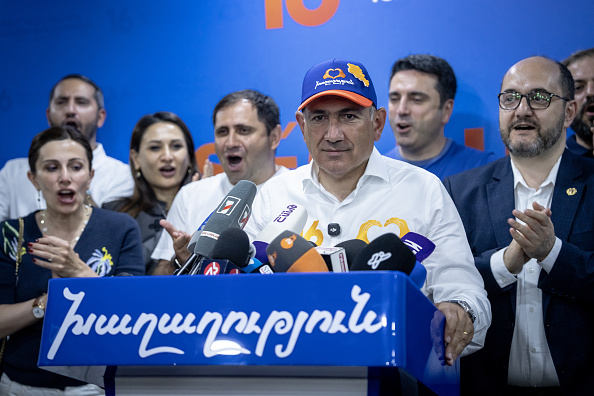
Armenia election Pashinyan Civil Contract pro Russian opposition 2026 results have delivered Prime Minister Nikol Pashinyan a victory he is calling historic while simultaneously producing a political landscape significantly more complicated than his Western-aligned government needed to advance its most ambitious and consequential policy objectives, with Civil Contract winning 49.8 percent of votes in Sunday's parliamentary election compared to 54 percent in 2021 while three pro-Russian opposition groups took a combined 37 percent and are on track to enter parliament, creating the divided legislative environment in which Pashinyan's peace deal with Azerbaijan and his broader pivot away from Russia toward the European Union and the West must now be navigated. The election Armenia's first general vote since the crushing 2023 military defeat in which Azerbaijan seized the entirety of Nagorno-Karabakh and displaced approximately 100,000 ethnic Armenians, was explicitly framed by both the government and its critics as a referendum on Pashinyan's handling of the catastrophic territorial loss and his decision to pursue peace normalisation with Azerbaijan and Turkey as the path forward for a landlocked nation of 3 million whose strategic options are severely constrained by geography and the collapse of its Russian security guarantee. Pashinyan declared victory in the early hours of Monday at a press conference when results from just over one-fifth of polling stations showed his party at around 54 percent, a premature announcement that his main rival Samvel Karapetyan, the Russian-Armenian billionaire founder of Strong Armenia, condemned as vote rigging, with the Armenia Alliance characterising the declaration as pressure on the Central Election Commission and usurpation of power.
The specific result that most constrains Pashinyan's second-term agenda is the failure to secure the two-thirds parliamentary majority that would allow him to call the constitutional referendum demanded by Azerbaijan as part of the peace deal framework and necessary to normalise relations with Turkey, Baku's key ally. A peace deal conditioned on a constitutional referendum that requires a two-thirds majority the election has not produced creates the specific impasse in which Pashinyan has a mandate to govern but potentially lacks the parliamentary arithmetic to deliver the peace deal's most politically sensitive requirements, forcing either a renegotiation of the referendum condition or a search for parliamentary support from opposition parties whose pro-Russian orientation makes their cooperation on Western-aligned peace terms structurally unlikely. The election's outcome therefore creates not just a coalition management challenge but a fundamental question about whether the peace deal architecture designed under the assumption of a stronger Pashinyan majority can survive in the more fragmented parliamentary landscape that Sunday's result has produced.
The 59 percent voter turnout in a landlocked country of 3 million that has experienced military defeat, mass displacement, energy dependency on hostile neighbours, and the political turbulence of multiple elections and coup attempts since independence documents an electorate that remains engaged with its democratic institutions despite the scale of the national trauma of recent years. Pashinyan's statement that the Armenian people voted for regional prosperity and cooperation, and his hope that the result would draw a positive response from Turkey and Azerbaijan, frames the election outcome as a mandate for his peace strategy that the 49.8 percent result provides less convincingly than the absolute majority would have, leaving the interpretation of what 37 percent for pro-Russian opposition parties means for the peace deal's democratic legitimacy as the central political question that his second term will immediately face.
How the 2023 Defeat Reshaped Armenian Politics and Created This Election's Stakes
The September 2023 Azerbaijani military operation that ended the decades-long Armenian presence in Nagorno-Karabakh within 24 hours, displaced virtually the entire ethnic Armenian population of the region, and exposed the complete ineffectiveness of Russia's security guarantee through the CSTO collective security mechanism it was supposed to provide, created the most traumatic geopolitical event in Armenia's post-Soviet history and the political crucible within which Pashinyan's continued leadership has been tested. The speed and totality of the military defeat, following the 2020 Azerbaijani offensive that had already recovered substantial territory, eliminated the Armenian military position that had been maintained for three decades since the first Karabakh war and confronted Armenian society with the full strategic consequences of a security architecture built around Russian protection that Moscow was either unable or unwilling to provide when Azerbaijan struck. Pashinyan's political survival following the defeat reflected the absence of a credible alternative rather than public satisfaction with his handling of the crisis, and his decision to pursue peace normalisation with Azerbaijan through a European-mediated process rather than continued Russian-framework negotiations represented the most consequential strategic pivot in Armenian foreign policy since independence.
The pro-Russian opposition groups whose combined 37 percent challenges Pashinyan's mandate reflect the significant portion of Armenian society that continues to believe Russian alignment provides better strategic guarantees than the Western pivot, despite the 2023 CSTO failure to respond to Azerbaijani military action. The argument that Russia's non-response reflected specific circumstances of the Iran war period and Russian military overcommitment in Ukraine rather than a fundamental abandonment of Armenian security interests is one that pro-Russian opposition figures have been making to constituencies whose cultural, economic, and political ties to Russia remain strong despite the security guarantee's evident failure. Karapetyan's Strong Armenia party, winning 23.2 percent, represents the most electorally significant expression of this constituency, combining the Russian alignment argument with a pro-business platform that appeals to segments of Armenian business and society whose interests are tied to the Russian economic relationship that continued sanctions pressure and the Ukraine war have complicated.
The peace deal with Azerbaijan whose constitutional referendum requirement Pashinyan cannot now easily deliver is not simply a bilateral Armenian-Azerbaijani matter but a regionally transformative agreement whose conclusion would normalise Armenian-Turkish relations for the first time since the Armenian Genocide of 1915, open border crossings and potentially trade routes that have been closed for decades, and integrate Armenia more fully into the South Caucasus regional economy in ways that could fundamentally improve its economic prospects. The magnitude of this potential transformation is precisely what makes its political management so difficult domestically, because the compromises it requires, including acceptance of territorial realities that Armenian nationalist consciousness finds deeply painful and the abandonment of maximalist demands that have been central to Armenian political identity for decades, are the kinds of concessions that democratic majorities find hardest to endorse in formal referendum processes.
Karapetyan's Fraud Accusations and Their Implications for Result Legitimacy
Karapetyan's accusation of vote rigging and his statement that the elections are not over and there are no results, combined with the Armenia Alliance's characterisation of Pashinyan's early victory announcement as usurpation of power, introduces the specific legitimacy challenge that disputed election results create in countries with contested democratic traditions and significant geopolitical stakes in the outcome. The OSCE monitoring mission whose press conference was scheduled for 1100 GMT will provide the most internationally credible assessment of whether the election met democratic standards, and its findings will shape the international community's interpretation of the result's legitimacy and therefore the degree of Western support for Pashinyan's second term that the peace process requires. A clean OSCE bill of health strengthens Pashinyan's mandate for the difficult peace deal negotiations ahead, while significant OSCE concerns about election conduct would provide the opposition with internationally validated grounds for contesting the result and potentially destabilising the parliamentary formation process.
The specific timing of Pashinyan's victory announcement, made when barely one-fifth of results were reported and while his party was showing 54 percent rather than the final 49.8 percent, reflects either the political calculation that early momentum declaration serves campaign purposes regardless of final margins or an overconfidence about the trend that the final results did not fully validate. Either interpretation is consistent with the Armenia Alliance's accusation of pressure on the CEC, because a prime minister declaring victory before official results are complete creates an implicit narrative that subsequent lower numbers must either confirm or explain, and the 4-percentage-point gap between the 54 percent at one-fifth reporting and the 49.8 percent final result represents exactly the kind of trajectory that opposition accusations of result manipulation can be built around regardless of whether the actual counting process was clean.
Parliamentary Formation, Peace Deal Arithmetic, and Armenia's Strategic Direction
The final parliamentary seat distribution, which had not been fully established by Monday morning reporting, will determine the specific coalition arithmetic that Pashinyan must work with in pursuing his legislative agenda, including the constitutional referendum requirement for the Azerbaijan peace deal whose importance to his second term's signature achievement is difficult to overstate. A parliament in which Civil Contract holds approximately 50 percent and three pro-Russian opposition groups hold approximately 37 percent leaves a relatively small pool of remaining votes and seats whose distribution could provide or deny the two-thirds supermajority that the constitutional referendum requires, and the absence of any obvious bridge party between Civil Contract's pro-Western peace orientation and the opposition groups' pro-Russian stance makes the parliamentary coalition arithmetic particularly challenging. The constitutional referendum's two-thirds requirement means Pashinyan would need to either persuade a substantial number of opposition parliamentarians to support a referendum whose substance they fundamentally oppose, negotiate a modification of the Azerbaijan peace deal terms that removes the referendum requirement, or accept that the peace deal's most ambitious elements cannot be delivered in the current parliamentary term.
The Strong Armenia party's 23.2 percent and its billionaire founder Karapetyan's specific combination of pro-Russian alignment and pro-business platform creates the interesting possibility that economic rather than security arguments might provide some common ground with Civil Contract on specific legislative issues that serve both parties' business constituencies, even if the fundamental strategic orientation questions remain unresolved. Prosperous Armenia's 4 percent, barely above the threshold for parliamentary entry, represents a smaller but potentially pivotal force if specific votes are close, and the Armenia Alliance's 9.9 percent is likely to be the most consistently oppositional force given its more explicitly geopolitically defined pro-Russian positioning. The OSCE's legitimacy assessment will be read closely by all parties as they assess the mandate that the final result represents and the coalition negotiations that must follow.
The Western community's response to the election will be closely watched in Yerevan as a signal of whether European and American support for Armenia's peace deal process remains robust despite the electoral outcome's failure to deliver the majority that would make the process most straightforward. European Commission statements, U.S. State Department reactions, and the specific tone of congratulations from Western capitals will all be interpreted as indicators of whether the West considers the result a sufficient democratic mandate for the peace process or whether the contested legitimacy claims and reduced majority raise questions about the process's domestic political foundation. Armenia's strategic direction toward the West was the election's stated question, and the answer that 49.8 percent pro-Western and 37 percent pro-Russian delivers is a more ambiguous verdict than either side can claim as definitive validation of its preferred Armenia.