
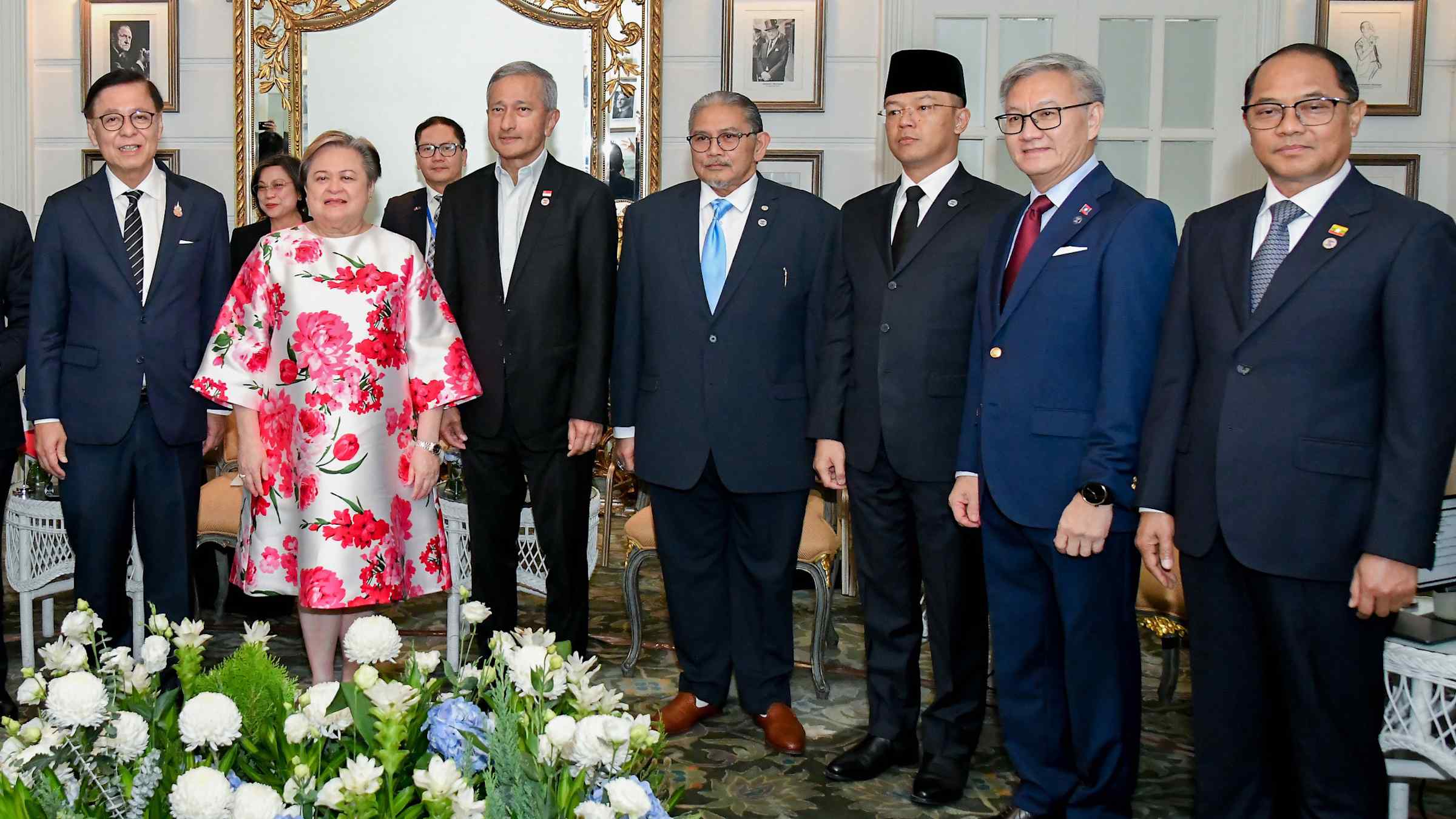
ASEAN Myanmar military junta legitimacy Five Point Consensus 2026 risks have been raised by analysts following Sunday's informal Bangkok gathering where foreign ministers from the Association of Southeast Asian Nations met Myanmar's top diplomat in the first such in-person meeting since the military's 2021 coup led to the junta being barred from bloc summits, with critics warning the meeting could normalise political engagement with a military-backed government that has not implemented any element of the Five-Point Consensus peace framework ASEAN itself agreed in April 2021, has not released political prisoners including Nobel laureate Aung San Suu Kyi, and whose military-dominated parliament last week formally urged the new government to counter the Five-Point Consensus as interference in internal affairs. The meeting marks a test of whether ASEAN will hold the line on its own peace framework or allow Myanmar's military-backed leaders to regain regional standing without meaningful steps toward ending a conflict that has killed an estimated 100,000 people, displaced more than 3.6 million, severely weakened the economy, and left Aung San Suu Kyi under house arrest with her whereabouts unknown while many senior members of her party and other junta opponents remain jailed or barred from politics.
"It would be a mistake for ASEAN to accept Myanmar back into the fold without getting anything meaningful in return," said Richard Horsey, senior Asia adviser at Crisis Group.
Horsey's warning that Sunday's meeting risks being a step in normalising political engagement before any change has been achieved captures the specific credibility concern that analysts have been raising about the trajectory of ASEAN's Myanmar policy since the bloc began signalling openness to re-engagement with the military-backed government, whose most recent political evolution was the sham election that culminated in April when a pro-military parliament elected former junta chief Min Aung Hlaing as president, formalising the power he had held since the 2021 coup under a civilian veneer that critics and Western governments dismissed as designed to preserve military rule rather than restore democratic governance.
"The central question is whether the organization will uphold its own agreed framework or permit re-engagement with the military regime without requiring meaningful implementation of the Five-Point Consensus," said Ye Myo Hein, senior fellow at the Southeast Asia Peace Institute.
How the 2021 Coup Created the Crisis ASEAN Has Failed to Resolve
Myanmar has been in turmoil since February 2021, when the military overthrew Aung San Suu Kyi's elected government in a coup that triggered nationwide protests whose violent suppression by the junta then fuelled the armed uprising that has become a prolonged civil war consuming the country more than four years later. The speed with which the coup's aftermath escalated from urban protest suppression to a multi-front civil war involving both the pre-existing ethnic armed organisations that have been fighting Myanmar's military for decades and the newly formed People's Defence Force aligned with the opposition National Unity Government surprised even the most pessimistic observers of Myanmar's political trajectory, creating the specific conflict complexity that any external engagement framework must navigate in attempting to move toward the resolution that ASEAN's Five-Point Consensus nominally addresses.
The human cost of more than four years of civil war, with an estimated 100,000 killed and more than 3.6 million displaced, represents one of the most severe ongoing humanitarian disasters in Southeast Asia and one whose scale has been consistently underreported in global media coverage relative to the suffering its numbers document. The conflict's geographic distribution across Myanmar's many ethnic regions, the multiple armed actors involved with different political objectives and relationships to both the junta and the opposition, and the deliberate restriction of humanitarian access that the military has imposed on affected areas all contribute to the specific information environment in which the conflict's true human cost is likely understated even in the estimates that humanitarian organisations have been able to compile from the partial information available.
Aung San Suu Kyi, whose detention under house arrest with whereabouts unknown while many of her party members and junta opponents remain jailed or barred from politics, represents the specific human rights accountability dimension that any assessment of ASEAN's engagement framework must incorporate, because her continued detention under the specific conditions that the military has imposed is the most globally recognised individual symbol of the political prisoners whose release the Five-Point Consensus called for and whose continued imprisonment ASEAN's Sunday Bangkok meeting has not required as a precondition.
The Five-Point Consensus and Why Its Non-Implementation Matters
ASEAN's Five-Point Consensus, agreed in April 2021 in the weeks following the coup when the bloc responded with unusual speed to the crisis in one of its members, called for an end to violence, dialogue among all parties including the opposition and ethnic armed groups, humanitarian assistance, the appointment of a special envoy, and the special envoy's access to all parties for mediation. The consensus represented ASEAN's most direct statement of engagement with a member state's internal political crisis in the bloc's history and established the specific framework conditions that the junta's compliance or non-compliance with would define ASEAN's response posture in the years following the crisis's outbreak.
The junta did not implement any element of the Five-Point Consensus in any meaningful way, prompting ASEAN to bar it from the bloc's top-level summits and invite only non-political representatives from Myanmar, a specific diplomatic downgrade whose reversal through the Bangkok foreign ministers meeting is the step that analysts are warning risks providing unearned legitimacy. The military-dominated parliament's approval last week of a motion urging Myanmar's government to counter the Five-Point Consensus and characterising it as interference in internal affairs is the specific contemporaneous action that makes Sunday's ASEAN meeting most difficult to defend from the legitimacy-without-results critique, because ASEAN is engaging directly with the foreign minister of a government whose parliament has just formally rejected the framework that ASEAN is supposedly maintaining as its engagement condition.
Opposition groups including the National Unity Government in exile and the Karen National Union, one of the most powerful ethnic armed organisations, released a joint statement on Saturday voicing concerns about the informal meeting and calling for ASEAN to engage with all principal democratic political stakeholders in the country rather than only with the military-backed government's representative. The opposition's joint statement documents the specific political exclusion that Sunday's format perpetuates, with the meeting briefing ASEAN foreign ministers on conditions inside the country as filtered through the Myanmar military government's representative rather than through the multiple political actors whose perspectives would be necessary for a complete picture of what those conditions actually involve.
ASEAN's Leverage Risk, Thailand's Defence of the Meeting, and What Comes Next
Ye Myo Hein's warning that once the regime secures the regional legitimacy it seeks without meeting any meaningful conditions, ASEAN will have far fewer tools to encourage compliance with the Five-Point Consensus or promote genuine political dialogue, identifies the specific structural dynamic that makes the sequence of engagement decisions critically important to the eventual outcome. Leverage in diplomatic negotiations is most available before the concession that the other party is seeking has been granted, and diminishes significantly once that concession has been provided, meaning that ASEAN's willingness to meet Myanmar's top diplomat without conditions makes any future conditions-based demands substantially harder to enforce because the re-engagement reward has already been partially delivered. The incremental nature of legitimacy restoration, where each meeting normalises the next and each informal contact provides the precedent for a formal one, creates the specific slippery slope risk that the Bangkok meeting represents for analysts who are watching whether Sunday's informal session becomes the baseline from which the next step toward full summit reinstatement is measured.
Thailand's Foreign Minister Sihasak Phuangketkeow offered the official ASEAN defence of Sunday's meeting, saying that the engagement process did not mean any change in the bloc's basic position as reflected in the Five-Point Consensus but represented movement toward engagement, listening, and being realistic about what can be achieved. The realistic framing is the specific diplomatic language whose interpretation determines whether Sunday's meeting represents a pragmatic recalibration of an approach that four years of non-implementation has demonstrated is not producing results, or a capitulation to the military regime's patient strategy of waiting out the isolation until regional fatigue and economic normalisation interests produce the re-engagement that it has been seeking since the coup.
Sihasak's reported plan to hold separate informal meetings with some ethnic armed organisations and the National Unity Government, though unconfirmed by officials or opposition groups at time of publication, would represent the multi-stakeholder engagement that the opposition's joint statement called for and that would partially address the legitimacy critique by demonstrating that ASEAN is not simply normalising the military government's position but is genuinely attempting the all-parties dialogue that its own Five-Point Consensus identified as the path to resolution. Whether those meetings occur, and whether they receive the same level of official characterisation and diplomatic weight as Sunday's junta-representative meeting, will be among the most important indicators of whether ASEAN's re-engagement represents a genuine peace process recalibration or a diplomatic drift toward the legitimacy-without-results outcome that analysts are warning against.
The six months since the sham election whose April culmination installed Min Aung Hlaing as president have been sufficient for the military government to claim the domestic political consolidation that its election process was designed to provide, even without the international recognition that the election's Western critics have withheld. ASEAN's Sunday meeting, in which Myanmar's top diplomat briefed the bloc's foreign ministers on conditions inside the country, represents the specific external validation step in the military government's legitimacy-building programme that its domestic political consolidation has been designed to enable, creating the momentum toward regional acceptance that the Five-Point Consensus's continued non-implementation has not prevented.