
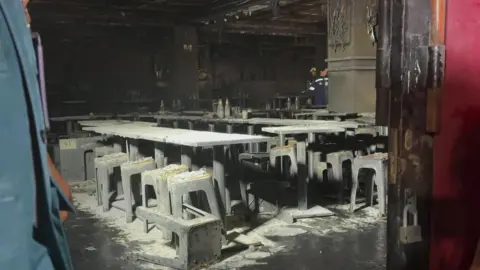
Bangkok Bar Fire deaths Chatuchak Rong Beer 2026 has killed at least 27 people and left eight critically injured after a devastating blaze tore through the Rong Beer Na Lat Phrao bar in Bangkok's popular Chatuchak district late on Sunday, with preliminary investigations by Bangkok's disaster mitigation department suggesting the fire could have been caused by an electrical short circuit in an air conditioner before spreading rapidly from near the stage, cutting power, and engulfing the room with thick smoke that proved fatal for the majority of victims found by firefighters in a bathroom where they had apparently sought shelter rather than finding a safe exit. Nine men and 18 women were killed, more than 60 people are being treated in hospital, and the eight critically injured represent the cases whose outcomes remain uncertain as Bangkok's healthcare system manages the acute consequences of a disaster that unfolded with such speed that panicked customers were filmed screaming as they fled through the flame-enveloped front door with some of their clothes on fire, in footage posted online that has circulated widely since the incident. Firefighters, alerted to the blaze by a passing driver who broke windows to help two people escape, arrived just after midnight and brought the flames under control in approximately half an hour, but found the majority of victims already dead in the bathroom where smoke inhalation rather than direct flame contact was identified by disaster mitigation director Suriyachai Raviwan as the primary cause of death for most of those killed.
"There was blasting and everybody tried to flee from the smoke and flames," Prime Minister Anutin Charnvirakul said on Monday after visiting the scene, relaying the account of a musician who was performing when the fire broke out.
The musician's account, reported by Anutin, that many people did not escape because they went to the back of the building and tried to hide themselves in the toilet captures the specific human decision-making under extreme panic conditions that determines mass casualty outcomes in enclosed-space fires, where the combination of darkness from power loss, disorientation from dense smoke, and the survival instinct to seek enclosed shelter rather than move toward the perceived danger of the flames leads people away from exits and toward confined spaces whose smoke accumulation becomes fatal. Bangkok governor Chatchart Sittipunt added that flammable interior decorations on the bar's ceiling may have facilitated the blaze's rapid spread, and that reports of people found unconscious near the emergency exit suggest there may have been some obstruction, though forensic investigation will be required to confirm both findings with the evidentiary certainty that official accountability requires.
Motorcyclist Surin Jaiharn, who helped approximately five people flee the burning bar by using clothing to extinguish flames on their bodies, told AFP: "I feel depressed. I saw many deaths and I do not know the fate of the people I helped."
Thailand's Recurring Nightlife Fire Disasters and Why They Keep Happening
The Chatuchak district fire is not an isolated event in Thai nightlife disaster history but the latest episode in a recurring pattern of bar and nightclub fires whose previous instances produced the same sequence of official investigation promises, safety standard announcements, and enforcement commitments that have demonstrably not prevented repetition. In 2022, a fire at a bar in a town south of Bangkok killed 22 people in an event whose geographic and circumstantial similarity to Sunday's disaster documents the persistence of the underlying safety conditions that make Thai entertainment venues vulnerable to exactly this category of fire emergency. On January 1, 2009, 66 people died in a Bangkok nightclub fire that also injured more than 200 others who were celebrating the new year in the same kind of crowded, acoustically and visually stimulating environment where fire warning signals are easily missed or misinterpreted in the initial critical seconds when evacuation decisions must be made.
Thailand's fire and electrical safety standards as written are not fundamentally different from those of other countries with comparable development levels, but their enforcement has been characterised by systematic weakness whose causes include the commercial pressure that entertainment district operators experience to minimise compliance costs, the corruption and institutional capacity limitations that reduce inspection effectiveness, and the political connections that allow well-established venues to operate outside the oversight frameworks that their legal obligations require. The gap between official promises to improve enforcement following each disaster and the actual enforcement practices that venues experience in the months and years after those promises are made is the specific governance failure whose persistence the 2022, 2022, 2024, and now 2026 series of Thai fire disasters documents. Despite every previous incident producing the same official response template, the underlying conditions that create the fire risk, flammable interior decorations, inadequate emergency exits, electrical systems that do not meet safety standards, and insufficient fire suppression equipment, remain present in enough venues to make the next disaster a matter of when rather than whether.
The 2024 fire at the famous open-air Chatuchak market that killed 1,000 animals in an electrically-triggered blaze in the same district as Sunday's bar fire creates the specific geographic accident cluster that documents the area's particular combination of commercial density, older electrical infrastructure, and enforcement gaps whose convergence makes Chatuchak one of Bangkok's higher-risk districts for exactly the category of electrical fire that preliminary investigation has identified as the probable Sunday disaster cause. The air conditioner electrical short circuit identified as the preliminary cause is the specific failure mode that Thailand's electrical safety enforcement has consistently failed to prevent, because the combination of high-capacity electrical equipment, non-compliant installation practices, inadequate maintenance, and the moisture and humidity conditions that Thai tropical weather creates around air conditioning equipment produces the short circuit risk that safety inspections are supposed to identify and require correction before they produce the ignition that the Rong Beer Na Lat Phrao fire demonstrates they can trigger.
The Bathroom Death Toll and What It Reveals About Fire Safety Training
The concentration of most victims' bodies in the bathroom where they had sought shelter reveals the specific gap between the instinctive human response to fire in an enclosed space and the fire safety behaviour that training and clear emergency communication could potentially produce in venue occupants who understand that seeking enclosed shelter increases smoke inhalation risk rather than reducing it. Fire safety research consistently documents that the bathroom-shelter behaviour observed in the Bangkok bar is a common response pattern in enclosed-space fires where exits are not clearly marked, darkness from power loss disorients occupants, and the natural instinct to move away from visible fire and toward the perceived safety of a closed door drives people into the rooms where smoke accumulates most rapidly. The counterfactual in which clear emergency lighting guides occupants toward the exits rather than away from them, trained staff communicate authoritative evacuation direction in the critical first seconds, and emergency exits are unobstructed and clearly marked, is the specific scenario that Thailand's fire safety enforcement framework is supposed to produce but that the Rong Beer Na Lat Phrao fire's death toll documents was not present on Sunday night.
Governor Sittipunt's reference to reports of people found unconscious near the emergency exit with a suggestion of possible obstruction identifies the specific physical safety failure that, if confirmed by forensic investigation, would represent the most direct and preventable contributing factor in the death toll, because an unobstructed and clearly marked emergency exit in the path that victims were attempting to use could have allowed their escape before smoke inhalation incapacitated them. The investigation's forensic phase will need to determine whether the exit obstruction reports reflect actual blockage of the designated emergency egress route or the disorientation and crowding that panicked evacuation from a smoke-filled space produces when multiple people attempt to use limited exit capacity simultaneously, a distinction that carries different accountability implications for the venue operators and regulatory authorities whose enforcement responsibility is being examined.
The Crime Scene Investigation, the Prime Minister's Visit, and What Accountability Requires
The cordoning of the Rong Beer Na Lat Phrao bar as a crime scene investigation location, with shattered windows and furniture piled outside the entrance and the interior walls, ceiling, and furnishings completely blackened with parts of the ceiling peeled away, creates the specific forensic environment whose systematic examination will determine whether the preliminary air conditioner electrical short circuit hypothesis is confirmed as the ignition source, whether the ceiling's flammable decorative materials contributed to the fire's rapid spread as the governor suggested, and whether the emergency exit's reported obstruction reflects a compliance failure whose criminal accountability the investigation must establish. Bangkok's disaster mitigation director Suriyachai's identification of smoke inhalation as the primary cause of death for most victims, combined with the bathroom concentration of bodies, creates the specific forensic picture whose full explanation requires both the physical investigation of the venue's safety compliance status and the witness account collection from survivors whose recollections of the evacuation experience will document what safety information was available to them in the critical first minutes.
Prime Minister Anutin's early Monday visit to the scene, where he spoke directly to the musician whose account of the blasting and mass flight from smoke and flames he relayed to reporters, represents the political accountability signalling that a disaster of this magnitude in a popular entertainment district of the capital requires, connecting the head of government to the immediate human reality of the disaster while committing the official investigation and enforcement response to the public accountability scrutiny that the prime minister's personal engagement creates. The pattern of previous Thai fire disasters followed by official promises that have not produced the enforcement improvements that prevention requires creates the specific credibility challenge that Anutin's government faces in communicating what will be different this time, because the affected families, public, and international observers are aware that 2022, 2009, and previous incidents produced the same official response template whose follow-through has been insufficient to prevent the current disaster.
The eight critically injured survivors whose outcomes remain uncertain at the time of Monday morning reporting represent the immediate human cost whose resolution in the coming hours and days will determine whether the final death toll rises above 27, with the critical injury category in fire casualties reflecting the specific physiological consequences of severe smoke inhalation and burns whose medical management requires the intensive care resources that Bangkok's hospital system is currently mobilising across the more than 60 people being treated. Thailand's health authorities' capacity to manage the acute surge in severe respiratory and burn injury cases that a mass casualty fire produces will be tested by the volume and severity of the current caseload, with the critical cases requiring the ventilator support, burn treatment, and intensive monitoring whose availability determines survival outcomes in the hours following the initial injury.