
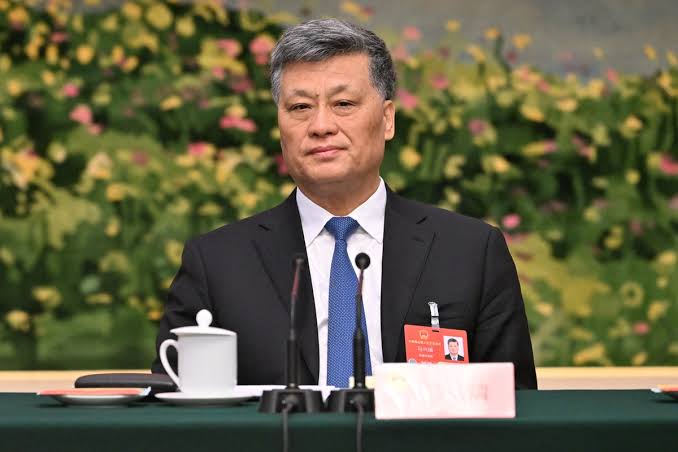
China Ma Xingrui Politburo expelled corruption Xi Jinping 2026 has removed the former Politburo member from the ruling Communist Party on corruption charges, making him the third sitting member of the party's elite decision-making body to be purged since 2025 as President Xi Jinping's anti-graft campaign reaches the highest levels of Chinese political power with an intensity and frequency that has no recent historical precedent in the depth of its penetration into the Politburo itself. Ma Xingrui, who also served as deputy head of the central rural work leading group, was placed under investigation in April over what the party's official language describes as suspected serious violation of law and discipline, the standard euphemism for corruption whose use in Politburo member cases documents the investigation's framing within the party discipline framework rather than the criminal law framework that ordinary corruption cases employ in their initial stages. State news agency Xinhua reported the specific findings against Ma that the investigation produced, including that he sought benefits for others in the selection and appointment of officials, improperly arranged jobs for others, illegally accepted gifts, helped relatives purchase property at below-market prices, and engaged in exchanges involving power and money for sex, with the family corruption characterisation applied to his allowing family members to leverage his official influence to obtain what Xinhua described as huge benefits through large-scale arrangements whose financial scale the report did not specify.
The expulsion's political significance extends well beyond the individual case of Ma Xingrui to what the pattern of three Politburo member purges since 2025 reveals about Xi Jinping's assessment of the political landscape and the specific strategic purposes that the anti-corruption campaign is serving in this phase of his consolidation of power. Three Politburo members removed in under two years represents a purge frequency at the party's highest decision-making level that indicates either genuinely pervasive corruption among the individuals who reached the Politburo under previous selection processes, Xi's determination to use corruption accountability as the mechanism for removing individuals whose political reliability or personal loyalty he questions, or both simultaneously operating through the same institutional mechanism. The pattern's acceleration, with the investigation opened in April and the expulsion confirmed Monday, documents a campaign tempo whose speed from investigation to expulsion has been increasing as the institutional processes have become more routinised through repeated application.
The specific corruption typology documented in Ma's case, involving official appointment manipulation, family benefit extraction, property acquisition below market price, and power-for-sex exchanges, follows a pattern that has appeared in multiple previous senior Chinese official corruption cases and reflects both the specific temptations that senior party power creates and the investigative methodology that the Central Commission for Discipline Inspection has refined through thousands of cases since Xi's anti-corruption campaign formally launched in 2012 at the 18th Party Congress. Each element of the documented conduct reflects a specific avenue through which senior party officials have historically converted political authority into personal and family enrichment, and the CCDI's ability to document all of these avenues in a single case reflects the investigative thoroughness whose demonstration through detailed public reporting is itself a deterrence communication to the officials who are observing the Ma case's public accounting.
How Xi's Anti-Corruption Campaign Reached the Politburo Level
Xi Jinping's anti-corruption campaign, launched formally at the 18th Party Congress in November 2012, has been the most sustained and institutionally penetrating anti-corruption effort in the People's Republic of China's history, having investigated, disciplined, or prosecuted millions of party members and officials at levels ranging from village cadres to the very apex of the party and military hierarchy in a process whose scope and duration have no precedent in the party's post-Mao governance history. The campaign's progression from lower-level officials through provincial and ministerial-level targets to Politburo Standing Committee members, the most elite inner circle of seven men who constitute the party's supreme collective leadership, and now repeatedly into the broader Politburo of approximately 24 members whose composition represents the party's full senior leadership, documents the progressive elevation of the campaign's targeting that each year has raised the ceiling of accountability beyond what the previous year demonstrated was reachable.
In October last year, He Weidong, a former vice chair of the Central Military Commission whose position placed him among the most powerful military figures in China, was expelled from the Communist Party on corruption charges, bringing the military accountability dimension of the campaign to its highest demonstrated level. In January of this year, China opened a corruption investigation into Zhang Youxia, the military's most senior general, in an action whose political significance derives from his seniority and from the specific implication that Xi Jinping's most intimate military circle is not exempt from the accountability scrutiny that the campaign has extended progressively upward through the hierarchy. The military's inclusion in the campaign's highest-level targeting is particularly significant because the People's Liberation Army's internal culture and institutional separation from civilian oversight have historically made it the institutional domain most resistant to external accountability penetration, making the Zhang Youxia investigation the specific escalation that documents Xi's willingness to extend the campaign into the military's inner sanctum regardless of the institutional friction that doing so creates.
The family corruption characterisation applied to Ma's case, involving family members leveraging official influence to obtain huge benefits, connects the individual official's corrupt conduct to the broader family networks whose enrichment through official position is one of the most culturally embedded and institutionally entrenched forms of Chinese official corruption, reflecting the Confucian family loyalty norms that make providing for extended family through official connections feel less like corruption than like familial duty to the officials whose formal party training teaches them to distinguish the two clearly. The large-scale characterisation that the CCDI applied to Ma's family corruption activities indicates that the benefit extraction was not occasional or incidental but systematic and intentional, creating the specific aggravated character that distinguishes cases prosecuted most severely from those where family benefit extraction was more opportunistic and limited in scale.
Why Politburo-Level Purges Send a Different Political Signal
The Politburo's specific institutional character, as the body from which the seven-member Standing Committee is drawn and which collectively manages the party's most significant national policy decisions between the larger Central Committee plenary sessions that formally ratify those decisions, means that corruption investigations at this level have a qualitatively different political meaning than investigations of ministerial or provincial officials whose individual removal does not affect the functioning of the party's supreme decision-making mechanisms. A Politburo whose membership is periodically subjected to corruption removal creates the specific uncertainty about the security of high-level positions that either deters the corrupt conduct that would expose remaining members to similar accountability, reinforces Xi's demonstration of willingness to remove senior officials regardless of their institutional status, or both simultaneously creating the political environment in which the Politburo functions under the awareness that the accountability that has reached three of its members since 2025 could extend further if the CCDI's investigations produce additional cases.
The appointment manipulation finding against Ma, that he sought benefits for others in the selection and appointment of officials, is the specific corruption category whose political implications extend beyond his personal enrichment to the integrity of the party's cadre selection system whose outcomes determine who occupies the official positions at every level below Politburo rank. Official appointment corruption, in which senior officials sell or trade promotion decisions for payment or other benefits, creates the specific systemic consequence that the officials selected through corrupt processes owe their positions to the corrupt official who arranged them, creating loyalty networks built on corrupt transactions rather than on merit or ideological alignment that the party's official cadre selection criteria are supposed to ensure. The identification and removal of officials who have corrupted the appointment system therefore serves not only the anti-corruption objective but the political control objective of eliminating the alternative loyalty networks that corrupt appointment practices create.
The Three-Purge Pattern and What It Signals for Chinese Political Risk
The three Politburo member purges since 2025, including Ma Xingrui, document a pattern whose frequency indicates that Xi's political control at the highest party level is sufficiently consolidated that removing Politburo members no longer creates the political risk that it might have earlier in his tenure when the factional dynamics among senior party figures required more careful balancing of anti-corruption targeting against the political coalition management that maintaining broad senior support required. A leader who removes three Politburo members in approximately two years is communicating through the pattern of removals that no position at the senior level is secure against accountability scrutiny, that the loyalty and reliability assessment that determines who faces investigation extends to the full Politburo membership rather than stopping at any institutional threshold, and that the anti-corruption campaign's continuation as the dominant mechanism of political discipline and control is Xi's preferred governing mode rather than a transitional phase whose conclusion he is preparing.
The CCDI's combination of findings in the Ma case, spanning appointment manipulation, family corruption, below-market property transactions, gift acceptance, and power-for-sex exchanges, documents the full spectrum of corruption typologies whose presence in a single senior official's conduct reflects the specific institutional environment in which Chinese senior officials have historically operated and the multiple channels through which official authority has been converted into private benefit. Each of these categories represents a separate enforcement priority whose public documentation through the Xinhua reporting serves the deterrence communication that the CCDI's public accountability reporting is specifically designed to produce in the officials who are observing the case and calculating whether their own conduct falls within the accountability perimeter that Ma's case has demonstrated extends to Politburo membership.
The political risk assessment for Chinese governance stability that the purge pattern creates involves the specific tension between the stability that Xi's demonstrated control implies and the institutional disruption that repeated senior-level removals create in the functioning of the party machinery whose smooth operation requires the experienced officials who are being removed to be replaced by successors whose institutional knowledge and operational effectiveness cannot be assumed to immediately match the officials they replace. Three Politburo purges in two years requires the party's talent pipeline to produce three credible replacements for the positions affected, at a level of the hierarchy where credible candidates are by definition limited in number and whose identification, vetting, and positioning requires the organisational resources that the CCDI's investigative activities are simultaneously consuming.