
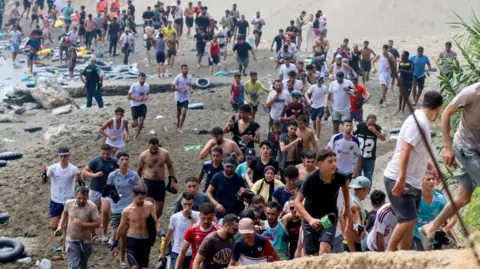
Approximately 49,000 migrants entered Spain's North African enclave of Ceuta Migration crisis from Morocco in a 24-hour period on Thursday, in what Spanish officials estimate to be the largest single-day border crossing event in European history, overwhelming a city of approximately 83,600 permanent residents and creating a humanitarian, security, and political crisis of a scale that Spain's domestic response systems were not designed to manage. Videos and images showing thousands of people swimming through the waters separating Morocco from Ceuta circulated globally on Thursday, while local media reported crossings continuing overnight. At least 18 people have died attempting to reach Ceuta in recent days, and Spanish officials estimate that approximately 7,000 of the approximately 49,000 who crossed in the 24-hour period are minors, a statistic that transforms the security and political crisis into a child protection emergency simultaneously. Spain has deployed its armed forces to Ceuta and is coordinating with its sister enclave of Melilla, where between 300 and 400 additional crossings were reported overnight, as Prime Minister Pedro Sánchez prepares to visit Ceuta on Friday.
The scale of Thursday's crossing requires immediate context to be comprehensible. If official estimates are accurate, approximately 59 percent of Ceuta's normal residential population entered the city in a single day from across the border. A comparable event in proportional terms would be the entirety of Greater Manchester's population, roughly 2.7 million people, entering a city of 4.5 million in 24 hours. The logistical, humanitarian, and security implications of such a rapid population increase are not manageable through normal emergency response frameworks, which is why Spain's interior ministry moved immediately to coordinate military deployment alongside civilian services and initiated diplomatic engagement with Morocco on returns. The 2021 Ceuta crossing, previously the largest in the city's modern history at more than 10,000 people, is now smaller by a factor of nearly five.
The triggering context for Thursday's mass crossing is not difficult to identify, though its precise causal weight relative to other factors requires careful analysis. Spain's Supreme Court ruled this month that migrants stopped at sea while attempting to reach Ceuta or Melilla cannot be summarily returned to Morocco, a legal decision that fundamentally altered the consequence framework for crossing attempts and that was widely understood in migrant networks and in the Moroccan communities from which most Ceuta crossers depart. The combination of a legal ruling that reduces the immediate return risk of a crossing attempt, whatever pre-existing migration pressures existed on the Moroccan side, and what appears to have been a breakdown or relaxation of Moroccan border control on Thursday, created the conditions for a crossing of this magnitude. Local Ceuta officials had been warning Madrid in the days before Thursday's event that they were seeing an increase in attempted crossings, but the scale of what materialised exceeded any contingency that warning had been designed to address.
The Crossing, the Deaths, and the Military Response
The crossing events of Thursday and overnight into Friday involved both land and sea approaches to Ceuta's boundary with Morocco. Videos showed thousands of people swimming through the waters of the Strait that separates the two territories, while other crossings occurred via land border points. The scale and coordination of the movement, with tens of thousands of people arriving at the crossing points in a concentrated window, suggests either an organised triggering event or an information cascade through migrant networks in which news of early successful crossings created a self-reinforcing flow of subsequent attempts. Moroccan border officials, who normally patrol the frontier and actively return or deter crossing attempts, appear either to have withdrawn from their positions or to have been overwhelmed by the volume of people.
The 18 deaths reported in recent days represent the human cost of crossings that involve sea approaches in which non-swimmers and those who become exhausted or disoriented in the water face lethal risk. The Strait between Morocco and Ceuta is not the open Mediterranean; it is a relatively narrow coastal stretch, but the combination of currents, cold water temperatures at certain times of year, distance from shore, and the physical condition of migrants who may have already travelled long distances to reach the Moroccan coast makes the crossing genuinely dangerous. The 7,000 minors among the estimated 49,000 who crossed include children who swam unaccompanied, a fact that Spanish child protection authorities and NGOs working in the region have described as requiring immediate and specific intervention protocols distinct from the general migration management response.
Spain's interior ministry response was to immediately coordinate military deployment to Ceuta and to initiate contact with Morocco for the return of those who crossed illegally "as soon as possible." The deployment of Spain's armed forces to a domestic territory for migration management purposes is not unprecedented, the 2021 Ceuta crisis also involved military deployment, but it carries specific legal and political sensitivities in a country where the role of the military in civilian affairs is carefully circumscribed by constitutional and legal frameworks developed after the Franco dictatorship. The ministry's framing of returns as the immediate priority reflects both the practical reality that Ceuta lacks the physical infrastructure to house, feed, and provide services to 49,000 additional people, and the political reality that a situation of this scale demands visible action that demonstrates the government is not passive in the face of a mass border breach.
The Supreme Court Ruling, Morocco's Role, and the Migration Pressures Behind the Crossing
Three distinct causal threads, legal, diplomatic, and structural, converge in the Ceuta crisis of Thursday and all three require examination to understand why an event of this scale occurred on this particular day.
The Spanish Supreme Court ruling is the most proximate legal trigger. Courts in Spain and across Europe have been progressively narrowing the legal basis for summary migration returns, and the specific ruling this month that migrants stopped at sea while attempting to reach Ceuta or Melilla cannot be immediately returned to Morocco was well understood in the communities from which Ceuta crossers typically depart. It is important to note that the court was not saying migrants are entitled to remain in Spain; it was saying that the process of stopping and returning them must comply with specific procedural requirements. But in the practical calculation made by people considering whether to attempt a crossing, any legal constraint on immediate return reduces the expected cost of a failed crossing attempt and can shift the cost-benefit calculation toward attempting the crossing. Information about the ruling would have spread rapidly through migrant networks.
Morocco's role in the management of Ceuta's border has historically been the most operationally significant factor in determining crossing volumes. Moroccan border forces have, in periods of good Spain-Morocco relations, actively prevented crossings through patrol, detention, and return of people attempting to reach Ceuta. In periods of diplomatic tension between Rabat and Madrid, Morocco has at times withdrawn that cooperation, either allowing or actively facilitating large crossing events as a form of leverage. The 2021 Ceuta crossing, also the then-largest in the city's modern history, occurred in a period of significant tension in the Spain-Morocco relationship over the hospitalisation of Polisario Front leader Brahim Ghali in Spain. Diplomatic and intelligence assessment of whether Morocco's reduced border enforcement on Thursday was a deliberate political signal, a capacity failure, or a response to overwhelming numbers, will be among the most sensitive analytical questions for Spanish and European officials in the coming days.
The structural migration pressures driving people toward Ceuta from sub-Saharan Africa and Morocco reflect a combination of economic push factors from across the African continent, the network effects of established migrant communities in Spain and Europe who support and sometimes finance further migration, and the specific appeal of a border crossing route that, unlike the central Mediterranean crossing, does not require a sea voyage of hundreds of kilometres with potentially fatal consequences. Ceuta's land and short-sea border with Morocco is perceived by many of those who attempt it as a more survivable crossing than the alternatives, even accounting for the 18 deaths recorded in recent days.
The Build-Up, the Crossing, and the Response
Days before Thursday — Local Ceuta officials alert Madrid to a noticeable increase in attempted crossings and request additional support. The warnings are consistent with an uptick that had been observed since the Supreme Court ruling earlier in the month.
This month, earlier — Spain's Supreme Court rules that migrants intercepted at sea while attempting to reach Ceuta or Melilla cannot be summarily returned to Morocco. The ruling is immediately understood as a significant change in the legal framework governing maritime interceptions.
Thursday around dawn — Crossings begin arriving at a scale that exceeds any previous experience in the city. Both sea and land approaches are used. Videos of thousands of people swimming toward Ceuta begin circulating on social media.
Thursday, ongoing — Border controls appear to break down. The volume of crossings is estimated at rates that overwhelm both Moroccan prevention capacity and Spanish reception and control infrastructure. By end of day, Spanish officials are estimating approximately 49,000 people have entered.
Thursday night — Crossings continue overnight. Local media reports that the flow has not stopped with the return of darkness. Between 300 and 400 crossings are also reported at Melilla overnight.
Friday morning — Spain deploys armed forces to both Ceuta and Melilla. The interior ministry confirms it is working with Morocco on returns. At least 18 deaths are reported in recent days. Pedro Sánchez confirms he will visit Ceuta on Friday. Official estimates stand at approximately 49,000 crossed, including approximately 7,000 minors.
Sánchez's Visit, Spain-Morocco Relations, and the European Migration Debate
Pedro Sánchez's decision to personally visit Ceuta on Friday is the clearest possible signal of how seriously the Spanish government assesses the political weight of the crisis. Prime ministerial visits to border emergencies serve multiple purposes simultaneously: they project political leadership at a moment of visible institutional failure, they allow the prime minister to receive direct operational briefings from the civil, military, and police authorities managing the response, and they demonstrate to both the local population and the national audience that the government is engaged at the highest level. Ceuta's population of approximately 83,600 people, which has effectively been asked to absorb a number of new arrivals equivalent to 59 percent of its normal size in 24 hours, will have specific and immediate demands to make of any visiting prime minister about housing, services, security, and the timeline for returns.
The Spain-Morocco diplomatic relationship will be the most consequential political variable in the days ahead. Spain needs Moroccan cooperation to implement returns at the pace required to manage the population pressure in Ceuta. Morocco knows this and has historically understood the Ceuta crossing volume as a form of diplomatic leverage that it can adjust to signal displeasure or seek concessions from Madrid. The interior ministry's statement about working with Morocco "as soon as possible" on returns is diplomatically careful: it acknowledges the dependency on Moroccan cooperation without publicly characterising Morocco's border management failure as deliberate, leaving diplomatic space for a cooperative outcome without conceding that Spain cannot act without Moroccan consent.
For the broader European migration debate, the Ceuta crisis provides the most dramatic single-day evidence in recent memory of what the combination of legal constraint on returns, migration pressure at the source, and border management failure can produce in terms of volumes. The European Commission, which has been managing the post-2015 migration policy debate across member states, will face renewed pressure from member states that have consistently advocated for stronger external border enforcement and faster return mechanisms to demonstrate that the EU's institutional approach can respond effectively to events of this scale. The 49,000 figure, if it stands as the confirmed crossing count, will be cited in European migration policy debates for years.
Ceuta's Overwhelmed Services, Spain's Fiscal Response, and the Return Cost
The economic consequences of 49,000 additional people arriving in a city of 83,600 begin with the immediate costs of emergency provision: food, water, temporary shelter, medical attention, child protection services, and security staffing at a scale that Ceuta's local budget was not designed to support and cannot sustain without emergency transfers from the central government in Madrid. The Spanish interior ministry's mobilisation of armed forces represents a cost beyond the normal military budget allocation, and the logistics of housing and feeding a population of this size, even temporarily, require emergency procurement and supply chain activation.
The cost of returns, which Spain has framed as its immediate priority, depends entirely on the pace at which Morocco accepts returnees and the per-person processing cost. Previous large-scale returns from Ceuta have been slow, partly because Morocco's reception capacity for large groups is limited and partly because the diplomatic negotiation of each return batch involves specific protocols about documentation, transportation, and the legal status of different categories of migrant. Returns of unaccompanied minors face specific legal constraints under both Spanish and international law: children cannot be returned without specific procedural protections, and the 7,000 minors among the estimated 49,000 arrivals represent a category that the Spanish child protection system must engage with under a different framework from adult migrants.
For Ceuta's local economy, the disruption of a normal commercial day in a city where the largest single employer sector is retail and cross-border trade with Morocco, events of this scale suspend economic activity, damage tourism and business confidence, and create insurance claims related to property damage or business interruption that compound the direct government cost. The economic impact on individual Ceuta residents and businesses will not be fully quantifiable for weeks or months after the immediate emergency is managed.
Tourism, Trade, and the Spain-Morocco Cross-Border Economy
Ceuta's economic character is fundamentally different from mainland Spanish cities. Its geographic position as a Spanish territory surrounded by Moroccan territory gives it a unique economic identity centred on the cross-border trade relationship with Morocco, duty-free retail serving Moroccan consumers who cross into Ceuta for Spanish and European goods, and a small but growing tourism sector that depends on the perception of the city as safe and accessible. Events of Thursday's scale disrupt all three of those economic pillars simultaneously: cross-border trade movement is suspended during security operations, duty-free retail cannot function when the city is in emergency management mode, and tourism confidence is damaged by global images of mass border breaches, deaths in the water, and military deployment.
The Spain-Morocco economic relationship, which extends well beyond Ceuta into bilateral trade, energy, and investment flows between the two countries, will be assessed by Spanish and European businesses for signs of the diplomatic consequences that a border management failure of this magnitude typically produces. Morocco is an important economic partner for Spain, with bilateral trade in food products, manufactured goods, energy, and services running into billions of euros annually. Spanish companies with significant Morocco operations, from Inditex to Telefónica and Mapfre, will be monitoring the diplomatic fallout of the Ceuta crisis for any signals about the Spanish government's relationship with Rabat that might affect their operating environment.
For the broader European business community assessing the Spanish migration situation, the Ceuta crisis is a data point in the assessment of political risk associated with Spain's immigration governance capacity. Large-scale migration events generate political volatility that can affect government stability, policy predictability, and the regulatory environment that businesses depend on for planning purposes. Whether the Ceuta crisis strengthens or weakens Sánchez's government depends partly on how effectively the immediate response is managed and partly on how the Spanish political opposition frames the event in the weeks ahead.
European Migration Policy, the Ceuta Precedent, and Africa's Migration Pressures
The Ceuta crossing event of Thursday is unprecedented in European history by its scale and is therefore a global migration policy event, not merely a Spanish or even European one. The combination of factors that produced it, a court ruling that altered the return framework, a wave of information spreading through migrant networks, and what appears to be Moroccan border management withdrawal, creates a specific pattern that other European external border states will be analysing for the lessons it contains about the fragility of border management systems that depend on third-country cooperation.
The 7,000 minors among the estimated 49,000 arrivals represent the most acute humanitarian dimension of the crisis and the one most likely to generate sustained international attention. Unaccompanied minors who have crossed an international border cannot be returned in the same manner as adults; they require specific identification, family tracing, care placement, and legal process that takes weeks or months and that engages the Spanish, Moroccan, and in some cases origin-country child protection systems simultaneously. The images and accounts of children swimming unaccompanied through the waters near Ceuta will generate responses from UNICEF, the International Organization for Migration, and European child protection bodies that will extend the humanitarian narrative of the crisis well beyond the initial 24-hour crossing event.
For African migration as a broader geopolitical phenomenon, the Ceuta crisis illustrates the structural inadequacy of EU-Africa migration partnership frameworks that have been under construction since the 2015 European migration crisis. The EU has invested substantial funds in partnerships with African governments designed to address the economic and security root causes of migration and to build the cooperation frameworks for return and readmission that make border management viable. The events of Thursday, in which one of those partnership frameworks with Morocco appears to have failed or been suspended at a critical moment, will prompt an assessment within the European Commission, member state governments, and the institutions that fund African development and migration partnership programmes about what those investments have actually purchased in terms of reliable cooperation when large-scale crossing events materialise.
What Migration Researchers and Border Security Experts Are Saying
Migration researchers examining the Ceuta event will identify several features that distinguish it from previous large-scale crossing events in European history. The speed of the crossing, with estimates of 49,000 in 24 hours compared to the 10,000 over several days in 2021, suggests either a more acute triggering event, a more developed information infrastructure through which crossing opportunity spreads in migrant networks, or a more complete withdrawal of Moroccan border management cooperation than occurred in 2021. All three factors may have operated simultaneously, and disentangling their relative contributions will require access to information about events on the Moroccan side that is not currently available.
Legal scholars examining the Supreme Court ruling and its consequences will be asked to assess whether the ruling's effect on crossing volumes was predictable, and whether the timing of the ruling's communication and implementation created a specific window of crossing opportunity that should have triggered pre-emptive response from Spanish authorities. The local Ceuta officials' warnings to Madrid in the days before Thursday's crossing suggest that some signal was visible, but the gap between the warnings received and the scale of what materialised raises questions about the assessment frameworks used to convert early warning signals into proportionate pre-emptive response.
Child protection experts assessing the 7,000 minor figure will be examining the breakdown between accompanied and unaccompanied children, the specific countries and communities of origin from which child migrants are departing, and the nature of the protection risks they face both during the crossing and in the immediate post-crossing period in Ceuta. The presence of 7,000 children in an emergency migration situation with inadequate infrastructure creates specific vulnerabilities to trafficking, exploitation, and secondary harm that are well documented in the literature on migration involving minors and that require specific prevention and protection measures that normal emergency management frameworks are not designed to provide.
Returns, Sánchez's Visit, and the Diplomatic Negotiation with Morocco
Sánchez's Friday visit — The prime minister's arrival in Ceuta will produce a set of public commitments about government response: additional resources, a timeline for returns, emergency support for Ceuta's infrastructure and services, and a message to both the local population and the national audience about the government's control of the situation. What he commits to and how those commitments are subsequently measured will determine the political damage or benefit the crisis produces for his government.
Returns coordination with Morocco — Spain's interior ministry has stated clearly that returns are the immediate priority. The pace of returns depends on Moroccan government cooperation, the availability of return transportation, the legal status determination of individual migrants, and the specific protocols for the return of minors who cannot be processed the same way as adults. Whether Morocco moves quickly to receive returnees or uses the situation as diplomatic leverage for concessions from Spain will be determined in diplomatic contacts that are unlikely to be publicly visible.
Child protection response — The 7,000 minors require specific and legally mandated responses from Spanish child protection authorities that will operate in parallel to the general migration management response. Separating accompanied from unaccompanied children, providing emergency care, initiating family tracing, and determining the legal status of each minor are processes that cannot be completed in days and will sustain the crisis as an ongoing humanitarian concern for weeks after the immediate crossing emergency is managed.
European institutional response — The European Commission and member state governments will assess the Ceuta crisis for its implications for EU migration policy, border management funding, and the Morocco partnership framework. Whether Thursday's events produce policy changes at the European level or are absorbed as an extreme but contained event will depend on the sustained political attention the crisis generates in the coming weeks.
Long-term Morocco relationship — The most consequential long-term consequence of the Ceuta crisis may be its effect on Spain's bilateral relationship with Morocco and the EU's engagement with Rabat on migration management cooperation. If Moroccan border withdrawal was a deliberate signal, identifying what Spain or the EU needs to offer in return for restored cooperation will define the diplomatic agenda for months.
What to Watch Next
The outcome of Sánchez's Friday visit to Ceuta and specifically what commitments he makes about return timelines, additional central government resources, and the diplomatic engagement with Morocco.
Whether Morocco begins accepting returnees quickly and at scale, or whether the pace of returns is slowed by diplomatic conditions, capacity limitations, or deliberate leverage-seeking, which would be the clearest indicator of whether Thursday's border management failure was deliberate or incidental.
The specific child protection response to the 7,000 minors, including the proportion identified as unaccompanied, the emergency care arrangements being established, and the legal determinations about their status and right to protection under Spanish and international law.
The European Commission's formal response to the crisis and whether it triggers any revision of the EU-Morocco migration partnership framework or the funding mechanisms that support Moroccan border management cooperation.
Whether additional large-scale crossing events occur in the days and weeks following Thursday's event, which would indicate that the triggering conditions remain active and that the crisis is not resolved by the immediate response measures.