
A 6.8 magnitude Japan earthquake Kumamoto struck inland on Kyushu island, Japan's southwesternmost major island, at 16:27 local time on Tuesday, according to the US Geological Survey. The quake hit near Kumamoto, a city of approximately 740,000 people in the centre of the island. Its inland location and the characteristics of the fault it struck produced the kind of intense, localised ground shaking that causes structural failures with speed and without warning. Eyewitnesses described the ground transforming from solid to a moving mass within seconds, with little time for preparation or evacuation before the shaking reached its peak intensity.
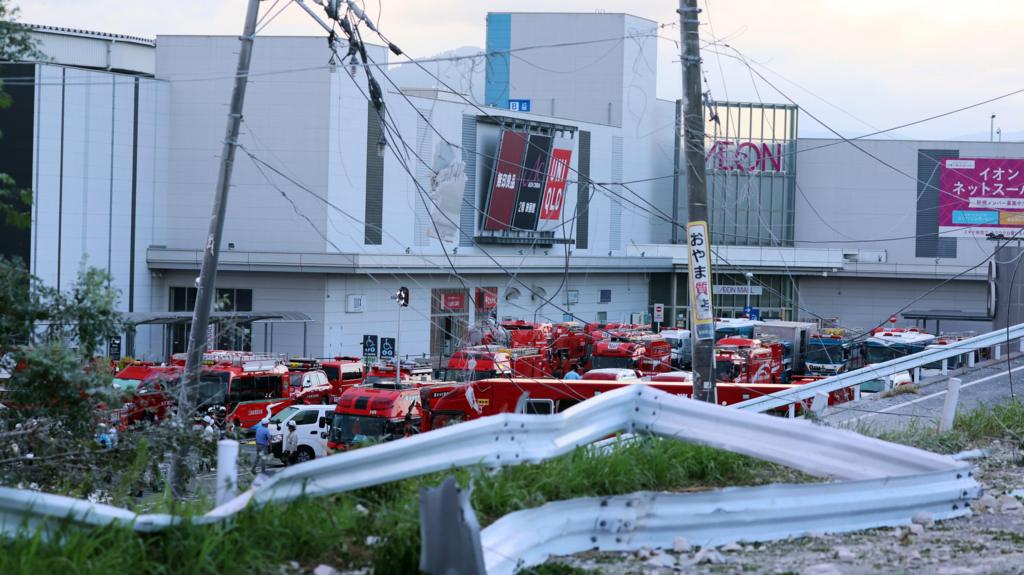
The most catastrophic single structural failure occurred at the Aeon mall in Kumamoto, a sprawling two-floor complex housing around 200 stores, a cinema, a bookshop, a food court, and 5,000 parking spaces. The mall's second floor partially collapsed during the earthquake, trapping an unknown number of shoppers. Two people have died inside the mall. Multiple others remain unaccounted for. Witnesses reported the second floor coming down while the building was occupied by Tuesday afternoon shoppers, and dramatic footage from a shop approximately 3.5 kilometres from the mall showed children crying and products scattered across floors as the shaking reached their location.
In the town of Hikawa, the structural damage was spread across residential buildings rather than a single large facility. At least 18 houses collapsed in the town, and NHK reported that two people found in the rubble showed no signs of life upon discovery, a condition Japanese media typically reports as "cardiac arrest" pending formal confirmation. Kumamoto authorities confirmed that residents are still trapped in at least two of the collapsed houses, with firefighters and Self-Defence Forces conducting rescue operations and clearing damaged structures. A factory in the affected area also reported multiple people unaccounted for after a chimney collapsed during the quake.
The Aeon mall's history and why the June reopening makes Tuesday's collapse especially significant
The Aeon mall at the centre of Tuesday's rescue operation is not simply a shopping centre. It carries specific historical weight in Kumamoto because of what it represents to the community that rebuilt it. The mall was first opened in 2005 and was damaged in the devastating 2016 Kumamoto earthquakes, a sequence of major quakes that killed nearly 300 people across the region and required years of large-scale reconstruction. After those 2016 earthquakes, the Aeon mall was temporarily closed, joining the hundreds of buildings and pieces of infrastructure across Kumamoto that required repair or complete reconstruction.
The mall had only reopened on 13 June 2026, less than two months before Tuesday's earthquake. The June reopening was timed to mark the mall's 21st anniversary and was framed specifically as a milestone in Kumamoto's decade-long recovery from the 2016 earthquakes. It was one of the more visible symbols of the city's reconstruction story, a large community space that had been absent for years returning to service. The fact that this same building has now partially collapsed in a second major earthquake within ten years will carry particular emotional weight for Kumamoto residents who had invested their sense of the city's recovery in its return.
Aeon malls are a fixture of Japanese suburban and semi-urban commercial life, with approximately 200 operating across the country according to the company's website. The Kumamoto branch, which sits just north of the Midorikawa river in the city's southeast, is one of the larger examples of the format, and its scale, covering a wide footprint across two floors, means that the partial collapse of a single floor can affect a very large number of people simultaneously. The coming hours of the rescue operation will determine how many of those people have been accounted for and whether the confirmed death toll remains at two or rises as search teams move through the structure.
What it felt like when the earthquake struck
Hiroko Ogata, 75, who runs an omelet rice restaurant in Yatsushiro City in Kumamoto Prefecture, was inside her restaurant when the earthquake struck. Her account captures the sudden, overwhelming physical reality of a major quake in a way that seismic measurements cannot.
"All of a sudden there was a big jolt, and I was surprised and scared. I have lived here for 75 years, but I have never experienced such a big quake. I thought I would die. I went under one of the tables right away, but the table moved largely towards right, left, right, left with me!"
Hiroko Ogata, 75, restaurant owner, Yatsushiro City, Kumamoto Prefecture, speaking to the BBC
Ogata's account of the aftermath is as revealing as her account of the quake itself. On Wednesday she was cleaning her restaurant, which was covered in fallen bowls and shattered glasses from kitchen shelves, working slowly because continuing aftershocks keep forcing her to stop. "A little I work, then we have another aftershock so it is going so slowly," she told the BBC. "If we keep having this many aftershocks it will be very stressful." Her statement captures the particular difficulty of the recovery phase of a major earthquake, when the immediate danger has passed but the accumulated disruption of aftershocks makes normal activity functionally impossible and psychologically exhausting.
A tourist named Chantel Mohar, who witnessed the earthquake, described the scene outside in the immediate aftermath in an interview with BBC Newsday. She said many people were standing outside to stay safe, and some were physically sick in the aftermath of the shaking. The crowd appeared, she said, "calm, but very scared." That combination of outward composure and internal fear is a recognisable feature of earthquake response in Japan, where decades of earthquake preparedness education have produced a public that knows the safety protocols but cannot prepare for the physical and psychological impact of experiencing a 6.8 magnitude quake at close range.
From the first tremor to the ongoing rescue operation
16:27 local time
6.8 magnitude earthquake strikes inland Kyushu island near Kumamoto. Ground described by eyewitnesses as instantly turning into a moving mass. Shaking felt across a wide area of southwest Japan.
Immediately after
Second floor of Aeon mall in Kumamoto partially collapses. Multiple shoppers trapped. Factory chimney collapses with people unaccounted for. At least 18 houses collapse in Hikawa town.
Early hours
Firefighters and Japan Self-Defence Forces begin rescue operations at Aeon mall, Hikawa residential area, and factory. Two people found without signs of life in Hikawa. Two confirmed deaths at Aeon mall.
13 June 2026
(Context) Aeon mall had just reopened following a decade of reconstruction after the 2016 Kumamoto earthquakes. The June reopening marked the mall's 21st anniversary and the region's recovery milestone.
Ongoing
PM Sanae Takaichi holds press conference, confirms 13 dead, describes rescue as "race against time." Aftershocks continuing. Casualty figures expected to rise as rescue teams access more of the structures.
PM Takaichi's response and Japan's earthquake governance framework
Prime Minister Sanae Takaichi confirmed the death toll of 13 and described the rescue operation as a "race against time" at a press conference held within hours of the earthquake. The speed and directness of the prime ministerial response reflects Japan's well-established disaster governance framework, in which cabinet-level engagement with major natural disasters is expected to begin within hours of an event and to communicate clearly to both the domestic population and international partners about the scale of the emergency and the government's response.
Japan's earthqukae disaster response system is among the most institutionally sophisticated in the world, shaped by decades of experience with major earthquakes including the 1995 Great Hanshin earthquake, the 2011 Tohoku earthquake and tsunami that triggered the Fukushima nuclear disaster, and the 2016 Kumamoto earthquakes that directly affected the same region now struck again. The Self-Defense Forces' rapid deployment to the Hikawa rescue site reflects the standard protocol under which Japan's military is mobilised as a disaster response asset in parallel with civilian emergency services, a framework established after the Hanshin earthquake revealed the inadequacy of civilian-only responses to large-scale structural collapses.
The political dimension of Tuesday's earthquake for Takaichi's government extends beyond immediate crisis management. Japan has been engaged in a sustained national debate about earthquake preparedness infrastructure, building codes, and the adequacy of its national disaster response capacity, particularly following concerns raised after the January 2024 Noto Peninsula earthquake revealed gaps in the speed and reach of early response. The Kumamoto earthquake will renew that debate, particularly given that the Aeon mall's structural failure occurred in a building that had been specifically reconstructed after the 2016 earthquakes and had only reopened weeks ago.
Kumamoto's earthquake history and why Kyushu is among Japan's most seismically active regions
Tuesday's earthquake is the second major seismic event to significantly damage Kumamoto within a decade. The 2016 Kumamoto earthquakes, which killed nearly 300 people, occurred in April of that year as a series of major tremors that affected the same Kyushu island region. Those quakes caused catastrophic damage to historic structures including Kumamoto Castle, a national landmark, and required years of reconstruction across residential, commercial, and heritage sites. The Aeon mall damaged on Tuesday had been one of the buildings closed and subsequently rebuilt as part of that decade-long recovery.
Kyushu sits on one of the world's most seismically complex geological configurations. Japan as a whole is located at the intersection of four tectonic plates: the Pacific Plate, the Philippine Sea Plate, the Eurasian Plate, and the North American Plate. The collision and subduction of these plates generates the seismic energy that makes Japan the most earthquake-prone country in the world by frequency of significant events. Kyushu is particularly vulnerable because of its position relative to the Philippine Sea Plate, whose subduction beneath the Eurasian Plate generates the fault systems responsible for the region's earthquake activity. The 2016 earthquakes and Tuesday's event both originate in the same geological stress environment.
Japan's building codes have been progressively tightened after each major earthquake, with the most significant reforms following the 1995 Hanshin quake. Buildings constructed or renovated after the 1981 code revisions are required to meet significantly stricter seismic resistance standards than older structures, and the 2016 Kumamoto earthquakes produced further reviews of whether those standards were adequate for the fault systems active in southwestern Japan. The fact that the Aeon mall, which underwent reconstruction after 2016 and reopened only weeks ago, experienced a partial floor collapse on Tuesday will be a specific focus of post-event engineering investigation into whether the reconstruction met current code standards and whether those standards are sufficient for the magnitude of seismic event that struck on Tuesday.
The Aeon mall, Kumamoto's commercial economy, and the cost of a second major earthquake
The economic impact of Tuesday's earthquake will begin to be assessed in the coming days, but the structural damage visible in early reports points to a significant local and regional economic disruption. The Aeon mall's partial collapse removes a major commercial hub from operation at a minimum for months and potentially for a significantly longer reconstruction period. The mall's 200 stores, cinema, and food court represent not just a retail facility but a significant concentration of local employment, with the workers, tenants, and supply chains connected to those businesses all facing immediate disruption.
For Kumamoto's broader economy, a second major earthquake within a decade creates a compounded challenge that goes beyond the direct cost of rebuilding. Investor confidence in commercial real estate, the insurance market for seismic risk, and the willingness of businesses to locate or expand in a region that has now experienced two major quakes will all be affected. The rebuild after 2016 required substantial public investment and took the better part of a decade to complete. Whether a second reconstruction cycle can be completed on a similar timescale, and whether the economic momentum Kumamoto had built during its recovery period can be maintained through another disruption, are questions that economic planners and local government will begin working through even before the immediate rescue phase is complete.
Aeon, as the parent company of the mall, faces direct commercial and legal questions about the building's structural failure, particularly given its recent reconstruction. The company will need to address questions about the adequacy of the reconstruction, the building's insurance coverage, and its obligations to the businesses and their employees who were operating inside the mall at the time of the collapse. Those questions will unfold over months of legal and insurance processes, but they begin in the immediate aftermath of the structural failure with the basic documentation of what happened to the building and why.
The rescue operation and the hours that will determine the final toll
The immediate priority over the next twelve to twenty-four hours is the structural rescue operation at the Aeon mall. In major structural collapse events, emergency responders operate under the principle that survival rates for trapped individuals decline significantly after the first 72 hours. With the collapse occurring on Tuesday afternoon, the window for finding survivors in the best possible condition extends through Friday. The presence of continuing aftershocks adds significant complexity to this operation, as each tremor risks further destabilizing the partially collapsed structure and creates safety risks for the rescue workers working inside and around it.
The Hikawa residential rescue operation presents different but parallel challenges. Houses that have collapsed in residential areas typically involve smaller structural voids than commercial buildings, and the rescue of individuals trapped under collapsed roofs and walls requires careful, often manual excavation to avoid further injuries to survivors. The two people found without signs of life in Hikawa represent the most immediate confirmed casualties from that area, but with residents still confirmed trapped in at least two houses, the rescue teams will be working to reach them as quickly as the structural conditions allow.
The factory chimney collapse represents a third active rescue site whose casualty picture is not yet established. Industrial collapse events of this kind can involve severe structural injury to workers in the immediate vicinity of the fallen structure, and the number of people unaccounted for at the factory has not been confirmed in early reporting. As rescue teams clear and assess each of the three primary sites, the confirmed death toll, currently at 13, will be updated. Prime Minister Takaichi's "race against time" framing reflects the operational reality that the hours immediately following a major structural collapse are the period in which the difference between the confirmed toll and the final toll is most likely to be resolved.