
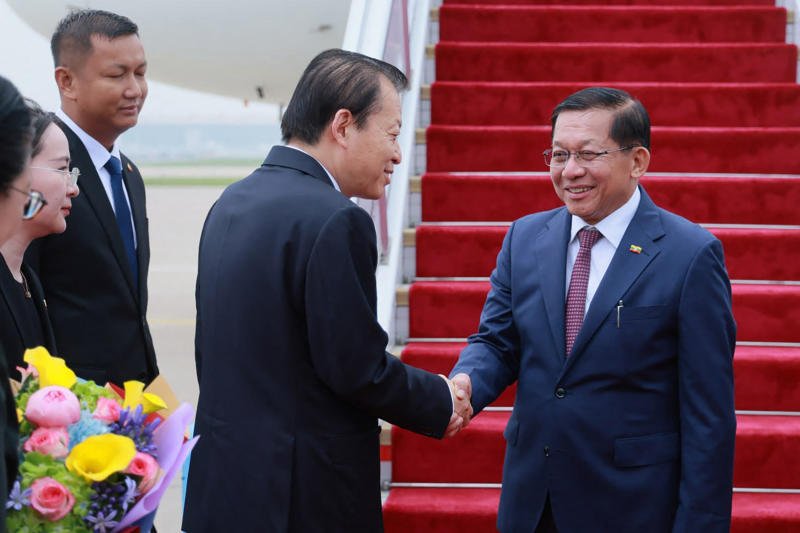
Myanmar's President Min Aung Hlaing, the former junta chief who seized power in a February 2021 coup and has since presided over a devastating civil war that has killed more than 93,000 people and displaced 3.7 million, is receiving the full diplomatic honours of a Chinese state visit hosted by President Xi Jinping, a level of engagement that analysts say delivers a significant legitimacy boost to a leader who has been widely condemned by Western governments and international institutions. The five-day trip represents the highest possible diplomatic recognition Beijing can extend, and it arrives after a carefully sequenced pair of visits that saw Min Aung Hlaing travel to India at the end of last month for talks with Prime Minister Modi, where he received warmth but not the formal honours of an official state visit.China Embraces Myanmar President Amid Legitimacy Push has now provided what India withheld, and the difference in diplomatic grade is a visible signal, as Crisis Group's senior Myanmar adviser Richard Horsey noted, that Beijing "is prepared to deal with Myanmar's new administration as a full partner."
The global politics of this visit extend well beyond the bilateral relationship between Beijing and Naypyidaw. China's decision to embrace Min Aung Hlaing with full state honours at this particular moment, following a military-engineered election in December and January that excluded all major opposition and produced an overwhelming victory for an army-backed party, constitutes a deliberate act of recognition that carries meaning for every government currently deciding how to calibrate its Myanmar policy. For the Western governments and international bodies that have refused to recognise the military administration as legitimate, Beijing's posture is a direct counter-signal: that the international isolation strategy they are pursuing has limits determined by the interests of major powers who have no intention of abandoning strategic relationships in Southeast Asia to preserve a human rights consensus that China has never endorsed. David Mathieson, an independent analyst based in Thailand who closely tracks Myanmar, framed Beijing's calculation with characteristic directness: "China also perceives the West in retreat from Myanmar and Beijing will assert a new suzerainty over the country."
The delegation accompanying Min Aung Hlaing to China includes the chief ministers of Kachin and Shan states, both of which border China, along with Myanmar's industry minister. That composition tells a specific story about what the visit is primarily about beyond the diplomatic optics. Kachin State contains one of the world's major heavy rare earth mining belts, a resource category of acute strategic importance in the global competition between China and the United States for control of the materials underpinning the electric vehicle, defence technology, and clean energy supply chains. Shan State shares multiple trading routes with China. The inclusion of these ministers signals that the substantive agenda of this state visit is extractive and infrastructural, not political or humanitarian, and that China's embrace of Min Aung Hlaing is the price of continued and expanded access to resources and corridors that serve Beijing's strategic interests regardless of who governs Myanmar or how they came to power.
How China Built Its Myanmar Influence Through Belt and Road, Border Management, and Military Partnership
China's current position as Myanmar's dominant external partner was not built during the civil war period but over decades of sustained strategic investment that predates the 2021 coup and reflects a long-term assessment of Myanmar's value to Chinese interests. China is Myanmar's top trading partner and largest investor, and its footprint in the country is anchored by major Belt and Road Initiative projects that include a cross-country oil and gas pipeline and a deep-sea port that together give Beijing a strategic corridor to the Indian Ocean, bypassing the Strait of Malacca chokepoint that would otherwise constrain Chinese energy imports and trade routes in a conflict scenario. Those infrastructure investments are not philanthropy or development aid; they are strategic assets whose value to China increases precisely in scenarios where Myanmar's governance is unstable and dependent on external support, because instability increases the leverage of the partner willing to provide that support without political conditions.
Beijing's relationship with the Myanmar military has been sustained through the coup and the subsequent civil war on a foundation of arms supply and diplomatic cover. China has served as a vital weapons supplier to the Myanmar military throughout the conflict, a role that has drawn international criticism but which Beijing has maintained as consistent with its principle of non-interference in the internal affairs of sovereign states. That principle, applied selectively in ways that consistently favour governments over opposition movements, has allowed China to position itself as a neutral actor while in practice providing the material support that has kept the military competitive against a remarkably effective armed resistance. Beijing has also occasionally brokered ceasefires along parts of the Myanmar-China border, where ethnic armed organisations with deep historical and commercial connections to China hold significant territory, a mediation role that enhances Chinese influence without requiring Beijing to take a public position on the conflict's political dimensions.
The 2021 coup created an immediate crisis in the relationship because China had also developed substantial ties with the elected government led by Aung San Suu Kyi and had invested in the political stability that democratic governance temporarily provided. Beijing's initial response was cautious, neither endorsing the coup nor condemning it, while quietly continuing its commercial and military relationships with the military establishment. As the resistance proved more durable than anticipated and the conflict deepened, China's position shifted toward more explicit engagement with the military administration, including brokering the ceasefire deals that served its border security interests and tolerating, and in some cases facilitating, the economic arrangements that kept military-controlled areas commercially connected to Chinese supply chains. The state visit honours now extended to Min Aung Hlaing represent the culmination of that gradual normalisation, and they come precisely because China has concluded that the military's grip on power, however contested, is durable enough to treat as the effective government of a strategically important neighbour.
What the Myitsone Dam, Rare Earths, and the Min Zin Espionage Case Mean for Regional Order
The specific agenda items that analysts expect to feature in Xi-Min Aung Hlaing discussions reveal the transactional character of the relationship with clarity that the diplomatic language of a state visit typically obscures. The Myitsone Dam, a $3.6 billion Chinese-led hydroelectric project in Kachin State that was shelved in 2011 after massive public protests and then-President Thein Sein's suspension of the project, has been under renewed discussion since Myanmar's military second-in-command General Soe Win personally raised the question of restarting it earlier in 2025. Independent analyst Aung Kyaw Soe told Reuters he expects the dam to feature directly in the current visit discussions, framing it as a natural follow-on from the military leadership's own public signalling. The Myitsone restart would represent a major Chinese investment recovery worth billions of dollars and would give Beijing a significant infrastructure asset in a state where active fighting between the military and the Kachin Independence Army continues.
The rare earth dimension of the visit is arguably the most globally consequential element of the Myanmar-China relationship for the international political economy. Heavy rare earth minerals, concentrated in Kachin State's mining belts, are essential inputs for defence electronics, electric vehicle motors, wind turbines, and a range of advanced manufacturing applications that are central to both the green energy transition and the military technology competition between major powers. China already dominates global rare earth processing capacity and has used export controls on rare earth materials as a trade and geopolitical leverage tool in its competition with the United States. Deepening access to Myanmar's rare earth mining through political arrangements with a government that has no other credible external partners willing to offer comparable investment and diplomatic support gives Beijing another layer of supply chain control in a strategic resource category that rivals are working urgently to diversify away from Chinese dominance.
Hanging over the visit is the recent arrest in China of Min Zin, a prominent American scholar of Myanmar, on espionage suspicion, a development that Richard Horsey of Crisis Group said would draw greater attention precisely because of its timing alongside the state visit. Min Zin is described as one of the most prominent Myanmar scholars working to improve understanding between the two countries, making his arrest a signal about how Beijing is managing the information environment around its Myanmar relationships at a moment of heightened international scrutiny. The intersection of a legitimacy-boosting state visit for a condemned military leader, a rare earth and infrastructure agenda that serves Chinese strategic competition interests, and the arrest of an American academic on espionage charges creates a picture of Chinese Myanmar policy that is comprehensive, strategic, and largely indifferent to the international governance norms that Western governments have been attempting to enforce through isolation and sanctions. For the regional order, the message is that Beijing's model of strategic engagement without political conditions is available to any government, however it came to power and whatever it has done since, that sits on a corridor China considers strategically essential.