
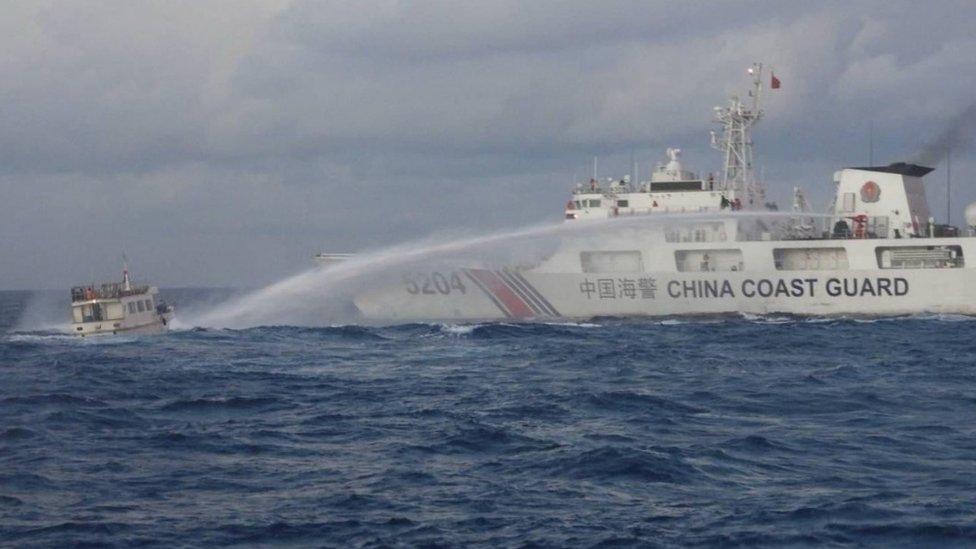
China's Coast Guard fired water cannon at Philippine government vessels near Scarborough Shoal in the South China fires water cannon Sea on both Thursday and Friday, in two of three confrontations between the two countries recorded in a single week. The Philippine Coast Guard reported that on Friday a Chinese vessel came within approximately 7 metres of a Philippine fisheries boat, creating what it described as a serious risk of collision. Spokesperson Jay Tarriela condemned the actions as "dangerous and unprofessional" and stated that Scarborough Shoal was a traditional Filipino fishing ground "whose rights cannot be lawfully impeded by any foreign power."
China's Coast Guard offered a different account, saying it had imposed "control measures" on Philippine vessels it claimed were operating illegally in the waters around the shoal. That framing reflects Beijing's long-standing position that the shoal and the surrounding waters are under Chinese sovereignty, a position that a 2016 international arbitration tribunal rejected in a ruling largely favourable to Manila, and that China has consistently refused to recognise.
The third confrontation of the week took place on Monday at a different location entirely: the disputed Second Thomas Shoal, 650 kilometres from Scarborough. There, Manila said a Filipino sailor was injured after being struck with a baton by Chinese Coast Guard personnel during a confrontation involving a Philippine navy vessel. China accused the Philippine navy of ignoring warnings and attempting to ram a Chinese patrol boat. Both countries subsequently summoned each other's ambassadors in formal protest, a diplomatic escalation that signals neither side intends to de-escalate without a clear concession from the other.
China's maritime strategy and the timing of this week's escalation
Understanding why three confrontations occurred in the same week requires understanding both China's long-term maritime strategy and the specific diplomatic context of this particular week. China's approach to the South China Sea has been characterised by what analysts describe as "grey zone" tactics: assertive actions by coast guard and maritime militia vessels that fall below the threshold of conventional military action, create facts on the water, and test the resolve of rival claimants and their international supporters without triggering a formal military response.
Scarborough Shoal is the centrepiece of that strategy. China effectively seized the shoal from the Philippines in 2012 during a standoff that ended with a US-brokered deal that Beijing then ignored, refusing to withdraw its vessels as agreed. Since then, China has maintained a near-permanent coast guard presence at the shoal, periodically blocking Filipino fishermen from accessing waters that are within the Philippines' Exclusive Economic Zone and that the 2016 arbitration ruling found to be under Filipino fishing rights. The water cannon incidents this week are not a new tactic. They are a continuation of a pattern that has been intensifying over the past two years as the Philippines, under President Ferdinand Marcos Jr, has adopted a more assertive posture and begun publicising confrontations that previous administrations managed more quietly.
The timing this week is the most revealing element of the story. Southeast Asian foreign ministers held regional meetings in Manila attended by both Chinese Foreign Minister Wang Yi and US Secretary of State Marco Rubio. The confrontations at Scarborough Shoal on Thursday and Friday occurred while those meetings were ongoing. China deploying water cannon on Philippine coast guard and fisheries vessels while its own foreign minister is in the Philippines' capital attending regional diplomacy is a deliberate signal: Beijing will not modify its behaviour in the South China Sea in response to diplomatic gatherings, regardless of who else is in the room. Rubio called China's actions "disturbing" and reaffirmed US support for the Philippines under the bilateral defence treaty. The Chinese actions continued regardless.
Five days that defined the South China Sea in July 2026
Monday July 21
Confrontation at Second Thomas Shoal, 650 km from Scarborough. Philippines says a Filipino sailor is struck with a baton by Chinese Coast Guard personnel. China accuses Philippine navy of attempting to ram a Chinese patrol boat. Both countries summon each other's ambassadors.
Thursday July 24
First water cannon incident at Scarborough Shoal. Chinese vessels deploy water cannon against Philippine government boats. Southeast Asian foreign ministers begin regional meetings in Manila attended by Wang Yi and Rubio.
Friday July 25
Second consecutive water cannon incident at Scarborough Shoal. Chinese vessel comes within 7 metres of Philippine fisheries boat, creating a serious collision risk. Philippine Coast Guard condemns actions as "dangerous and unprofessional." Rubio calls China's behaviour "disturbing" and reaffirms US defence treaty support for Manila. Regional meetings in Manila conclude.
The geography of the dispute: why Scarborough Shoal and Second Thomas Shoal are both flashpoints
Key features in the South China Sea dispute
Scarborough ShoalWithin the Philippines' Exclusive Economic Zone. Occupied by China since 2012. Known in China as Huangyan Island. Traditional Filipino fishing ground. 2016 arbitration ruled Chinese blockade illegal. China does not recognise the ruling.
Second Thomas Shoal650 km from Scarborough. Site of the BRP Sierra Madre, a deliberately grounded Philippine navy ship maintained as a military presence. China disputes Philippine access for resupply missions. Filipino sailor injured by baton strike there on Monday.
China's claimBeijing claims sovereignty over almost the entire South China Sea under the "nine-dash line," including areas within the EEZs of the Philippines, Vietnam, Malaysia, Brunei, and Indonesia.
2016 rulingInternational arbitration tribunal found China's nine-dash line claims had no legal basis and that its Scarborough blockade violated international law. China refused to recognise the ruling and has not complied with it.
US positionThe US-Philippines Mutual Defence Treaty obliges the US to treat an armed attack on Philippine forces as an attack on the US. Washington has repeatedly reaffirmed this applies in the South China Sea.
Scarborough Shoal sits within the Philippines' Exclusive Economic Zone as defined by the United Nations Convention on the Law of the Sea. China does not recognise the concept of a Philippine EEZ in waters it claims under its own historical assertions, which have been rejected by the only international legal body that has adjudicated on them. The 2016 tribunal ruling was unambiguous: China's expansive claims had no legal basis in international law. China's response was equally unambiguous: it dismissed the ruling as null and void and has never modified its behaviour in response to it.
Second Thomas Shoal represents a different but related dimension of the dispute. The Philippines deliberately grounded an aged navy ship, the BRP Sierra Madre, on the shoal decades ago as a means of maintaining a military presence and asserting sovereignty. China has repeatedly attempted to prevent Philippine resupply missions from reaching the vessel, creating an ongoing cycle of confrontations at the shoal that has intensified significantly over the past two years. The baton strike on Monday, in which a Filipino sailor was directly and physically assaulted by Chinese Coast Guard personnel, crossed a threshold that previous confrontations at the shoal had not reached and generated the most severe formal diplomatic response of the week.
What three confrontations in one week mean for China-US-Philippines relations
The political significance of this week's confrontations is amplified by their diplomatic context. Rubio's presence in Manila for the regional meetings, combined with his public statement calling China's behaviour "disturbing" and reaffirming US treaty obligations to the Philippines, puts the United States' position on record in the clearest terms it has been stated in recent months. The Trump administration's relationship with China has been complex and transactional across multiple issues, but the defence treaty relationship with the Philippines has been consistently upheld, and Rubio's statement reinforces that the US will not allow ambiguity about whether that treaty covers exactly the kinds of coast guard confrontations that occurred this week.
For China, the calculus is different. Wang Yi's presence in Manila at the same time as Rubio, while Chinese coast guard vessels were firing water cannon on Philippine boats, reflects Beijing's consistent position that it treats maritime enforcement operations and diplomatic engagement as separate tracks that do not constrain each other. Chinese officials attending ASEAN gatherings while Chinese vessels conduct assertive operations in disputed waters is a pattern that has been observed repeatedly and that serves a deliberate dual purpose: maintaining the appearance of a China willing to engage in multilateral diplomacy while making clear through actions that its maritime claims will not be subject to diplomatic concession.
For the Philippines, the publicisation strategy that the Marcos administration has pursued is producing results in terms of international attention but has not yet produced a change in Chinese behaviour. Manila has been releasing real-time video and photographic documentation of confrontations, making it significantly harder for China to deny or minimise incidents that were previously managed through quiet diplomatic channels. That transparency has rallied international support, particularly from the US, EU, Japan, and Australia, but China's coast guard operations have continued and in some respects intensified. The political bet Manila is making is that sustained international attention will eventually impose a diplomatic cost on Beijing that modifies its behaviour. That bet has not yet paid off.
Fishing rights, trade routes, and the cost of South China Sea instability
The economic dimensions of the South China Sea dispute are often underestimated in coverage that focuses on the military and geopolitical aspects. For Filipino fishing communities, the confrontations at Scarborough Shoal are not abstract territorial disputes. They are direct interference with livelihoods that have depended on access to traditional fishing grounds for generations. China's coast guard presence at the shoal has periodically blocked Filipino fishermen from waters that are legally within their country's EEZ and where fishing rights were affirmed by the 2016 arbitration ruling. The economic impact on those communities, which are among the Philippines' most economically marginal, is real and ongoing.
The South China Sea carries approximately one-third of global maritime trade, estimated at over $3 trillion annually. The waterway connects the manufacturing economies of East and Southeast Asia with markets in Europe, the Middle East, and South Asia. Any sustained escalation that threatens freedom of navigation in the South China Sea would impose costs on global supply chains that extend far beyond the immediate parties to the dispute. Oil and gas reserves in the South China Sea are also significant, estimated by various assessments at billions of barrels of proven and potential reserves, with overlapping claims between China and Southeast Asian nations over the rights to exploit them.
For energy and shipping markets, the incidents this week represent a familiar pattern of managed tension that has not yet reached the level of disruption that would materially affect trade flows or insurance premiums. But the trajectory of escalation, from verbal confrontations to water cannon to baton strikes to ambassadors being summoned, is moving in a direction that investors and shipping companies with exposure to South China Sea routes will be monitoring carefully. The question financial markets are asking is not whether this week's incidents will disrupt trade, but whether the cumulative direction of the dispute is moving toward a level of confrontation that begins to price in sovereign risk in ways that current insurance and freight assessments have not yet fully reflected.
What the South China Sea dispute means for regional trade and investment
For multinational businesses with operations in the Philippines, Vietnam, Malaysia, and other Southeast Asian nations with South China Sea claims, the sustained territorial dispute creates a category of geopolitical risk that has become structural rather than episodic. Supply chains routed through the South China Sea, energy projects in contested waters, and investment decisions in countries that are in active territorial confrontation with China all carry a risk premium that has been growing as incidents become more frequent and more severe.
The fishing sector impact is the most direct and immediate. Filipino fishermen who rely on Scarborough Shoal for their livelihoods face an operational environment that is increasingly dangerous and unpredictable. Chinese coast guard vessels that fire water cannon and close to within metres of fishing boats are creating conditions that discourage Filipino fishermen from exercising the rights the 2016 arbitration affirmed they have. The economic displacement of those communities, which have no comparable alternative fishing grounds, is a concrete and measurable cost that is largely invisible in coverage focused on geopolitical strategy.
For foreign direct investment in the Philippines more broadly, sustained South China Sea confrontations create a security environment perception problem that Philippine officials have to manage carefully. The Marcos government's strategy of publicising confrontations is designed partly to demonstrate that the Philippines is asserting its rights rather than acquiescing, which supports the sovereign credibility that foreign investors assess when making long-term commitments. Whether that strategy succeeds in improving investor confidence or increases concern about the security environment depends on how the confrontations develop in the coming months.
The ASEAN context and what the week's events mean for the rules-based maritime order
The broader significance of this week's confrontations extends to the question of whether international law and arbitration decisions carry any practical weight in managing state behaviour in contested maritime zones. The 2016 arbitration ruling was the most authoritative international legal judgment on South China Sea claims that has been delivered. It found China's expansive historical claims had no legal basis, that its Scarborough blockade violated international law, and that Philippine fishermen had rights in those waters that China was obligated to respect. China refused to recognise the ruling, has not complied with it, and the international community has not imposed any consequence on Beijing that has changed that calculus.
The pattern established by China's non-compliance with the 2016 ruling, and the absence of effective international enforcement, has implications that extend well beyond the South China Sea. It signals to other revisionist powers considering maritime boundary changes that international legal decisions without enforcement mechanisms carry limited practical constraint on state behaviour. Russia, Iran, and others have noted the precedent. The question of how to make international maritime law meaningful when the country violating it is a permanent UN Security Council member and one of the world's largest economies is one that the international community has not found an answer to.
ASEAN's response to this week's confrontations will be closely watched. The regional body has historically struggled to produce unified positions on South China Sea issues because several of its members, including Cambodia and Laos, have economic relationships with China that make them reluctant to support language that Beijing opposes. The regional meetings in Manila this week concluded with Chinese and American foreign ministers both present. Whether the discussions produced any concrete agreement on managing South China Sea conduct, or whether they produced the kind of carefully worded communique that acknowledges tensions without committing to any mechanism for addressing them, will reveal something important about how much diplomatic leverage the Philippines and its supporters can actually exercise on China's behaviour in the water.
The escalation pattern and its limits
The week's confrontations follow a pattern that China scholars and security analysts have described as "salami slicing": a series of incremental assertive actions, each individually below the threshold that would trigger a military response, that collectively advance China's effective control over contested maritime space. Water cannon is not a weapon of war. Baton strikes on sailors are serious but fall short of lethal force. Coming within 7 metres of a fishing boat creates a collision risk but does not constitute an attack. Each individual action is deniable, minimisable, and ambiguous enough to avoid triggering the mutual defence treaty threshold that would formally draw the United States into a military confrontation with China.
The Philippines' publicisation strategy is a deliberate counter to this approach. By releasing real-time documentation of each incident, Manila is attempting to make the cumulative pattern visible in ways that individual deniability cannot obscure. The goal is to build an international record of Chinese behaviour that establishes a clear trajectory and creates political costs for Beijing that are proportionate to actions that individually seem manageable but collectively represent a sustained campaign of coercion. Whether that strategy succeeds depends on whether the international community, and particularly the United States, maintains the political will to impose costs on China that modify the incentive calculation driving its coast guard operations.
"The PCG strongly condemns the dangerous and unprofessional actions of the China Coast Guard. Scarborough Shoal is a traditional fishing ground of Filipinos whose rights cannot be lawfully impeded by any foreign power."
Jay Tarriela, spokesperson, Philippine Coast Guard, July 25, 2026
China deployed water cannon on Philippine vessels while its own foreign minister was attending regional meetings in Manila. The message was deliberate: Beijing will not modify its maritime behaviour in response to diplomacy, regardless of who is in the room.
What happens next
The immediate near-term question is whether the week's confrontations represent a temporary intensification that will subside following the conclusion of the Manila regional meetings, or whether they signal a sustained escalation in Chinese coast guard operations that will continue regardless of diplomatic context. China's track record at Scarborough Shoal since 2012 suggests the latter is more likely: the operations have been persistent, have intensified during periods of heightened diplomatic engagement rather than moderating in response to them, and have not been constrained by any bilateral or multilateral agreement that has so far held.
The baton strike on a Filipino sailor at Second Thomas Shoal on Monday is the most serious physical incident of the week and the one most likely to produce a sustained diplomatic response from the United States. Rubio's description of China's actions as "disturbing" is a public statement of displeasure but falls short of the formal diplomatic or economic consequence that would signal a genuine change in US calculus about how to respond to Chinese coast guard operations in the South China Sea. Whether the Trump administration escalates beyond public statements to some form of tangible consequence for Beijing will be the defining question of the next phase of this dispute.
For ordinary Filipino fishermen, the question is more immediate and more personal. Scarborough Shoal has been their traditional fishing ground for generations. The 2016 arbitration affirmed their rights there. China's coast guard operations have made exercising those rights dangerous and unpredictable. Whether the political and diplomatic contest between Manila and Beijing eventually produces an outcome that allows Filipino fishermen to return to Scarborough Shoal in safety is the human dimension of a dispute that is too often discussed in purely strategic terms.