
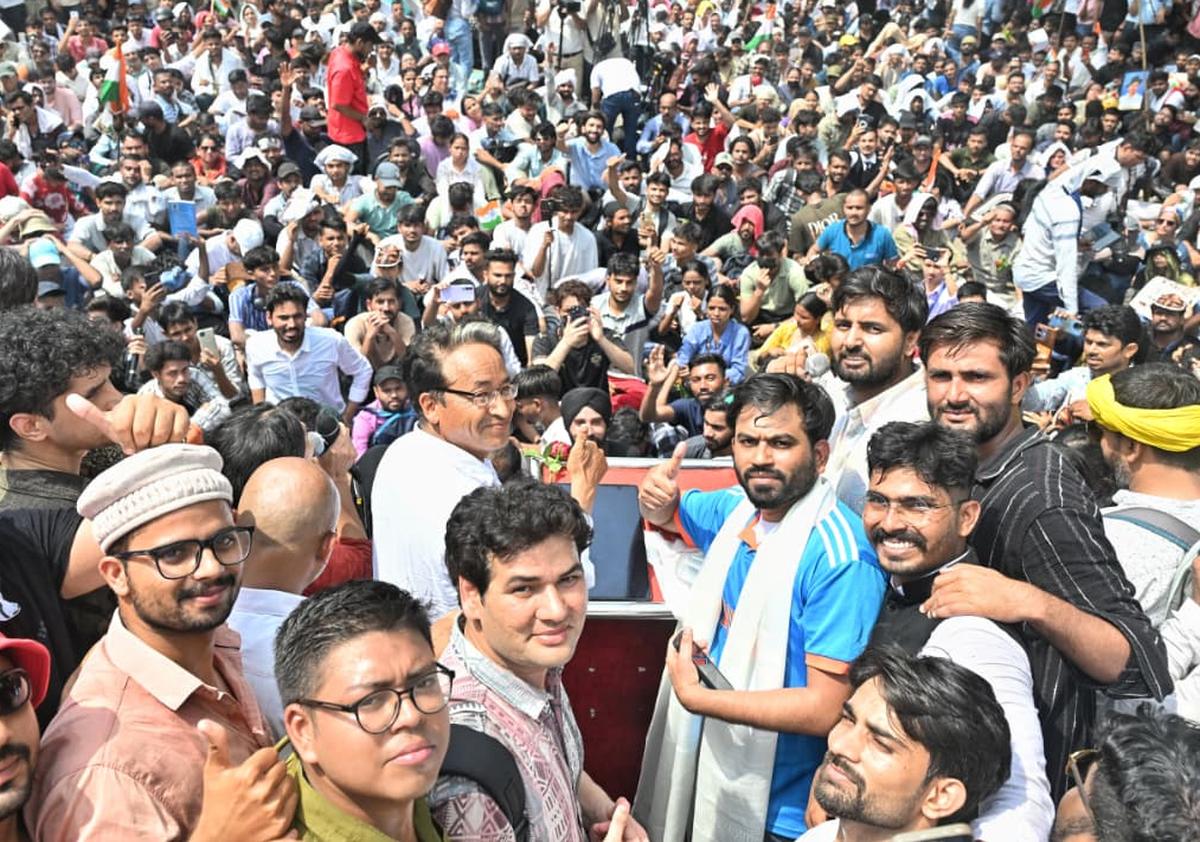
Cockroach Janta Party Jantar Mantar protest Delhi education 2026 has brought hundreds of young Indians onto the streets of the national capital on Saturday, with school students, college-goers, competitive exam aspirants, and their parents gathering at one of India's most historically significant protest sites to demand the resignation of Union Education Minister Dharmendra Pradhan over examination-related lapses including question paper leaks, technical glitches, and the accountability failures that have shaken young people's confidence in the examination system that determines their educational and professional futures. The movement's founder Abhijeet Dipke flew back to India from Boston specifically for the demonstration, arriving at Indira Gandhi International Airport and telling supporters he had felt as though he was living his last moments of freedom as the plane landed, and that he was fully prepared to sacrifice his freedom for the cause, a statement that captured the emotional stakes of a movement whose transformation from satirical online phenomenon to organised street protest with paramilitary security deployment documents the speed and seriousness with which Indian youth political energy has been channelled into concrete accountability demands. Climate activist and education reformer Sonam Wangchuk joined the protest at Jantar Mantar, having previously announced he would attend if Minister Pradhan had not resigned by June 5, and stated he would undertake a six-week fast if Dipke was arrested, transforming his presence from a celebrity endorsement into a specific personal commitment that amplifies the protest's stakes.
The accountability demand at the heart of Saturday's protest is not abstract political theatre but the expression of a specific and documented grievance about the examination system that governs access to medical colleges, engineering programmes, and other competitive higher education streams that represent the primary pathway to professional mobility for hundreds of millions of Indian families. The NEET and CBSE examination controversies that NCP SP MLA Rohit Pawar cited in his statement of support for the CJP protest, describing recurring irregularities including question paper leaks and technical glitches that have directly affected young people and triggered widespread anger, are the concrete policy failures that give the satirical movement's accountability rhetoric its substantive foundation. Sixteen-year-old medical college aspirant Utkarsh Raj, speaking to AFP at the protest site while police officers in riot gear watched nearby, articulated the core grievance with the directness of someone whose future is directly affected: we want accountability from the government and how is it that exam papers get leaked in this country.
The deployment of more than 1,000 police personnel across New Delhi, including at Indira Gandhi International Airport, border entry points, and other sensitive locations, as well as the preventive detention of six individuals who were found attempting to create a disturbance near the protest site, documents the institutional seriousness with which the Delhi establishment is treating a movement that began as internet satire and has now produced organised mass street presence under heavy security. The CJP's own circulation of guidelines urging non-violent conduct and respectful engagement with law enforcement, reinforced by Dipke's repeated appeals for peace and discipline, reflects the movement's conscious strategy of maintaining the moral authority that peaceful protest provides while navigating the police presence that any large-scale demonstration in the national capital attracts. The contrast between protesters carrying paper cockroach masks and flowers and the police officers in riot gear creates the visual tension that photographs from Jantar Mantar are documenting, where the movement's deliberately non-threatening aesthetic meets the state's security apparatus in the frame that tells the accountability story most powerfully.
How Examination Scandals and Political Alienation Created the CJP Movement's Accountability Demand
The National Eligibility cum Entrance Test and the Central Board of Secondary Education examinations represent the two most consequential examination systems in the lives of India's student population, with NEET determining access to medical college seats whose limited supply relative to the hundreds of thousands of aspirants creates the extraordinarily high stakes environment that makes any examination irregularity catastrophically unjust for the students who have invested years of preparation. The question paper leaks that have been documented in multiple examination cycles, the technical glitches that have disrupted examination delivery, and the uncertainty about results that has left students in extended limbo while their academic and career timelines are disrupted represent the specific accountability failures that the protest is demanding accountability for, not as isolated incidents but as a pattern of systemic failure that the responsible ministry has not adequately investigated, admitted, or corrected. The political economy of examination administration in India, where coaching industry interests, state board politics, and central ministry accountability intersect in complex and sometimes corrupt ways, makes the accountability demands of the CJP protest not simply a student grievance but a systemic governance challenge whose resolution requires political will at the ministerial level.
The decision to demand the resignation of a specific minister rather than the correction of a system reflects the CJP's political accountability logic, which treats individual ministerial responsibility as the mechanism through which democratic accountability for policy failure is delivered. Education Minister Dharmendra Pradhan's continued tenure despite the examination controversies documented under his ministerial watch is the specific accountability gap that the protest is designed to close, applying the principle that democratic accountability requires consequences for governance failures rather than managed communication and institutional continuity regardless of outcomes. The standard government response to examination controversies, involving commitments to investigation and reform without admission of systemic failure or ministerial responsibility, is precisely what the CJP protest is contesting, demanding the more direct form of accountability that resignation represents in parliamentary democratic systems where ministerial responsibility is supposed to be a meaningful governing principle rather than a rhetorical commitment.
The scale of India's youth population and the specific concentration of examination system grievances among the age cohort that both sits competitive examinations and has the digital fluency to participate in online political movements creates the demographic precondition for the CJP's rapid growth from satirical concept to mass movement. India's approximately 700 million people under 30, many of whom have either directly experienced examination controversies or know peers and family members who have, represent a political constituency whose concerns about the examination system are concrete, personally felt, and directly connected to their economic futures in ways that make the accountability demand viscerally meaningful rather than abstractly political. The CJP's success in mobilising this population through the internet culture language of memes, hashtags, and self-deprecating identity claims documented in its 10 million Instagram followers has created the awareness and emotional solidarity that Saturday's physical presence at Jantar Mantar is translating into the visible street accountability demand.
The Online to Offline Movement Transition and What It Demonstrates
The CJP's transition from an online satirical movement to an organised street protest represents the specific political trajectory whose completion at Jantar Mantar on Saturday tests whether the digital energy that accumulated around a cockroach-themed meme party can sustain itself through the more demanding conditions of physical protest organisation, police deployment, and the legal risk that Dipke's prepared to sacrifice his freedom comment explicitly acknowledged. Online movements that generate extraordinary digital engagement frequently struggle to convert that energy into the sustained physical and organisational presence that produces durable political change, and the success of Saturday's Jantar Mantar demonstration in drawing hundreds of young people despite heavy police presence and the preventive detention of six people is itself an accountability demonstration, showing the government and political establishment that the CJP's constituency is real, motivated, and willing to accept the personal risk of physical protest to make its accountability demands visible. Dipke's return from Boston to lead the protest rather than managing it remotely is the specific personal commitment that signals the movement's determination to advance from online phenomenon to street-level political force, accepting the legal risks of being on Indian soil while participating in a demonstration that the political establishment clearly considers significant enough to warrant major security deployment.
Wangchuk's participation brings a specific kind of validation to the CJP's accountability demands that the satirical movement's own identity cannot provide, because his established record of climate activism, his 2023 fast in Ladakh that drew national attention, and his standing as a credible voice on governance and institutional accountability give the CJP protest access to the moral authority that institutional recognition provides. The announcement that he would undertake a six-week fast if Dipke was arrested converts his participation from endorsement to direct personal stake, creating the specific solidarity signal that tells the government that any attempt to suppress the protest through the arrest of its founder would produce the kind of high-profile hunger strike response that carries its own significant political cost. The combination of Dipke's personal risk acceptance and Wangchuk's solidarity commitment creates the accountability pressure dynamic that moves the protest beyond a one-day demonstration toward the beginning of a sustained campaign whose resolution requires a governmental response.
The Demands, the State Response, and What Accountability Requires
The specific demand for Education Minister Pradhan's resignation, as distinct from demands for investigation or reform, reflects the CJP's assessment that the accountability gap in the examination system cannot be adequately addressed without the ministerial consequence that resignation represents. Several participants who spoke at the protest, expressing disappointment with both the BJP and the opposition parties for failing to adequately address issues affecting young people, document the political alienation that the CJP is channelling into a specific accountability demand rather than a generalised protest against the political system. The support from NCP SP's Rohit Pawar, whose party is part of the opposition constellation, provides the political backing that gives the protest some institutional legitimacy without compromising its independence from party structures, though the CJP's explicit non-alignment with established parties is central to its appeal to the young people who see both ruling and opposition parties as failing to represent their interests.
The government's response to Saturday's protest, represented most visibly in the massive security deployment, the preventive detentions, and the drone hovering over demonstrators displaying a peaceful protest banner, reflects the establishment's assessment that the CJP's accountability demand requires containment rather than engagement, at least in the immediate protest context. A government that deploys 1,000 police officers to manage a peaceful student demonstration about examination irregularities is demonstrating through its security posture that it takes the protest seriously as a political threat while not yet offering the substantive response to the accountability demand that would provide the most direct and effective way of addressing the protest's concerns. The absence of any Pradhan resignation announcement or formal government response to the accountability demand before Saturday's demonstration proceeded, despite Wangchuk's June 5 resignation deadline, indicates the government's current calculation that managing the protest through security rather than through accountability is its preferred approach.
The six-week fast commitment from Wangchuk if Dipke is arrested, and Dipke's own arrest risk acceptance, establish the specific escalation pathway that makes the government's security response and its absence of substantive accountability a short-term management rather than a resolution. If Dipke is arrested, the fast begins and the political cost of the arrest immediately escalates beyond the protest itself to the institutional response that a high-profile hunger strike by a credible public figure commands. If Dipke is not arrested and the protest concludes without a government accountability response, the CJP must decide whether to sustain the momentum that Jantar Mantar has generated through further demonstrations, through the examination reform advocacy that the accountability demand implies, or through the political organisation that translates movement energy into durable institutional presence.