
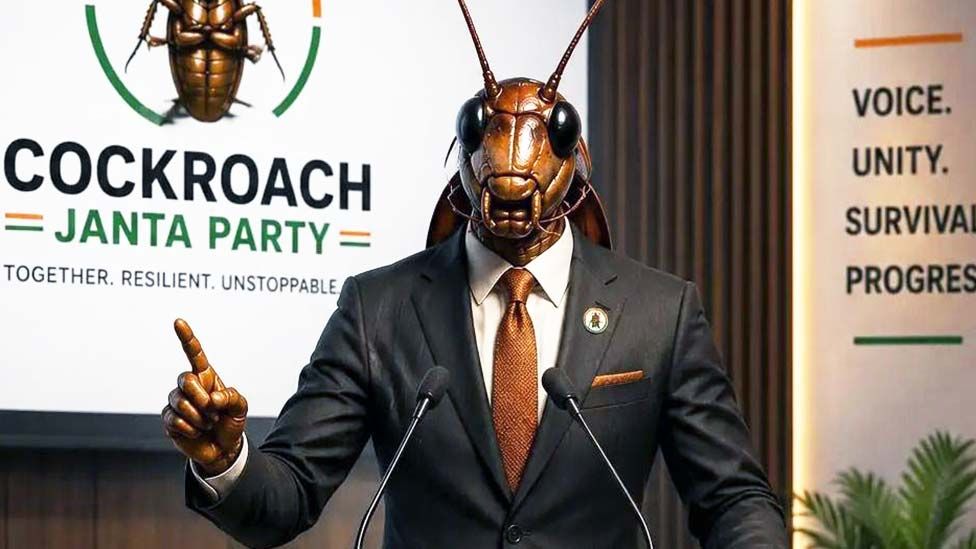
Cockroach Janta Party India youth politics CJP 2026 has emerged as one of the most unexpected and revealing political phenomena in recent Indian democratic history, with a satirical online collective named after one of nature's most reviled insects accumulating 10 million Instagram followers in less than a week, surpassing the official account of the BJP, widely described as the world's largest political party by membership, which has approximately 8.7 million Instagram followers, and attracting endorsements from opposition leaders, tens of thousands of membership sign-ups, and mainstream media attention that has made veteran politicians sit up and take notice. The movement was born from a moment of institutional controversy: India's Chief Justice Surya Kant allegedly compared unemployed young people drifting toward journalism and activism to cockroaches and parasites during a hearing, a characterisation that he later clarified was directed specifically at people with fake and bogus degrees rather than India's youth broadly, but whose spread online had already triggered the combination of outrage, humour, and political imagination that created the Cockroach Janta Party as a collective response. The CJP's name is an explicit parody of Prime Minister Narendra Modi's Bharatiya Janata Party, and its rapid growth has become both a marker of generational frustration among young Indians who feel underrepresented in formal politics and a test of whether online cultural energy can translate into meaningful political change.
The CJP was created by Abhijeet Dipke, a political communications strategist and Boston University student who previously worked with the Aam Aadmi Party in India, and who told BBC Marathi that the idea came as a joke but produced results far beyond his expectations. Within days the movement had amassed tens of thousands of sign-ups through a Google form, sparked the hashtag MainBhiCockroach, which translates as I too am a cockroach, and attracted endorsements from opposition politicians including Akhilesh Yadav who posted BJP versus CJP on X, and Mahua Moitra and Kirti Azad alongside senior lawyer Prashant Bhushan. The CJP's membership criteria reflect the satirical register that has made it resonate with its audience: being unemployed, lazy, chronically online, and having the ability to rant professionally are listed as requirements, capturing the self-aware irony of a generation that has absorbed enough political disappointment to have given up on earnest engagement while still caring enough about the underlying injustices to express frustration in every medium available to it.
The movement's X account with more than 200,000 followers is currently not visible in India, with users trying to access it told that it has been withheld in response to a legal demand, a development whose significance in the context of a satirical political movement that parodies the ruling party is not lost on the observers, critics, and supporters who have noted the restriction. The withholding of the CJP's X account in India while its Instagram account continues to grow has become itself a talking point that reinforces the movement's narrative about press freedom, political dissent, and the treatment of critical voices in the current political environment, adding an additional layer of political resonance to what began as internet humour about an insect metaphor from a judge's courtroom remarks.
How India's Chief Justice Comment Sparked a Cultural and Political Moment
India's Chief Justice Surya Kant's remarks during a hearing, in which he allegedly compared unemployed young people drifting toward journalism and activism to cockroaches and parasites, arrived in an online environment primed for exactly this kind of institutional language to become a viral catalyst, because the combination of judicial authority, the specific characterisation of a generation's professional and political choices as pest-like, and the broader political context of debates about press freedom and civil liberties in India created the perfect storm of outrage and darkly ironic recognition that internet culture converts into memes, hashtags, and movements. The Chief Justice's subsequent clarification that he was referring specifically to people with fake and bogus degrees rather than India's youth broadly addressed the literal content of the comment without fully addressing the political and symbolic resonance of having a senior judicial figure reach for the cockroach metaphor in the first place, particularly in a political climate where critics of the government have felt the pressure of institutional hostility toward dissent.
The comment's transformation into the CJP reflects a specific form of political judo that online communities have refined across multiple countries and political contexts, in which an attempted insult is absorbed and redirected as a badge of identity by the people it was intended to diminish. By adopting the cockroach identity enthusiastically, the CJP's members are doing what cockroaches allegedly do in nature: refusing to be exterminated, surviving hostile conditions, and proliferating despite being unwanted by those who hold institutional power. The self-description as indestructible, stubborn, and reviled is not an acceptance of the Chief Justice's negative characterisation but a reframing of those attributes as virtues for a generation that has been told its frustrations are illegitimate, its career choices are parasitic, and its political engagement is unwelcome.
India's generational demographics give the CJP phenomenon its particular political salience, because roughly half of the country's 1.4 billion people are under 30 years old in a country where formal political participation among young people remains limited, with a recent survey finding that 29 percent of young Indians avoided political engagement altogether while only 11 percent were members of a political party. The gap between the scale of India's young population and their formal political representation creates the structural conditions in which a satirical online movement can achieve extraordinary reach by providing a form of political expression that feels authentic to a generation that has largely abandoned conventional political participation without abandoning political opinions. Dipke's observation that Gen Z has given up on traditional political parties and wants to create its own political front in a language they understand is both a diagnosis of the CJP's appeal and a description of the broader political disengagement that the movement briefly converts into participation.
The Cockroach as Political Symbol and Its Cultural Resonance
The choice of the cockroach as the CJP's mascot is not accidental or purely reactive to the Chief Justice's comment but reflects a deeper symbolic logic that has made the insect's adoption feel both surprising and immediately right. The cockroach is not heroic, aspirational, or conventionally appealing as a political symbol, making it the anti-mascot that precisely captures the mood of a generation whose relationship to political aspiration has been defined by disappointment rather than inspiration. Conventional political parties ask supporters to identify with strength, virtue, progress, or national achievement, while the CJP asks supporters to identify with resilience, adaptability, and survival under hostile conditions with very low expectations, a register of political identity that resonates more authentically with the lived experience of many young Indians navigating economic uncertainty, political alienation, and institutional indifference to their concerns.
The movement's website reflects the same sensibility as its mascot choice, reading less like a manifesto and more like something shaped inside internet culture, describing itself as the voice of the lazy and unemployed while claiming zero sponsors and one stubborn swarm. The deliberately rough edges, mock forms, and visual language closer to an inside joke than an institution are not signs of amateurism but deliberate aesthetic choices that signal authenticity within a cultural framework where the over-produced institutional presentation of conventional political parties is itself a marker of inauthenticity. Buried within the humour are recognisable political claims about accountability, media reform, electoral transparency, and expanded representation for women, the conventional reform agenda of centre-left opposition politics expressed in a register that reaches audiences who would never read a party manifesto.
Opposition Endorsements, the X Restriction, and What Comes Next
The endorsements that senior opposition politicians including Akhilesh Yadav have given to the CJP movement introduce a complicating dynamic to a phenomenon whose appeal rests partly on its independence from the conventional political system that both the BJP and the opposition parties represent. A satirical movement that parodies the ruling party while receiving endorsements from the opposition's most prominent figures occupies an ambiguous position between genuine grassroots cultural phenomenon and opposition political tool, and the criticism from detractors who point to Dipke's earlier AAP association and argue the CJP is less spontaneous rebellion than carefully packaged digital politics reflects this ambiguity. The question of whether the CJP represents authentic generational frustration or opposition digital strategy packaging is not simply a factual question but a political narrative contest whose outcome will significantly affect whether the movement's energy is sustained or dissipated.
Dipke's own framing of the CJP as reflecting frustration that spans conventional political allegiances, and his rejection of the characterisation that it is simply an opposition front, is the necessary public position for a movement whose authenticity is its primary asset, because a satirical anti-establishment movement that is visibly captured by an establishment opposition loses the independence that makes it attractive to the young people who feel equally unrepresented by all conventional political options. The CJP's ability to maintain the perception of independence from established parties while receiving their endorsements and benefiting from their promotional amplification will determine whether its growth continues or whether the association with conventional opposition politicians reduces its appeal among the apolitical and politically alienated young people it has most successfully reached.
The withholding of the CJP's X account in India in response to a legal demand, while its Instagram continues to grow, has added a dimension to the movement's narrative that could sustain or amplify its momentum by demonstrating the institutional response to critical political expression that the movement's founders have been arguing motivates their creation of alternative political languages. Whether the legal demand originates from the government, from individuals mentioned in the account's content, or from other sources is unknown, but its timing and visibility within the CJP controversy means it will be interpreted through the political lens of a movement that explicitly challenges the current government's approach to political dissent, press freedom, and civil liberties. The cockroach's supposed indestructibility in the face of attempted extermination is exactly the narrative that a platform restriction tends to reinforce rather than undermine for a movement whose identity is built around surviving institutional hostility.