
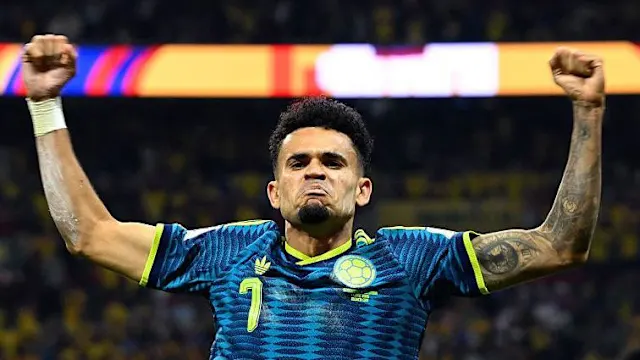
Colombia made a winning return Daniel Munoz Volleys to the FIFA World Cup with a 3-1 victory over debutants Uzbekistan at the iconic Estadio Azteca in Mexico City, a result that sends the South Americans to the top of Group K and delivers a statement of intent in one of the tournament's more intriguing groups. It was Colombia's first World Cup appearance since 2018 after they failed to qualify for the 2022 edition in Qatar, making the three points not just strategically important but emotionally significant for a football nation that prides itself on its attacking identity and had endured four years of frustration watching from home. Former Liverpool forward Luis Diaz, now at Bayern Munich, scored his first-ever World Cup goal in the process, a moment that will be replayed extensively given his profile and the quality of what preceded it in a performance that confirmed his form from a brilliant debut Bundesliga season had carried seamlessly into the tournament.
The Estadio Azteca, which has hosted two previous World Cup finals and carries the weight of football history in every corner of its structure, provided a fitting backdrop for what turned into a genuinely competitive encounter rather than the comfortable Colombia win the pre-match rankings might have suggested. Uzbekistan, ranked 50th in the world, are at their first-ever World Cup finals and arrived under the coaching of Fabio Cannavaro, the Italian World Cup-winning defender and former Ballon d'Or winner whose management career has taken him across Asia and the Middle East. Cannavaro's side showed throughout the match that they had been organised and prepared thoughtfully, equalising in the second half and creating a late chance to make it 2-2 before Colombia's substitute sealed the points. The result reflects the gulf in experience between the two sides while doing justice to what Uzbekistan brought to their debut.
Group K also features Portugal and DR Congo, who drew 1-1 in the group's other game on the same day. Uzbekistan face Portugal on Tuesday at 18:00 BST, a match that will test whether they can take a point from one of the tournament favourites after their competitive Azteca performance. Colombia take on DR Congo on Wednesday at 03:00 BST. The early standings, with Colombia on three points and the other three sides on one each, set up a genuinely open group in which qualification from the top two remains contested and every game in the remaining two rounds will carry direct knockout implications.
Why Colombia's Return Matters and What Diaz's World Cup Goal Means for His Career
Colombia's absence from the 2022 World Cup was one of the more surprising qualification failures in South American football given the country's history of producing technically gifted, attacking players capable of competing at the highest level. The South American qualification format, where ten nations contest nine places in a continuous round-robin across home and away fixtures, is relentlessly demanding, and Colombia's failure to navigate it in the 2022 cycle was the culmination of a period of inconsistent results that frustrated supporters who remembered the excitement of the 2014 and 2018 World Cups. Their return to the finals in 2026, achieved through a qualification campaign that saw them play with the attacking intensity that has always defined Colombian football at its best, was celebrated as a restoration of a natural order that the 2022 absence had disrupted.
For Luis Diaz specifically, the World Cup goal carries significance that extends beyond the single match context. Diaz has been one of the most consistently impressive wide forwards in European football over the past three seasons, winning the Premier League with Liverpool in 2024-25 before completing a £65.5 million transfer to Bayern Munich last summer. His debut season in Munich was exceptional by any measure: 15 goals and 14 assists across all competitions, contributions that helped Bayern win the German league and cup double and confirmed that the step up from a Liverpool side already at the summit of English football to one of Europe's most demanding projects had been taken in full stride. A World Cup goal, arriving in his country's first game back at the finals after a four-year absence, adds a chapter to his career narrative that pure club football cannot provide.
Daniel Munoz's opening goal deserves its own explanation for readers less familiar with the Colombian defender, whose profile in England has grown steadily since joining Crystal Palace. The finish, a full-stretch volley connecting with Diaz's precise forward pass, was the kind of goal that goalscoring forwards spend careers attempting and defenders almost never produce. Munoz's ability to arrive in advanced positions and contribute offensively is one of the qualities that makes Colombia's right side so productive when he and Diaz combine, and the Azteca goal was a showcase of exactly that partnership. For Crystal Palace supporters watching at home, it was a reminder of a player whose contribution to their club's season has consistently been undervalued by those who only track his defensive statistics.
How the Match Unfolded, What Each Goal Meant Tactically, and Why Uzbekistan's Performance Matters
The match's opening phase saw Colombia control possession and territory while Uzbekistan organised defensively in a compact shape under Cannavaro's instructions. The breakthrough came through individual quality: Diaz hit the post with an earlier attempt that should have been a warning for Uzbekistan, and when Munoz arrived at the far post to meet Diaz's pass with a technically demanding volley, it rewarded Colombia's sustained pressure with a goal that reflected the quality differential without flattering it. The 1-0 scoreline at half-time left Uzbekistan in the match and gave Cannavaro's tactical adjustments at the interval a genuine opportunity to influence the outcome.
Uzbekistan's equaliser in the 60th minute came from a set-piece sequence that exposed a moment of uncertainty in the Colombian goalkeeping. Camilo Vargas parried Gustavo Puerta's effort without fully clearing the danger, and Abbosbek Fayzullaev converted the rebound header at close range. The goal was a fair reward for a period of Uzbek pressure and immediately changed the dynamic of the match, giving the debutants the belief that a point, or even a victory, was within reach. Colombia's response was telling: rather than retreating into defensive caution, they went back on the front foot, and Diaz's goal to restore the lead within minutes of the equaliser demonstrated the mental resilience and forward quality that separates sides who know how to win tournaments from those experiencing their first.
The late drama added context to the final scoreline that the 3-1 result alone does not capture. Akmal Mozgovoy curled a shot just wide in the 90th minute that would have made it 2-2 and potentially changed the psychological landscape of the group. Substitute Jaminton Campaz headed Colombia's third shortly afterward, and Uzbekistan's Jakhongir Urozov then hit the crossbar in the dying moments. A match that could have ended 2-2 instead finished 3-1, a scoreline that overstates the gap between the sides in terms of what the match actually looked like for significant periods. That context matters for understanding both Colombia's Group K prospects and Uzbekistan's realistic chances of progressing, because a side that can push Colombia this hard, equalise, and create a genuine late equaliser against a team ranked in the world's top 20 has demonstrated more than a debut World Cup side might be expected to show.