
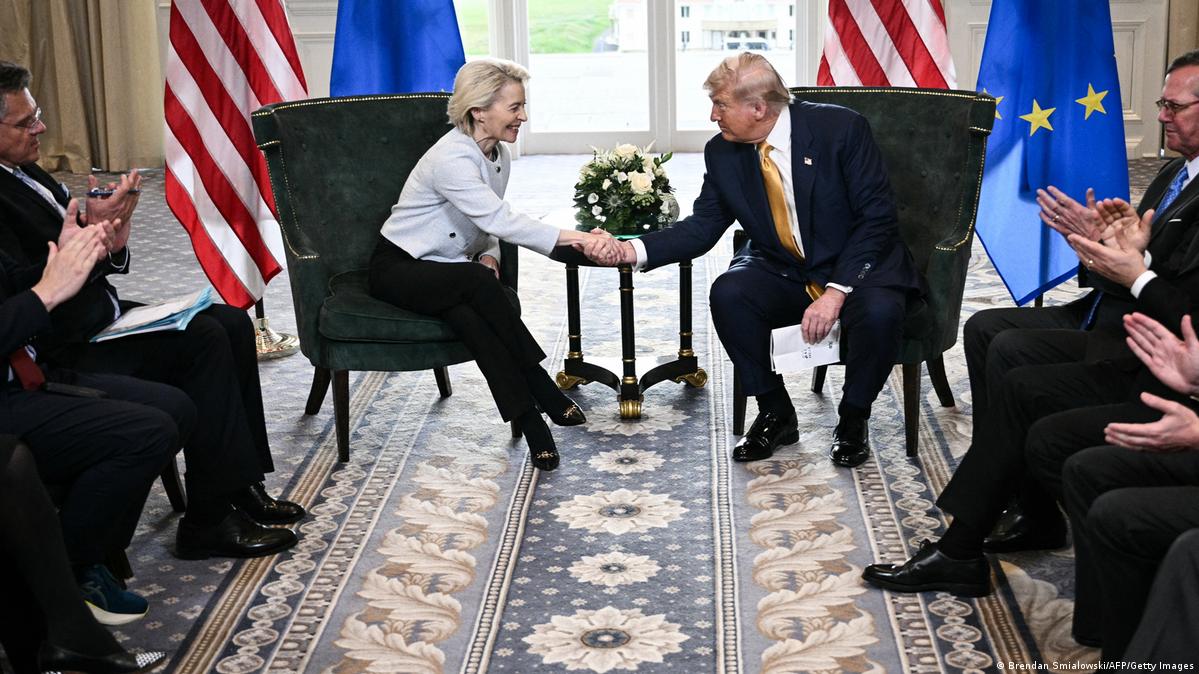
The European Union's Council, the grouping of EU member state governments, formally adopted legislation on Thursday to remove import duties on many US goods, completing the EU's legislative obligations under a EU US Trade Deal deal struck with President Donald Trump last year and putting the bloc on track to meet his July 4 deadline. The move fulfils a commitment that the European Parliament had already approved the previous week by a vote of 440 to 151, with 50 abstentions, a margin that reflected broad but not unanimous support across EU political groups. The legislation will take effect following publication in the EU's official journal, the final procedural step before it becomes binding law.
The timing is not incidental. Trump had threatened significantly higher tariffs on EU goods if the bloc failed to act by July 4, a deadline that transformed what might otherwise have been a routine legislative ratification into a high-stakes diplomatic test with real economic consequences attached. The EU's ability to meet that deadline, almost exactly 11 months after the framework agreement was first struck, demonstrates that the bloc's legislative machinery can move with political urgency when the economic cost of delay is made sufficiently explicit. Whether the speed of adoption reflects genuine political alignment with the deal's substance or simply a pragmatic calculation about the costs of non-compliance is a separate question that the 151 votes against make worth examining.
The legislation covers three distinct categories of trade concession. The EU will remove import duties on US industrial goods, provide preferential market access for US agricultural products, and extend duty-free treatment for US lobster imports, a concession that originated during Trump's first term as a mini-deal and is now being incorporated into the broader agreement. Together, these provisions represent a meaningful shift in the terms of transatlantic trade, one that gives US exporters improved access to the EU's single market across both manufactured and agricultural goods in exchange for the avoidance of the higher tariff regime Trump had threatened to impose.
How the threat of higher US tariffs and an 11-month legislative process shaped the deal's final adoption
The EU-US trade deal that Thursday's adoption finalises was reached as a framework agreement roughly 11 months ago, but converting that political agreement into binding EU law required navigating the bloc's multi-stage legislative process involving both the European Parliament and the Council of member state governments. That process took the better part of a year, a timeline that reflects the structural complexity of legislating simultaneously for 27 member states with divergent economic interests, some of which are more exposed to US tariffs than others and some of which were more reluctant to accept the agricultural access provisions the US side sought.
Trump's threat of "much higher" tariffs unless the EU acted before July 4 injected an external deadline into a legislative timeline that was already approaching its natural conclusion, and it had the intended effect of concentrating political minds in the final weeks before the Council vote. The threat was credible because Trump had already imposed significant tariffs on EU goods during his first term and had demonstrated a willingness to use trade pressure as a diplomatic instrument regardless of the disruption it caused to allied relationships. EU governments that might have found reasons to delay further adoption were left with a clear cost-benefit calculation that favoured completing the process on schedule.
The 151 votes against in the European Parliament reflect a persistent minority view within EU politics that the deal gives too much to the United States without securing sufficient reciprocal concessions, particularly on the agricultural side where European farmers have historically been protective of their domestic market from US competition. The safeguard clauses written into the legislation, which would allow the EU to suspend its concessions if the US breaches the deal's terms, were partly designed to address that concern by ensuring the commitment is conditional rather than permanent. Whether those safeguards prove practically usable if a future dispute arises will be a key test of the deal's durability over its five-year lifespan.
What EU concessions on US farm produce and lobster reveal about the diplomatic trade-offs behind the agreement
The agricultural dimension of the EU-US trade deal is the most diplomatically sensitive element of what Thursday's adoption puts into law. Preferential access for US farm produce to the EU market represents a concession that European agricultural lobbies and several member state governments resisted strongly during the negotiations, on the grounds that it would expose European farmers to competition from US producers operating under different regulatory and subsidy frameworks. The fact that this provision made it into the final legislation reflects how much political weight the tariff threat from Washington was carrying relative to the domestic agricultural pressure pushing in the other direction.
The lobster provision carries a different kind of diplomatic symbolism. Duty-free US lobster imports were first agreed as a targeted concession during Trump's first term as a way of de-escalating a specific trade dispute, and their inclusion in this broader deal signals that both sides found value in cementing that arrangement on a more permanent legislative basis. For US lobster exporters, primarily operating out of New England states, the extension of duty-free access to a market of 450 million consumers is a concrete commercial benefit. For the EU side, it represents the lowest-friction agricultural concession available, one that does not compete directly with major European farming interests and that can be presented domestically as a targeted rather than a sweeping market opening.
The deal's five-year duration, expiring at the end of 2029, and the inclusion of multiple suspension safeguards together reflect the EU's awareness that trade agreements with the Trump administration require built-in escape routes rather than permanent commitments. The safeguards allow the EU to reinstate duties if the United States breaches the deal's terms, a provision that preserves leverage without undermining the agreement's immediate commercial value. That architecture acknowledges the asymmetric nature of the relationship: the EU is making legally binding domestic legislative changes, while the US side's commitments depend on presidential policy choices that could shift with future administrations or political circumstances.
What the EU-US deal means for transatlantic trade flows, diplomatic relations, and the risk of future tariff disputes
The adoption of the EU-US trade legislation averts what would have been a damaging renewal of transatlantic trade conflict at a moment when both sides are already managing significant economic pressures from the Iran war's energy price impact and from broader global supply chain disruptions. A return to elevated US tariffs on EU goods would have added inflationary pressure to European economies already struggling with energy costs, and would have complicated the diplomatic relationship between Washington and Brussels at a time when cooperation on Ukraine, NATO, and Middle East policy all require functional transatlantic communication.
For US exporters, the deal's immediate commercial impact is most significant in the industrial goods and agricultural sectors that gain improved EU market access. US manufacturers of goods that previously faced EU import duties will now be able to price more competitively in the European market, potentially gaining market share from non-US competitors who do not benefit from the preferential treatment. US agricultural exporters, particularly those producing goods for which the EU is granting preferential access, gain a structural advantage over third-country competitors in one of the world's largest and wealthiest consumer markets.
The deeper diplomatic significance of Thursday's adoption is that it demonstrates the EU can function as a reliable trade partner when political will exists to complete the legislative process, even under external deadline pressure. That demonstration matters for future negotiations because US administrations considering trade deals with the EU have historically been sceptical about whether the bloc's complex institutional structure can deliver timely compliance with agreed commitments. The July 4 deadline was met, the Parliament approved the deal by a substantial margin, and the Council adopted it on schedule. For the durability of the transatlantic trade relationship through the remainder of Trump's term and beyond, that track record of delivery is itself a form of diplomatic capital.