
The Hamas disarmament Gaza 2026 agreement announced on Friday represents the first time in Hamas's nearly four-decade history that the organization has committed to completely disarming in Gaza. Hamas was founded in 1987 and has consistently refused any commitment to lay down arms, framing its military capacity as an instrument of resistance to Israeli occupation that cannot be surrendered as a precondition for political engagement. The refusal to disarm has been the single most significant obstacle to every peace framework proposed for Gaza over that entire period, including the Oslo framework, the post-2007 governance negotiations, and every phase of the ceasefire discussions that followed the October 7, 2023 Hamas attack on Israel.
Under the proposal seen by the BBC, Hamas has agreed to provide an inventory of its weapons, military production sites, and tunnel network. Its arms are to be stored and kept under the control of the new Palestinian transitional administration rather than destroyed or transferred. They cannot be transferred to Israel under the terms as described. The process is explicitly linked to a phased Israeli withdrawal from Gaza, meaning disarmament and withdrawal are designed to proceed in parallel rather than sequentially, with neither side required to fully complete its obligation before the other begins. An independent "implementation verification committee" will monitor progress, with US and Board of Peace officials acknowledging the difficulty of Hamas and Israel monitoring each other directly.
Nickolay Mladenov, the Board of Peace's director-general and high representative for Gaza, described the agreement's arrival as the product of months of negotiations that came close to collapse at multiple points. "There were several points when I did not believe we would make it," he wrote on X. A former Bulgarian foreign minister who has held multiple senior UN regional roles including as UN special coordinator for the Middle East peace process, Mladenov is one of the most experienced multilateral conflict resolution practitioners currently engaged on the Gaza file. His acknowledgment of how close the talks came to failing gives weight to both the significance of the agreement and the fragility of the progress it represents.
Why Israel's silence is the most important political fact about the agreement
As of Friday, Israel had not officially responded to the announcement. That silence is not a minor diplomatic detail. It is the central unresolved question that determines whether the agreement is a genuine step toward peace or a statement on paper that cannot move to implementation. Israel's government, led by Prime Minister Netanyahu, has been consistently and explicitly sceptical about Hamas's willingness and capacity to disarm in any meaningful way. Netanyahu's government has raised objections to the Board of Peace's disarmament proposal with envoy Tony Blair, without specifying the precise issues, according to the Times of Israel citing an Israeli official statement.
The Israeli official position on what would be required for an IDF withdrawal is unambiguous and directly contradicts the parallel process the agreement describes. "There will be no IDF withdrawal from the Yellow Line in the Gaza Strip before Hamas is disarmed and the Strip is fully demilitarized," the Israeli official stated. That position makes Israeli withdrawal a consequence of completed disarmament rather than a process that proceeds in parallel with it, a fundamental structural difference from the proposal Hamas has agreed to, which links the two processes as simultaneous and mutually dependent. Reconciling those two incompatible sequencing positions is the most immediate practical obstacle between the agreement's announcement and its implementation.
US officials have made clear that there will be political consequences if Israel does not engage. Officials said Trump will be "very disappointed" if Israel does not withdraw as part of the agreement, a phrase that, in diplomatic language, is intended as a warning without crossing into a threat. The relationship between Trump and Netanyahu has been strained throughout the Gaza conflict, including a June phone call in which Trump called Netanyahu "fucking crazy" in frustration over the conflict's trajectory. Whether Trump's disappointment would translate into concrete pressure on Israel, including any form of conditional relationship with US military support or diplomatic backing, is the question that Netanyahu's government will be assessing before deciding how to respond officially to Friday's announcement.
The obstacles ahead: operational questions that will determine whether this agreement survives contact with reality
Even if Israel responds positively to the agreement, the operational questions that remain unresolved are numerous and genuinely complex. The verification committee's task is described by US officials as more comparable to verifying the disarmament of a state military than a militant group, given the scale of Hamas's tunnel network, weapons production facilities, and trained fighters. That scale makes the timeline for verification potentially very long, and the agreement does not yet specify a timeline that both parties have accepted. A process that could take years to verify creates sustained uncertainty about when Israel would be expected to complete its withdrawal, which in turn affects Israeli political acceptance of the agreement's terms.
The Yellow Line, Israel's military buffer zone inside Gaza's northern perimeter, is the specific geographic point at which the sequencing dispute becomes concrete. Israel's stated refusal to withdraw from the Yellow Line before full disarmament means that the buffer zone would remain under Israeli military control throughout the disarmament process, a presence that Hamas and Palestinian civilians in the affected areas will experience as continued occupation regardless of the agreement's formal terms. Whether Hamas's leadership can maintain the agreement's political coherence while Israeli forces remain in the buffer zone through what could be a lengthy verification process is an open question.
Questions about who takes custody of Hamas's collected weapons, how they are stored securely, and what the Palestinian transitional administration's actual capacity to manage a weapons collection of this scale looks like in practice are all unspecified in the current proposal's outline. The transitional administration that would receive Hamas's police weapons in the first phase and ultimately oversee the entire weapons collection is itself a new institution without a proven track record or established international recognition. Its ability to perform the security and custodial functions the agreement assigns to it will depend heavily on international support, including from the Arab mediating states and from Israel, which would need to accept the transitional administration's authority over weapons it considers a direct threat to its citizens.
From the October 7 attack to Friday's disarmament announcement
7 October 2023
Hamas leads an attack on Israel in which 1,200 people are killed and 251 are taken hostage. Israel responds by launching a military campaign in Gaza.
October 2024
A ceasefire between Israel and Hamas takes effect. Since the ceasefire, at least 1,168 Palestinians have been killed in Israeli attacks and four Israeli soldiers have been killed in Palestinian attacks, per respective official sources.
Six months of stall
Phase two of the US-brokered ceasefire deal stalls. Hamas disarmament identified as the key sticking point. Intense negotiations begin between Hamas and regional mediators.
September 2025
UN commission of inquiry says Israel has committed genocide against Palestinians in Gaza. Israel rejects the report as "distorted and false."
Recent weeks
Hamas meets with mediators from Qatar, Egypt and Turkey. A new proposal is submitted to Washington. Trump writes on social media that "a monumental step toward lasting peace and security" has been taken.
Friday July 31
Trump announces the Board of Peace has reached agreement for "complete disarmament" of Hamas. A senior Hamas official confirms the agreement to the BBC. Israel does not comment. Cairo prepares to host a mediators meeting.
What this means for Netanyahu, Hamas's leadership, and the future of Gaza governance
For Netanyahu's government, the announcement puts an immediate political test on the table that has no comfortable answer. Accepting the agreement as it stands requires Israel to accept a parallel disarmament-withdrawal process that Israeli officials have explicitly rejected, to acknowledge Hamas's continued role in the transition even as it disarms, and to engage with a Palestinian transitional administration whose authority over collected weapons implies a degree of legitimacy that Netanyahu's coalition partners have consistently opposed granting to any Palestinian governance structure associated with Hamas. Rejecting the agreement risks a public break with Trump and US support at a moment when Israel is highly dependent on American diplomatic and military backing.
For Hamas, the agreement carries internal political risks that are not publicly visible but are analytically significant. Committing to complete disarmament is the most politically sensitive step Hamas's leadership could take, given that its military capacity has been the foundation of its political identity for nearly four decades. The framing in the proposal, that weapons are stored under Palestinian authority rather than surrendered or destroyed, is designed to provide Hamas's leadership with a narrative of transition rather than capitulation. Whether that framing holds within Hamas's internal political structure and with its external supporters, including Iran, which has consistently supported Hamas's military posture, will determine whether the agreement's announcement translates into genuine organisational compliance.
The plan described by Trump as paving the way for Gaza to "finally be governed by a new Palestinian government" raises questions about what that government would look like, who would lead it, and how its authority would be established and recognised. A technocratic transitional administration has been discussed as one model, but the political process by which such an administration gains legitimacy with Gaza's population, with the Palestinian Authority in the West Bank, with Israel, and with the international community simultaneously has not been specified. Mladenov's reference to "a Gaza rebuilt, governed by Palestinians and at peace with Israel and a political horizon to a meaningful resolution of the Israeli-Palestinian conflict" is a vision, not a plan, and the distance between the two will be the defining challenge of everything that follows.
Reconstruction, aid flows, and what the agreement means for Gaza's devastated economy
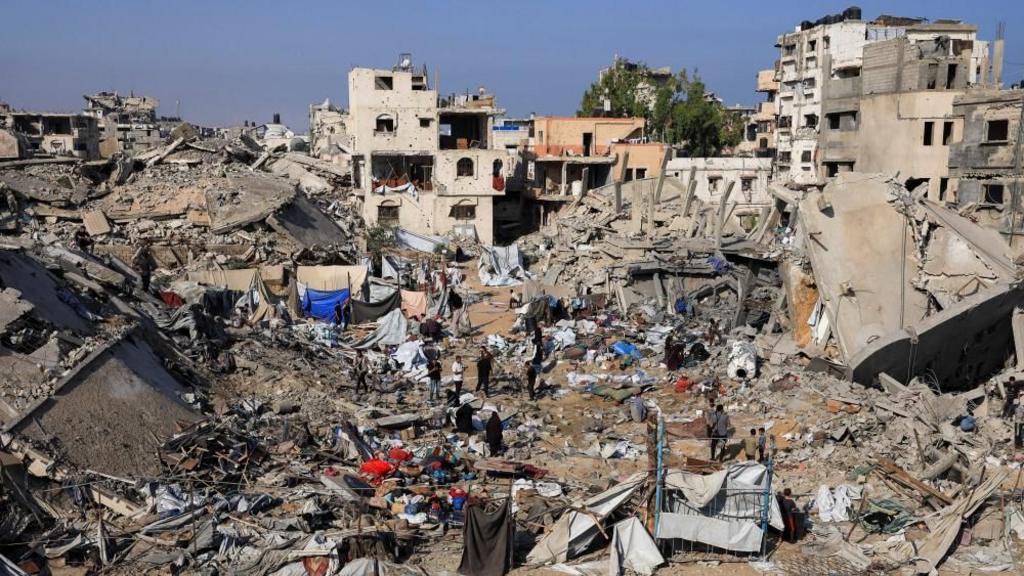
Gaza's economy has been functionally destroyed by more than twenty months of intensive military operations since October 2023. The scale of physical destruction, including to residential infrastructure, commercial facilities, hospitals, water and power networks, and agricultural land, means that any reconstruction process will require sustained, large-scale international investment over many years before Gaza reaches anything resembling a functioning economic environment. The disarmament agreement, if implemented, is the political precondition for the international reconstruction investment that Gulf states, the European Union, and the United States have all indicated they would be willing to provide under a viable post-conflict governance arrangement.
Saudi Arabia and the UAE, the two largest potential regional investors in Gaza reconstruction, have both conditioned their engagement on a credible peace process and a governance structure that is not controlled by Hamas. The disarmament agreement, if it proceeds, directly addresses the governance condition by creating the transitional administration framework that would receive international recognition and investment. Saudi interest in Gaza reconstruction is also linked to the broader Abraham Accords context, in which Riyadh's normalisation with Israel has been presented as conditional on a credible path toward Palestinian statehood or at least Palestinian governance, making the Gaza agreement a potential enabler of the much larger regional diplomatic framework Trump has been pursuing.
For ordinary Gazans, the economic significance of the agreement is more immediate and more human. More than 73,290 people have been killed, including over 21,280 children, and the displaced population numbers in the millions. A functioning transitional government capable of distributing humanitarian aid, establishing basic security, and beginning the process of reconnecting civilians to water, electricity, and healthcare is the most urgent economic need Gaza faces, well before the longer-term reconstruction questions can be addressed. Whether the disarmament process creates the conditions for that basic governance to be established, or whether the disputes over sequencing, verification, and the Yellow Line delay it indefinitely, will determine the immediate lived reality of Gaza's surviving population.
What Hamas disarmament means for the region and the international order
A successfully implemented Hamas disarmament would represent one of the most significant changes to the Middle East's security landscape in decades. Hamas's military capacity has been a defining feature of the Gaza conflict since the group took control of the territory in 2007, and its elimination as a military force would fundamentally alter the security environment for Israel's southern border, for Egypt's Sinai border region, and for the broader Iranian-backed axis of resistance that has used Hamas's military presence as leverage in regional confrontation with Israel. Iran's response to a Hamas disarmament, if it proceeds, will be one of the most consequential geopolitical developments of the coming months.
The International Criminal Court's outstanding arrest warrants for Netanyahu and former defence minister Yoav Gallant over alleged war crimes in Gaza will remain in place regardless of the disarmament agreement's progress. Those warrants create a legal backdrop that complicates the diplomatic engagement required to make the agreement work, particularly in European countries that are parties to the ICC and would face legal obligations if Netanyahu or Gallant visited their territory. The UN commission's September 2025 finding that Israel committed genocide against Palestinians in Gaza, which Israel categorically rejected, similarly remains part of the legal and political environment that any reconstruction and governance framework will need to navigate.
For the United States, a successful Hamas disarmament would be the most significant Middle East policy achievement since the Abraham Accords and would give Trump a foreign policy legacy that combines the Iran war's military dimension with a political resolution in Gaza. The interconnection between the two conflicts, with both being managed simultaneously through what Trump's team describes as a dual-track strategy of pressure and negotiation, means that the Gaza agreement's success or failure will affect the credibility of the broader US Middle East policy framework that is simultaneously managing the Iran negotiation, the Saudi normalisation track, and the ongoing military operations in and around the Strait of Hormuz.