
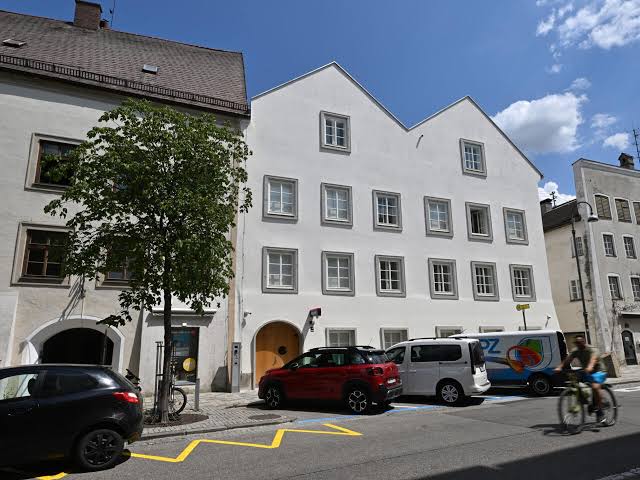
On a quiet Wednesday morning in the Austrian border town of Braunau am Inn, a large traditional terraced house with a white facade and a single new sign reading Police officially began a new life as a local police station, completing one of the most politically sensitive building conversions in European postwar history. The house at Salzburger Vorstadt 15 is where Adolf Hitler was born on April 20, 1889. He lived there for only a few weeks before his family moved on. The building has been a source of profound political, ethical, and historical discomfort for Austria ever since, and the Austrian government's decision to turn it into a police station reflects a specific philosophy about how to manage a site whose very existence creates a problem that no architectural solution can fully resolve.
The conversion, years in the making after Austria's compulsory purchase of the building in 2017, embodies a deliberate strategy of de-mystification, stripping the building of the neo-Nazi pilgrimage appeal that has made it an uncomfortable landmark for the town of 17,000 that has been trying to move past its accidental historical connection for most of the last 80 years. Whether it works is a question that Austria's most prominent Holocaust memory organisations and some of the building's most thoughtful critics say will not be answered by architecture alone.
A White Building Gets a Police Sign and Opens a Debate That Never Closed
The building's official conversion on Wednesday is the conclusion of a process that began formally in 2017 when Austria completed a compulsory purchase from private ownership, ending a decades-long situation in which a privately held property whose historical significance was internationally known was managed through a series of ad hoc arrangements rather than state policy. For years, a charity for people with handicaps occupied the building, a use that local officials eventually concluded made the property too publicly accessible given the pilgrimage traffic its historical identity attracted. A government commission recommended repurposing the building for either charitable or official administrative purposes, with the police station eventually winning out as the option that most directly converted the building from public landmark to working institutional space.
The exterior transformation is deliberately minimal. The facade remains white. The only new sign reads Police. The only acknowledgment of the building's historical significance is an existing memorial rock on the pavement sourced from the Mauthausen concentration camp, bearing the inscription Never again fascism, a formulation that pointedly does not mention Hitler by name. No new historical interpretation has been added to the exterior. No museum plaque. No explanatory text. The strategy is erasure-by-normalisation rather than confrontation-by-commemoration.
Stephan Mlczoch, head of the Austrian interior ministry's history department, was direct about the intent.
"The aim was to prevent any association with Adolf Hitler, so as to strip it of that mystique," he told reporters on a tour of the building.
The mystique Mlczoch referenced was not accidental. Under Nazi rule, the Fuehrer birth house was converted into an art museum, a deliberate act of personality cult whose purpose was to elevate Hitler's birthplace into sacred ground for the movement he led. Tourists from across the Third Reich made the journey to Braunau. The building was infused with ideological meaning by the regime that most benefited from Hitler's birth in it.
That meaning did not disappear with the Third Reich's defeat. The building's continued existence, its recognisability, and the internet's preservation of its address and photographs has made it a destination for neo-Nazis and far-right pilgrims whose visits have been described by local officials as now reduced to isolated incidents compared to the more frequent occurrence of earlier years.
The Impossible Problem of Managing a Site Defined by Infamy
No country chooses the location of its worst historical associations. Austria did not plan to produce Adolf Hitler. Braunau am Inn did not select itself as the Fuehrer's birthplace. Yet both Austria and the town have spent nearly a century managing the specific burden that the accident of Hitler's birth in a specific building on a specific Austrian street has imposed on their international identities and domestic political cultures.
The compulsory purchase in 2017 was not Austria's first encounter with the building's management problem. For much of the postwar period, the building remained in private ownership and was occupied by various tenants and organisations, with Austria's official relationship to the property best characterised as reluctant custodianship from a distance. The Mauthausen memorial rock, placed at the pavement with the Never again fascism inscription that does not name Hitler, was a compromise formulation that acknowledged the building's association with catastrophe without explicitly endorsing the historical tourism that naming Hitler would have encouraged.
The police station decision reflects a specific theory of managing historically problematic sites that differs fundamentally from the commemorative memorial approach that Holocaust remembrance advocates typically prefer. The theory is that emptying a building of the symbolic charge it carries requires filling it with the most prosaic and institutionally ordinary possible alternative use, rather than commemorating the association through museum exhibits, plaques, or interpretive displays that would maintain the site's identity as a place to visit specifically because of Hitler. A police station whose staff are working on ordinary law enforcement matters, whose visitors are members of the public with administrative matters to resolve, and whose daily life is entirely unrelated to the building's historical occupant is the specific antidote to the pilgrimage dynamic that the conversion is designed to produce.
Whether this theory is correct is contested, and the terms of the contestation illuminate a genuine disagreement about how societies should relate to the physical sites of their worst historical actors and episodes.
How Austria Managed and Then Decided to Transform Hitler's Birthplace
1889: Adolf Hitler is born at Salzburger Vorstadt 15, Braunau am Inn, on April 20. His family moves out within weeks. Hitler's connection to the building is essentially biographical rather than biographical, a fact of origin rather than a place of meaningful personal history.
1938: Austria is annexed by Nazi Germany in the Anschluss. The Braunau birthplace is converted into an art museum as part of the Nazi cult of personality around Hitler, establishing the building's status as ideologically significant pilgrimage site within the Third Reich's cultural geography.
1945: Nazi Germany's defeat ends the museum function. Austria, occupying the ambiguous postwar position of first victim of National Socialism as Austrian political culture largely characterised its wartime experience, does not initially address the birthplace systematically.
1952 to 1970s: The building passes through various private uses and occupancies. The Austrian state's relationship to the property is distant and uncomfortable rather than actively managed.
1989: The Mauthausen memorial rock is placed on the pavement outside the building, the first official acknowledgment of the birthplace's association with catastrophe, using the Never again fascism formulation that avoids naming Hitler directly.
1990s to 2010s: A charity for people with disabilities occupies the building, providing a socially positive use that de-politicises the space without resolving the underlying management question. Neo-Nazi pilgrimage visits continue, creating periodic incidents that local officials manage.
2017: The Austrian state completes a compulsory purchase of the building from its private owner, ending the ad hoc private management era and bringing the building into state ownership whose policy management can be formally determined.
2019: Austria announces the building will be converted into a police station, ending the debate between options including demolition, a museum, or various institutional uses.
2019 to 2025: Conversion work is undertaken. The interior is completely reconfigured for police station functions. The exterior is maintained with minimal modification.
July 2026: The building officially opens as a police station, completing the conversion and beginning the period in which its effectiveness as a de-mystification strategy can be assessed.
What the Conversion Reveals About Austria's Relationship to National Socialism
Austria's official postwar narrative for decades rested on the first victim characterisation, the position that Austria was annexed against its will in 1938 and that Austrian citizens' participation in National Socialism's crimes was coerced rather than chosen. This narrative was convenient for Austrian postwar political reconstruction and for the international community's management of Austrian membership in the postwar European order, but it was historically incomplete in ways that serious scholarship has consistently documented.
The Waldheim affair of 1986, in which Kurt Waldheim's wartime service in a German Army unit that committed war crimes became the subject of international scrutiny during his presidential campaign, was the specific historical moment that forced Austria's first victim narrative into a direct confrontation with the evidence of Austrian perpetration that the narrative had been suppressing. Waldheim won the presidency despite, or in some analyses partly because of, the international criticism, and Austria's political culture spent the subsequent decade gradually shifting toward the more complex acknowledgment that the country's current official position expresses: Austrians were also perpetrators.
The police station solution sits within this political context as an expression of the current Austrian official approach to National Socialism history, which is acknowledgment without deep elaboration. Austria says it accepts that Austrians were perpetrators, but as the Mauthausen Committee's Eiter notes, it rarely elaborates on what this means concretely, who did what, and what accountability that perpetration requires. The Braunau building's conversion to a police station without historical interpretation exhibits is consistent with this approach: acknowledge the problem exists (hence the compulsory purchase and conversion rather than simply ignoring the building), address the immediate practical issue (neo-Nazi pilgrimage visits), but do not create the interpretive space that deep historical engagement with Hitler's origins and Austria's role in National Socialism would require.
What a Police Station Does to a Town That Has Always Been Uncomfortable With Its Fame
Braunau am Inn is a prosperous border town whose economy is not primarily tourism-dependent, but the Hitler birthplace has always created a specific ambiguity in its relationship to visitors. The town does not advertise the building. Local guides have historically avoided it. The international attention the birthplace attracts has been a source of discomfort rather than commercial opportunity for a community that has been trying for decades to be known for something other than the accident of where a mass murderer happened to be born.
The police station conversion serves the town's economic identity interests in a specific way: it converts a building that attracted uncomfortable visitors for uncomfortable reasons into a building that serves ordinary administrative purposes for the local community, changing the visitor profile from neo-Nazi pilgrims and dark tourism practitioners to residents with police business. The economic calculation is not about tourism revenue but about community identity, and the community's assessment, as expressed by Mayor Johannes Waidbacher and supported by most of the local residents quoted in reporting from the conversion's opening, is broadly supportive of a solution that normalises the building's status rather than amplifying it.
Estate agent Thomas Spreitz captured the commercial community's perspective directly: the periodic neo-Nazi groups who appeared were an unwanted presence whose cessation the police station conversion should produce, and that cessation is commercially positive for a town that has no interest in being associated with far-right pilgrimage tourism.
Why Holocaust Memory Organisations Are Not Convinced
The Mauthausen Committee's opposition to the police station solution is not based on preference for continued inaction but on a fundamentally different theory about how societies should relate to the physical sites of atrocity history. The organisation's concern rests on two arguments that deserve serious engagement rather than dismissal.
The first argument is that a police station is institutionally inappropriate as the specific use for the building whose occupant was directly responsible for the murder of millions of people by a state apparatus whose enforcement arm included police forces, with the specific Austrian police having played a direct role in implementing National Socialist persecution in Austria after 1938. Placing a police station in the building where the figure who transformed German and Austrian police forces into instruments of genocide was born carries an institutional irony that the Mauthausen Committee finds objectionable regardless of the de-mystification logic that Austrian officials advance.
The second argument, advanced by Robert Eiter, is that the de-mystification strategy will fail because the world's memory of Hitler's birthplace location is not dependent on Austrian official policy.
"The world won't forget where the worst mass murderer in history was born. Wikipedia won't change its entries," Eiter said.
This is an empirical prediction about the effectiveness of the de-mystification strategy rather than a values objection to de-mystification itself. Eiter's assessment is that neo-Nazis who wish to make the Braunau pilgrimage will continue to do so regardless of whether they encounter a police sign rather than a museum plaque, because their motivation is to visit the geographic location associated with their ideological hero rather than to engage with any particular use the building has been assigned. The pilgrimage is to the address, not to the institution currently occupying it.
If Eiter is correct, the police station conversion succeeds at deterring casual visitors who might be discouraged by the absence of any commemorative material while failing to deter the committed neo-Nazi pilgrims whose visits are the security and political concern that motivated the conversion in the first place. Whether this prediction proves accurate will be observable through monitoring of far-right incidents at and around the building in the coming years.
What Braunau Teaches About Managing Sites of Historical Infamy
The Braunau police station conversion is not a unique problem. Countries across the world manage the physical sites of historical atrocities, perpetrators' birthplaces, and genocide infrastructure whose continued existence creates the specific tension between memory, commemoration, tourism, and the risk of site elevation that the Braunau case illustrates.
The closest comparable cases involve sites associated with other perpetrators of mass violence. Romania manages the birthplace of Nicolae Ceausescu. Germany has developed a sophisticated practice of deliberately demolishing or allowing to decay buildings specifically associated with Nazi leadership, with Hitler's mountain retreat at Berchtesgaden largely demolished after the war and the Nazi party rally grounds in Nuremberg managed as a documentation centre rather than a preserved monument. The Soviet-era practice of renaming cities, removing statues, and converting associated sites to institutional uses parallels the Austrian approach in its theory of de-mystification through normalisation.
The United States has engaged in its own version of this debate around Confederate monuments, plantation tourism, and the sites of racial terror whose commemoration or removal has been one of American culture's most contested questions of the current era. The underlying question in all these cases is the same one that Braunau embodies: does erasing or normalising a site's historical association with violence diminish the violence's hold on the present, or does it reduce the accountability that confronting the association directly could produce?
There is no consensus answer. The memorial industrial complex that has developed around Holocaust remembrance, with its emphasis on never forget and its investment in documentation centres, museums, and interpretive sites, represents one theory. The Austrian police station represents another. Both theories carry risks: commemorative memorial sites can inadvertently create the mystique they seek to warn against, while de-mystification through institutional normalisation can reduce the historical engagement that prevents repetition.
What Cultural Memory Specialists Say About the De-Mystification Strategy
Cultural memory specialists who study how societies manage the physical traces of historical violence generally identify several factors that determine whether de-mystification or commemorative engagement is more effective in reducing the pilgrimage appeal of sites associated with perpetrators.
The nature of the perpetrator's connection to the site matters significantly. A building where Hitler lived for only a few weeks before his family moved has a much weaker biographical connection than, for example, the Eagle's Nest or the Reich Chancellery where he actually made the decisions that produced the Holocaust. The Braunau birthplace's significance is almost entirely symbolic rather than operational, which makes the de-mystification theory more plausible: the building's appeal to neo-Nazi visitors rests on the symbolic significance of the birth location rather than on any material connection to the crimes themselves.
The visibility of the site within the internet information landscape also matters. Eiter's Wikipedia point is empirically correct in the sense that the building's address and history are permanently accessible through digital channels whose content Austrian domestic policy cannot control. However, the internet's preservation of historical information does not necessarily translate into continued physical pilgrimage: many historically significant sites with extensive online documentation attract minimal actual visitors because the physical experience adds nothing to the digital information. Whether the Braunau building falls into this category or whether the physical pilgrimage to the location retains significance for committed neo-Nazis independent of what they can access online is the specific empirical question that the post-conversion period will begin to answer.
What Happens Next: How Austria Will Know If the Conversion Worked
The Austrian interior ministry's theory of success is that pilgrimage visits to the building will decline to the point of insignificance as the building's institutional identity as a working police station gradually displaces its historical identity as Hitler's birthplace in the practical experience of visitors to Braunau. Local officials have already noted a reduction in incidents compared to earlier years, though the specific metrics are not publicly defined.
The Mauthausen Committee's prediction is that the visits will continue at levels that make the conversion's claimed success illusory, with the building's geographic identity as Hitler's birthplace persisting in far-right culture regardless of the police sign on its facade. Both predictions are testable over time, and the Austrian government's monitoring of incidents at and around the building will provide the empirical data whose accumulation over years will determine which theory the evidence supports.
What is certain is that the underlying question the building poses, how Austria relates to its role in National Socialism and what responsibility that role creates for contemporary Austrian institutions and culture, is not answered by the police station conversion. It is deferred to the continuing work of historical accountability that organisations like the Mauthausen Committee advocate and that Austria's official position of Austrians were also perpetrators without elaboration has not fully engaged.
What to Watch Next
Watch for reports of neo-Nazi pilgrimage incidents at the Braunau building in the months and years following the police station opening, whose frequency compared to the pre-conversion period will determine whether the de-mystification strategy is producing the results its architects intended.
Watch for Austrian political response to the conversion's opening and any parliamentary or public debate that the Mauthausen Committee's criticisms generate about Austria's broader approach to National Socialism historical accountability.
Watch for international media and far-right online community responses to the police station opening, whose characterisation of the conversion as erasure or as appropriate institutional management will indicate whether the building's significance in far-right culture has been affected by the change of use.
Watch for comparative international policy responses from countries managing similar historically problematic sites, whose approaches may be influenced by Austria's Braunau experience as either a model or a cautionary example depending on the empirical evidence of the conversion's effectiveness.