
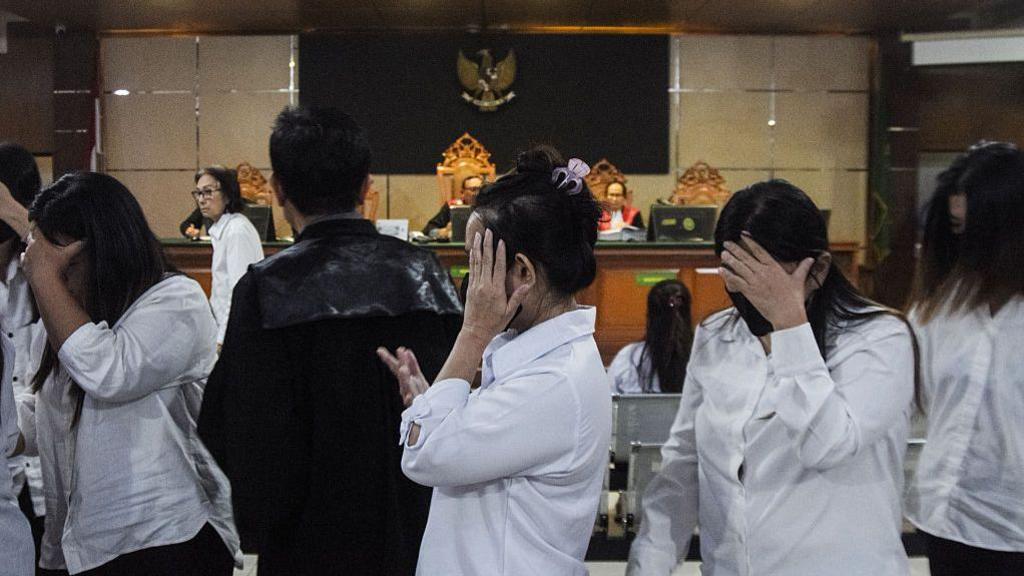
An Indonesian court in West Java is delivering its verdict on one of Southeast Asia's most disturbing cross-border Indonesia baby trafficking cases of recent years, ruling on 19 defendants accused of illegally buying, selling, and trafficking at least 34 babies between Indonesia and Singapore between 2023 and 2025, with a 70-year-old woman named Lie Siu Luan identified by prosecutors as the alleged ringleader who built and ran the operation and who faces up to ten years in prison if convicted. The verdict does not only determine the criminal fate of 19 Indonesians, 18 of them women, who have been on trial since April. It triggers a set of far more complex and emotionally devastating questions for the 12 babies believed to already be living with adoptive families in Singapore, for the Singaporean couples who believed they were conducting legitimate adoptions, and for two governments whose legal frameworks for cross-border adoption have been exposed as insufficient to prevent a sophisticated criminal operation from exploiting the desperate desire of childless couples and the desperate poverty of parents willing to sell their infants.
This case is about more than a trafficking syndicate. It is about the structural failures that allow baby trafficking to exist at the intersection of Indonesia's poverty crisis, Singapore's tightly regulated adoption system, and the grey market that thrives when legal pathways are too restricted, too expensive, or too slow.
The Architecture of a Cross-Border Baby Selling Operation
The alleged syndicate operated with the logistical precision of a supply chain business. Babies were sourced across West Java from parents who sold their infants, often driven by poverty, debt, or family pressure. The children were brought to the city of Depok, outside Jakarta, where they were held and cared for by hired nannies. From Depok, selected babies were moved to a house in Pontianak in West Kalimantan on the island of Borneo, transiting through Jakarta before being taken to Singapore.
The operation's sophistication went beyond logistics. A dedicated document forger allegedly produced fake birth certificates and Indonesian family registration cards that disguised the babies' true origins and parentage. Other defendants allegedly posed as biological mothers, listing their names on fraudulent documents or appearing on video calls with prospective Singaporean adoptive parents to create the illusion of legitimate direct placement.
The alleged price: at least 18,000 Singapore dollars, equivalent to approximately $14,000 or £10,300, per baby. Lie Siu Luan has admitted in court to supplying babies for adoption to at least four Singaporean contacts at that price, though she claimed she did not know it was wrong and that her Singapore partner had led her to believe the arrangements were above board.
Prosecutors are not persuaded. They are seeking a ten-year prison sentence for Lie, for alleged main broker Astri Fitrinika, for document forger Lai Siu Ha, and for two other alleged brokers. The remaining defendants face up to five years.
Of the 34 babies identified as having been trafficked, 12 are believed to be currently in Singapore in the care of their adoptive parents.
The Structural Forces Behind Indonesia's Baby Trafficking Problem
Child trafficking in Indonesia, particularly baby trafficking for adoption, is not a new problem. It is a persistent and structurally embedded one whose roots lie in the intersection of three specific conditions that create both supply and demand for trafficked infants.
Poverty and social stigma on the supply side. Indonesia's informal economy supports hundreds of millions of people whose household incomes leave them without the safety net that formal employment provides. For parents in genuine economic distress, a payment of several million Indonesian rupiah from a broker can represent months or years of earnings. Social stigma around out-of-wedlock births in conservative Muslim communities, and in some cases pressure from domestic violence or abandonment, produces parents who see no alternative to giving up children they cannot support. The trafficking networks that exploit these situations do not create the desperation they feed on. They monetise it.
Restricted legal adoption on the demand side. Singapore maintains strict regulations on inter-country adoption, with the legal framework designed to prevent exactly the kind of commercialised baby market that this case documents. The country is a signatory to the Hague Convention on Inter-Country Adoption, whose standards require central authority involvement, home studies, and verified consent from biological parents through official channels. The legal pathway is lengthy, uncertain, and emotionally exhausting for couples who desperately want to become parents. The grey market traffickers exploit the gap between the desire and the legal pathway's difficulty, offering a faster route that appears legitimate through forged documents and coached video calls but is not.
Weak enforcement at the point of document verification. The syndicate's ability to create fake birth certificates and family registration documents that passed inspection at multiple stages, including presentation to Singaporean prospective parents and potentially to immigration officials, documents a verification failure whose responsibility spans Indonesian civil registration systems and the due diligence that prospective adoptive parents and any intermediaries they used performed before completing the placement. The sophistication of the forgery operation, with dedicated personnel specifically hired for document falsification, indicates an understanding of which documents needed to be convincing and what level of detail the verification process would examine.
How the Syndicate Operated and How It Was Caught
2023: The alleged syndicate begins operations, sourcing babies from West Java and establishing the logistics network through Depok and Pontianak to Singapore. At least four Singaporean contacts begin receiving babies through Lie Siu Luan's network.
2023 to 2025: A total of 34 babies are alleged to have been trafficked through the network. Twelve reach Singapore and are placed with adoptive families. The remaining babies are believed to have been placed within Indonesia.
2025: Indonesian authorities identify and dismantle the alleged syndicate, arresting 19 individuals across their various roles as ringleader, brokers, document forgers, fake biological mothers, and caregivers.
April 2026: Trial begins in West Java court with 19 defendants facing human trafficking charges. The case attracts significant media attention in both Indonesia and Singapore given the cross-border dimension and the fate of the 12 babies already in Singapore.
July 2026: Court delivers verdict on all 19 defendants. Neither the Indonesian nor the Singaporean government has provided a definitive answer to the question of whether the 12 babies in Singapore would be required to return to Indonesia.
Two Governments Facing a Question Neither Wants to Answer
The political management of this case's aftermath is uncomfortable for both Jakarta and Singapore, for reasons that are different but equally difficult.
For the Indonesian government, the case highlights the persistent failure of social welfare systems to prevent parents from selling children, the weakness of civil registration systems that can be manipulated by criminal networks, and the international reputational damage of being the source country for a baby trafficking operation that victimised its own most vulnerable citizens, newborn infants, for foreign profit. Indonesia's stated position that it will prioritise the babies' best interests is the correct political and legal framing whose implementation detail, specifically what the best interests assessment produces for each of the 12 children in Singapore, has not been provided.
For the Singaporean government, the case creates the specific political sensitivity of acknowledging that 12 children whose presence in Singapore was facilitated by forged Indonesian documents and a criminal trafficking network are currently living with Singaporean families who believed they were legitimate adoptive parents. Singapore's strict inter-country adoption framework was apparently circumvented not through any failure of the legal system itself but through criminal actors who bypassed the system entirely rather than exploiting its weaknesses. The question of what happens to the 12 children goes to the heart of child welfare law, adoption law, and the specific complication that declared trafficking victims present when they have already been integrated into family units that wish to retain them.
The non-answer that both governments provided when asked directly about the Singapore babies' future reflects the genuine legal complexity of the situation rather than purely political evasion, because the answer requires the resolution of legal questions about trafficking victim status, adoption legality, and children's best interest determinations that cannot be made in the abstract.
The $14,000 Price Tag and What It Reveals About the Market
The 18,000 Singapore dollar price per baby documented in this case is the specific market price whose existence reveals the economic structure of cross-border baby trafficking in the Indonesia-Singapore corridor. At this price point, a syndicate that trafficked 34 babies would have generated gross revenues of approximately 612,000 Singapore dollars, or roughly $450,000 at current exchange rates, before the costs of nanny care, document forgery, transport, and broker fees. The margin after costs would depend on how much the Indonesian-side defendants paid to the original parents, figures that have not been publicly disclosed in this reporting, but the network's existence and sophistication indicates commercially sustainable operations whose profit incentives survived over at least two years of activity.
The $14,000 per baby price point in Singapore is not an outlier in the global grey market adoption economy. Comparable prices for black market infant placements have been documented in multiple countries across Southeast Asia, sub-Saharan Africa, and Eastern Europe, reflecting the specific demand-side desperation that childless couples willing to pay substantial sums to become parents creates regardless of the supply-side criminality that meeting that demand at scale requires. The economic incentive for trafficking operations is structural, not incidental, meaning that criminal prosecution of individual networks like the West Java syndicate, while legally necessary, does not by itself address the market conditions that generate the replacement networks that fill the gap when one operation is dismantled.
Adoption Agencies, Intermediaries, and Due Diligence Failure
The case raises serious questions about the intermediaries that Singaporean prospective adoptive parents used to connect with Indonesian sources. The forged documents that passed scrutiny, the coached video calls with fake biological mothers, and the payments made at above-market prices for adoption arrangements that bypassed Singapore's legal framework all suggest that the due diligence performed by some parties in the adoption chain was either insufficient or deliberately avoided to preserve the arrangement's commercial viability.
Adoption facilitation is a legitimate and regulated industry in Singapore, but the existence of informal intermediary networks whose incentives favour quick placements over rigorous verification creates the specific commercial environment in which criminal networks like the West Java syndicate can present their trafficked placements as indistinguishable from legitimate ones. The reputational and legal exposure for any licensed adoption service or intermediary whose assistance was used by Singaporean families in these cases, however unwittingly, is significant, and the case will prompt a reassessment of the verification standards and source documentation requirements that legitimate adoption facilitation in the Singapore-Indonesia corridor requires.
For the broader investment and business community in Southeast Asia, the case documents a specific category of governance and legal risk that cross-border personal service industries face in jurisdictions where document security, civil registration integrity, and law enforcement capacity vary significantly between neighbouring states.
What This Case Means for Child Trafficking Beyond Indonesia and Singapore
Indonesia is not unique as a source country for trafficked children, and Singapore is not unique as a destination. The structural conditions that produced the West Java syndicate, poverty combined with weak civil registration and legal adoption pathways that create grey markets, exist across Southeast Asia, sub-Saharan Africa, Eastern Europe, and Central America in the specific combination that generates cross-border child trafficking wherever the economic differential between source and destination countries is large enough to sustain a profitable market.
The UNICEF global estimate that hundreds of thousands of children are trafficked annually, with a significant proportion being infants and young children placed in fake adoption arrangements, provides the statistical context within which the West Java case's 34 documented victims represent one documented instance of a much larger and largely undocumented phenomenon. The Hague Conference on Private International Law's monitoring of inter-country adoption has documented the specific correlation between periods of high demand for international adoption and increases in trafficking for adoption purposes, suggesting that the West Java case is a predictable consequence of the demand conditions that Singapore's and similar countries' prospective adoptive parent populations create when legal channels are perceived as too slow or too restrictive.
What Happens to the 12 Babies in Singapore: The Legal Question Neither Government Has Answered
The most consequential and emotionally devastating dimension of the court's verdict is what it means for the 12 babies already living in Singapore with families who consider themselves their parents. David and Ally's account of loving their son Marcus from first sight, of having tried for years to have a child before choosing adoption, and of now facing the nightmare of possibly losing him, captures the human reality of a situation whose legal resolution the Indonesian government's best interests commitment and the Singaporean government's silence have not resolved.
The legal framework applicable to this situation involves several overlapping considerations. If the court finds the defendants guilty of human trafficking, the babies may be legally classified as trafficking victims, triggering the specific protections and procedural requirements that trafficking victim status creates under both Indonesian and international law. The Palermo Protocol on Trafficking in Persons, to which both Indonesia and Singapore are party, creates obligations around victim identification, protection, and recovery that would apply to the babies if they are formally declared trafficking victims.
The best interests of the child standard, enshrined in the UN Convention on the Rights of the Child to which both countries are party, requires that any decision about the babies' future placement prioritise the child's welfare above the legal claims of either biological parents, adoptive parents, or sending and receiving states. For babies who have spent months or years with Singapore families and for whom those families are their psychological parents regardless of the legal status of the adoption, the best interests assessment may well favour maintaining the existing placement rather than disrupting the attachment relationships that the children's developmental wellbeing depends on, even if the original placement was achieved through criminal means.
The Indonesian government's prioritise the babies' best interests formulation is therefore not simply a political evasion but potentially the accurate articulation of the legal standard whose application may produce different outcomes for different children depending on their ages, their integration into their Singapore families, and the specific circumstances of their original removal from Indonesia.
What Legal Specialists Say About the Jurisdictional Challenge
Child welfare law specialists working in the inter-country adoption space have consistently identified the jurisdictional complexity of trafficking for adoption cases as one of the most difficult challenges in the international child protection framework, because the criminal law dimension, the child welfare dimension, and the family law dimension all pull in potentially different directions whose reconciliation requires coordination between legal systems that were not designed to operate together.
The principle that trafficking victims should be restored to their pre-trafficking situation would, if applied mechanically, require the return of the babies to Indonesia and their reintegration into birth families or Indonesian child welfare systems. The best interests principle, applied to children who have developed attachment relationships with Singapore families, may produce the opposite conclusion. The reconciliation of these principles in specific cases requires the case-by-case assessments that neither government has committed to conducting on a defined timeline, leaving the affected families in a state of uncertainty whose psychological cost for both the children and their Singapore parents accumulates with each passing month.
The Verdict's Immediate and Longer-Term Consequences
Immediate. The court's verdict on all 19 defendants determines their criminal fate and triggers the formal classification of the 34 babies as trafficking victims or otherwise, which in turn activates the specific legal frameworks that apply to their situations. The Indonesian government's best interests commitment requires operationalisation through the welfare assessments of each child's current situation.
Short term. Singapore's government will face increasing pressure to clarify its position on the 12 babies in the country, from the affected families, from child welfare advocates, and from the parliamentary accountability that a case of this public profile creates. Singapore's adoption regulatory framework may face review, with enhanced due diligence requirements for Indonesian placement the most likely immediate regulatory response.
Medium term. The case will be cited in regional and international discussions about inter-country adoption reform, strengthening civil registration systems in source countries, and the regulatory frameworks that legitimate adoption agencies must meet to operate in the Indonesia-Singapore corridor. UNICEF and the Hague Conference on Private International Law may make specific recommendations based on the case's documented failure points.
Long term. The underlying structural conditions, Indonesian poverty combined with restricted legal adoption pathways and willing Singaporean prospective parents, will continue to generate the demand and supply conditions that trafficking networks exploit unless the legal adoption pathway is made more accessible, the civil registration systems that forgers exploited are strengthened, and the social welfare systems that prevent parents from feeling they have no option other than selling their children are improved.
What to Watch Next
Watch for the court's specific verdict on each defendant and the sentences imposed relative to prosecutors' requests, whose gap or alignment will indicate judicial assessment of culpability distribution across the 19 defendants' different roles.
Watch for both governments' formal statements on the 12 babies in Singapore following the verdict, whose content and timing will determine how quickly the affected families receive the certainty whose absence is their most immediate source of distress.
Watch for Singapore's regulatory response to the adoption framework exposure that this case represents, whose scope and timeline will determine whether the grey market conditions that the West Java syndicate exploited are addressed or persist.
Watch for Indonesian government action on the civil registration and social welfare dimensions of the case, whose resolution requires more than criminal prosecution of individual trafficking networks.