
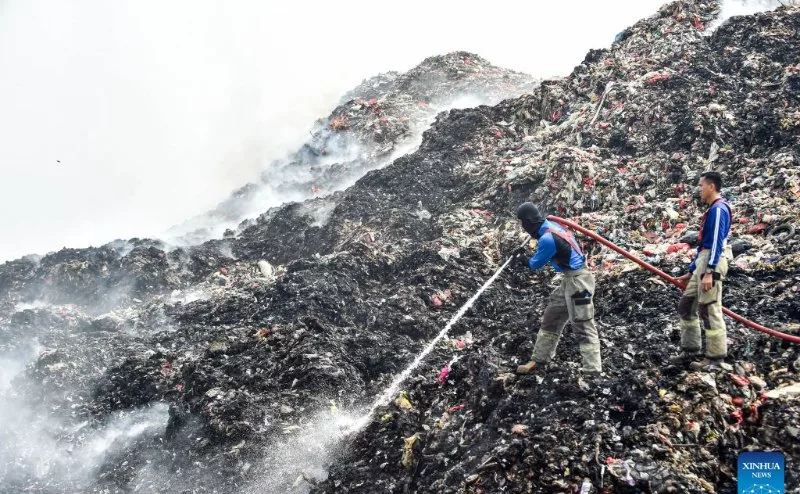
Indonesia Jakarta landfill fire Jatiwaringin toxic smoke 2026 environmental crisis has entered its eighth day with the blaze at the Jatiwaringin landfill on the outskirts of the Indonesian capital Jakarta still burning across more than 15 hectares, generating thick toxic smoke that has inundated surrounding residential areas, displaced hundreds of local residents to government shelters, caused local health authorities to examine at least 234 residents for respiratory illnesses including 72 cases of acute respiratory tract infections, and prompted the deployment of helicopters, water tankers, bulldozers, and drones in a firefighting response that officials hope can achieve full extinguishment by the end of the week. The fire broke out on June 30, initially triggered by a small spark fanned by strong gusts of wind that spread to multiple locations including the highest waste piles and spots that have proven difficult for firefighters to reach, with environmental NGO Walhi suggesting methane gas accumulation from decomposing organic waste as the underlying cause of a blaze that the Indonesian non-profit describes as an ecological disaster resulting from systemic negligence rather than an isolated accident. Djohan Darmawan, Director of Emergency Operations Control Coordination at Indonesia's National Disaster Management Agency, confirmed the fire required special handling because the blaze was not burning on the surface but smouldering inside the heaped rubbish itself, creating the internal combustion dynamic that surface water application cannot effectively reach and that makes landfill fires particularly difficult to extinguish once established in large waste mountains.
The human cost is documented through the specific testimonies of residents whose daily lives have been made unliveable by eight days of toxic smoke exposure. Forty-five-year-old Sarmanah told the BBC that smoke so thick you could not see anyone flooded her house, stinging noses, causing coughing and runny noses, and making breathing impossible, forcing her to flee with her child and join hundreds of others in the government emergency shelter. Tosiyani, 37, said she was prohibited from returning home because the smoke contains toxic gas, documenting the specific health authority assessment of the air quality emergency whose Ministry of Environment measurements have confirmed hazardous levels around the landfill, though severity has eased in recent days. The 234 residents examined for respiratory illness and the 72 acute respiratory tract infections confirmed among them represent the documented health burden of a fire whose daily proximity to residential areas has turned a waste management failure into a public health emergency whose cost will continue accumulating if the fire is not fully extinguished in the coming days as authorities are hoping.
The environmental analysis that Walhi campaigner Wahyu Eka Styawan provided to the BBC frames the Jatiwaringin fire not as a weather event or an operational accident but as a time bomb of accumulated waste management problems ignored for years without fundamental improvements, connecting the specific fire to the structural waste governance failure that makes Indonesia's landfills chronic environmental hazards rather than properly managed waste processing facilities. The Jatiwaringin landfill can accommodate up to 2,700 tonnes of waste per day but that only covers 59 percent of Tangerang Regency's total waste generation, with the remaining waste being dumped at open sites across the regency including areas within a hundred metres of people's homes that the longsuffering local community had been living with the odour, flies, and landslide fear from long before the fire began.
How Indonesia's Waste Management Failure Created the Jatiwaringin Time Bomb
Indonesia's unregulated open dumping system, whose widespread adoption across the country's waste management infrastructure created the specific conditions that make landfill fires a recurring environmental emergency rather than an exceptional event, is the structural context within which the Jatiwaringin fire must be understood as a predictable outcome of systemic negligence rather than an unforeseeable accident. Open dumping, in which waste is deposited in large piles without the compaction, soil covering, and leachate management that properly engineered landfill cells require, creates the specific aerobic and anaerobic decomposition conditions that produce methane gas as organic waste breaks down in the oxygen-depleted interior of a waste mountain whose depth prevents atmospheric ventilation. Methane's specific properties as a flammable gas whose ignition temperature is low enough that a small spark, a hot day, or a carelessly discarded cigarette can trigger ignition, combined with its tendency to accumulate in underground pockets within large waste piles, makes open dumps in warm climates fundamentally combustion-prone systems whose fire risk is not accidental but inherent to the physical and chemical processes that unmanaged organic waste decomposition produces.
The Jatiwaringin landfill's 2025 administrative sanctions from the Ministry of Environment and Forestry for poor management document the government's awareness of the specific facility's non-compliance with the waste management standards that its permit conditions require, and the gap between those sanctions and the infrastructure improvements that the sanctions were intended to compel represents the specific regulatory enforcement failure that the fire has retrospectively made visible. The ministry's instruction to implement a controlled landfill system with compaction, levelling, and periodic soil covering was the technically appropriate corrective requirement whose implementation would have reduced the methane accumulation risk that Tuesday's fire illustrates, but the combination of minimal regional waste management budgets, insufficient enforcement firmness, and the absence of sanctions severe enough to compel compliance that Wahyu identified as the systemic failure created the conditions in which the instruction remained unimplemented until the fire made its absence consequential.
The pattern of major landfill fires across Indonesia in 2023, including the Sarimukti Landfill in Bandung Regency that torched dozens of hectares and a Tangerang landfill fire that destroyed approximately 80 percent of a 35-hectare site in the same year, both suspected to have been caused by cigarette butts and methane buildup in the same mechanism as Jatiwaringin, documents the systemic and recurring nature of a waste fire problem whose repetition in multiple locations across multiple years establishes it as a structural governance failure rather than a series of isolated incidents. Each fire has prompted the same emergency response, the same ministerial investigation commitments, and the same calls for improved waste management without producing the fundamental system change that would prevent the next fire, creating the specific cycle that Wahyu characterises as making future fires inevitable as long as organic waste remains piled up in a jumbled mess producing underground methane gas.
The Tangerang Waste Overflow and the Proximity to Residential Areas
The specific waste volume mathematics that Walhi provided, with Jatiwaringin's 2,700 tonne daily capacity covering only 59 percent of Tangerang Regency's total waste generation, creates the structural overflow dynamic whose physical expression is the open dumping sites across Tangerang where the remaining 41 percent of the regency's waste ends up deposited outside the formal landfill boundary. The proximity of these overflow dumping sites to residential areas, some within a hundred metres of people's homes according to resident accounts, transforms a waste management system design problem into a direct daily quality of life and health impact on the communities who have been living in the fetid shadow of waste mountains whose pungent odours, fly infestations, and landslide risk had been persistent sources of complaint long before the June 30 fire began. The failure to address these community concerns before the fire represents the specific governance accountability failure whose most damaging expression the current crisis has produced, but whose chronic lower-level manifestations the affected communities had been experiencing and reporting without generating the policy response their wellbeing required.
The climate crisis dimension that Wahyu explicitly identified, with heat waves exacerbating the methane ignition risk at open dumping sites, connects the Jatiwaringin fire to the broader environmental context in which climate-driven temperature increases are turning pre-existing waste management failures into acute environmental emergencies at an accelerating rate. Indonesia's experience of more frequent and intense heat waves as part of the global warming pattern that climate scientists document creates the specific additional environmental stress that converts a methane-producing open dump from a chronic pollution problem into an acute fire risk whenever ambient temperatures rise high enough to trigger the ignition threshold. The Jatiwaringin fire's outbreak during an Indonesian summer period reflects this climate-waste management interaction at exactly the moment when the pattern of more frequent and severe heat events makes the underlying waste management infrastructure's methane accumulation risk more dangerous than it has historically been.
The Ministry Evaluation, Extinguishment Progress, and What Structural Reform Require
Indonesia's Ministry of Environment and Forestry announcement that it will evaluate 390 landfills across the country in early August 2026 following the Jatiwaringin fire represents the institutional acknowledgment that the problem's scale extends well beyond the single facility whose fire has generated international attention, creating the specific nationwide assessment opportunity whose findings could provide the evidence base for the systematic policy reform that Walhi and environmental advocates have been calling for without success through multiple previous fire cycles. A comprehensive evaluation of 390 landfills against the controlled landfill standards that the ministry's own regulations require would identify the specific proportion of Indonesia's waste disposal infrastructure that is operating in conditions analogous to Jatiwaringin's pre-fire state, providing both the regulatory accountability mapping that enforcement action requires and the political evidence base for the budget allocation and enforcement strengthening that genuine system improvement demands. The evaluation's value depends entirely on what follows from its findings, with the pattern of previous assessments, sanctions, and instructions not producing implementation suggesting that findings alone without the enforcement firmness and budget commitment that Wahyu identifies as the missing policy elements will produce another round of documented non-compliance rather than corrective action.
The controlled landfill system that the ministry instructed local governments to implement, involving compaction with heavy equipment and periodic soil covering, represents the technically achievable improvement to Indonesia's waste disposal practices that does not require the sophisticated engineered landfill infrastructure that the country's fiscal and technical capacity cannot immediately provide but that would substantially reduce the methane accumulation risk at existing disposal sites. The specific soil covering instruction's value is that it interrupts the anaerobic decomposition process that produces methane in oxygen-deprived waste pile interiors by periodically introducing the aerobic decomposition layer that covered waste generates, reducing the methane pocket formation whose ignition potential the Jatiwaringin fire has illustrated. The requirement that the instruction be enforced with the budget allocation and regulatory firmness that previous instructions lacked is the specific governance condition whose addition to the technical requirement creates the policy environment in which implementation becomes the path of least resistance for local governments rather than the financially and operationally demanding alternative to continued non-compliant open dumping.
Wahyu's warning that the fire could definitely catch fire again if the pattern is not changed, and that as long as organic waste remains piled up in a jumbled mess methane gas will continue to be produced underground, captures the specific environmental risk assessment whose communication to the Indonesian public, policymakers, and international environmental community the Jatiwaringin fire has created the attention moment for. The stark warning's substance is straightforward: without waste reduction at the source, ongoing sorting, and organic waste processing that prevents methane formation, every open dump in Indonesia is a potential Jatiwaringin waiting for the weather conditions and the spark that will turn it into an ecological disaster. Once the weather gets hot again, be prepared for more fires is the environmental advocate's summary of the risk landscape that Indonesia's 390 inadequately managed landfills represent to the communities living near them.