
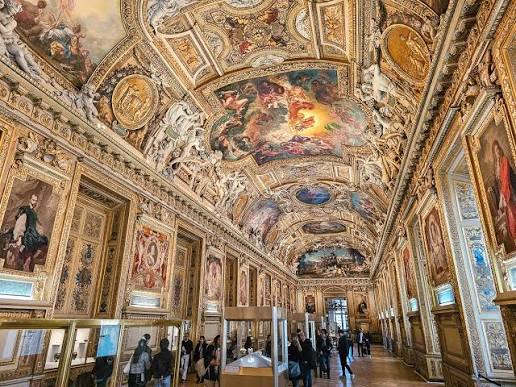
The Louvre Apollo Gallery opened its doors to visitors again on Wednesday, nine months after two men rode a movers' lift to its second-floor windows, smashed their way inside, and stole crown jewels valued at $102 million in a robbery that lasted less than seven minutes and left one of the world's most celebrated cultural institutions facing questions about its security, its governance, and its priorities that a gleaming reopening cannot fully answer. The gallery's richly decorated 17th-century interior, one of the most significant historic spaces in French cultural heritage, is once again accessible to the public. But the jewels are not there. They have been moved to a more secure location elsewhere in the museum, a practical concession to a security reality that the October heist made impossible to ignore.
The reopening was attended by Culture Minister Catherine Pegard, who called it the symbol of a new beginning after what she described as a "trauma for the whole world," and pledged to strengthen security at museums across France. Louvre director Christophe Leribault, who replaced Laurence des Cars following her February resignation, oversaw an event that was simultaneously a celebration of the gallery's return and a tacit acknowledgement of everything that went wrong in the months and years leading up to the robbery. The stolen items remain largely missing. Four suspects have been charged. The crown belonging to Empress Eugenie, Napoleon III's wife, was found damaged near the museum and is currently undergoing restoration. But the rest of the haul, one of the most valuable museum thefts in European history, has not been recovered.
The heist did not happen in the dead of night through sophisticated infiltration. It happened in broad daylight, with the thieves using an ordinary movers' lift parked outside the museum, smashing a window, cracking open display cases with angle grinders, and escaping on scooters driven by two accomplices waiting below. The entire operation took under seven minutes. That such a method worked, at the world's most visited museum on one of Paris's most heavily surveilled streets, is the central question around which every subsequent investigation, resignation, and security review has orbited. The answer, when it came, was uncomfortable: the Louvre had chronically under-invested in security infrastructure while spending heavily on art acquisitions, post-pandemic relaunch projects, and prestige initiatives, only a quarter of whose purchased artwork is currently accessible to the public.
The Apollo Gallery Heist in Full
The robbery took place in October, during the day, in one of the most high-profile cultural venues in the world. The Apollo Gallery, situated on the second floor of the Denon Wing of the Louvre, houses what has long been considered the crown jewels collection of France, items including crowns, sceptres, orbs, and decorative objects accumulated by French monarchs over centuries and surviving the Revolution, the Napoleonic period, and two world wars. Their value is both financial, assessed at $102 million, and cultural, representing an irreplaceable record of French royal history and goldsmithing tradition at the highest levels of European craftsmanship.
The thieves' method was notable for its directness and its disregard for the conventional assumptions of museum security. Two men arrived with a movers' lift, the kind of industrial platform used in furniture removals, and positioned it against the exterior of the building. They rode it to the second floor, broke a window, entered the gallery, and used angle grinders to force open the display cases containing the jewels. Two accomplices waited on scooters below. Within seven minutes, the group was gone, driving into the Paris traffic with one of the most significant collections of royal jewellery in European history. CCTV footage later examined by investigators captured the operation with a clarity that was both useful for the prosecution and mortifying for the institution.
Four people suspected of direct involvement have been charged and placed in custody, a significant law enforcement development that suggests French investigators have made meaningful progress on identifying the perpetrators. However, the recovery of the stolen items has been far more limited. The crown of Empress Eugenie, the consort of Napoleon III, was found damaged near the museum in the aftermath of the robbery and is currently being restored. The remainder of the stolen collection has not been located, raising the possibility that pieces have been broken up, melted down, or smuggled out of France through the networks that handle the movement of high-value stolen goods across international borders.
Security Underfunding, Governance Failures, and a Museum Under Financial Pressure
The heist was enabled by security failures that did not emerge spontaneously but accumulated over years of institutional prioritisation decisions that repeatedly chose art acquisition and prestige projects over security infrastructure maintenance. The state auditors' office, in reports that have gained new prominence since the robbery, had raised concerns about the Louvre's security spending relative to its other expenditures. The museum had been pursuing an ambitious acquisitions programme, adding artwork to a collection that is already so large that only a quarter of what is owned can be displayed at any given time, while simultaneously investing in post-pandemic visitor experience projects and international partnerships.
The specific vulnerability that the thieves exploited, an exterior window accessible from ground level by a standard movers' lift without triggering adequate alarm or response, reflects a physical security infrastructure that had not been maintained or upgraded to match the value and visibility of what it was protecting. A window on the second floor of the world's most visited museum, housing $102 million in crown jewels, should not be accessible to two men with a rented lift. That it was reflects not a single point of failure but a systemic pattern of security being treated as a lower priority than acquisitions, visitor experience, and institutional prestige.
The governance dimension is equally significant. Laurence des Cars, who was director of the Louvre at the time of the heist, resigned in February under pressure from criticism that included not only the robbery itself but the institutional culture that preceded it. Her departure after years of running one of the world's most prominent cultural institutions reflects the scale of the reputational damage and the intensity of the political and public pressure that followed. The appointment of Christophe Leribault as her successor was accompanied by an implicit mandate to address the security and governance failures that the October heist had exposed, and the Apollo Gallery's reopening, with jewels relocated to a more secure setting, is the first visible deliverable of that mandate.
From Heist to Reopening
October 2024 — Two men using a movers' lift access the Louvre's Apollo Gallery through a second-floor window, steal crown jewels valued at $102 million in a robbery lasting under seven minutes, and escape on scooters. French law enforcement launches an immediate investigation.
October to November 2024 — The crown of Empress Eugenie is found damaged near the museum. It begins the restoration process. The remainder of the stolen collection remains missing. Four suspects are identified, charged, and placed in custody.
November to January 2025 — The Apollo Gallery remains closed for security assessment and investigation. The Louvre faces sustained public and political criticism over security failures. The state auditors' office reports on security underspending are revisited and amplified in media coverage.
February 2025 — Louvre director Laurence des Cars resigns after facing intense criticism over both the robbery and the museum's rolling strikes over pay and working conditions. Christophe Leribault is appointed to lead the museum.
February to July 2025 — Security reviews are conducted. The decision is made to reopen the Apollo Gallery without the jewels, which will be displayed in a more secure location elsewhere in the museum. Restoration work on the Empress Eugenie crown continues.
Wednesday, July 2025 — The Apollo Gallery reopens to the public. Culture Minister Catherine Pegard attends and pledges a nationwide museum security upgrade. The jewels remain absent from their historic home.
France's Cultural Heritage Under Scrutiny
The Louvre heist has become a political flashpoint that extends well beyond the museum itself. France's identity as the global custodian of Western cultural heritage, a self-conception embedded in decades of cultural policy and enormous public investment, was directly challenged by an event that demonstrated the gap between that aspiration and the physical reality of how France's most prominent cultural institutions are actually protected. Culture Minister Pegard's attendance at the reopening and her pledge to strengthen security at museums nationwide reflects political acknowledgement that the failure at the Louvre was not an isolated incident but a symptom of a broader pattern.
The critical scrutiny of the Louvre's financial priorities, including its acquisition of artwork that is not publicly displayed and its heavy post-pandemic spending on visitor experience projects, has forced a political conversation about accountability in the management of public cultural assets. The Louvre is a public institution funded by a combination of state subsidy and visitor revenue. When state auditors raise concerns about how that money is being spent, and when those concerns are followed by a $102 million robbery enabled by security infrastructure that was not fit for purpose, the political accountability question is unavoidable. Who approved the spending priorities that left a window on the second floor of the world's most visited museum inadequately secured?
The resignation of des Cars added a personal accountability dimension to what might otherwise have been framed as a systemic or institutional failure. Her departure means there is a named individual whose professional departure is the consequence of the institutional failures, but it does not resolve the governance question of how the pattern was allowed to develop and whether the structures that enabled it have been genuinely reformed or merely reorganised. Leribault's first months in post will be watched carefully by both the cultural policy community and the political oversight bodies that fund the institution.
The Financial Cost of the Louvre's Security Failure
The $102 million valuation of the stolen items represents the financial floor of the loss, not the ceiling. The cultural and historical value of the missing pieces is not reducible to market price: these are objects that cannot be legitimately sold, insured at full value, or replaced. If any of the missing pieces have been broken up for their component materials, the destruction of unique historical artefacts represents an irreplaceable loss that no financial settlement can compensate.
The direct costs of the security failure extend beyond the stolen items. The Apollo Gallery's nine-month closure cost the Louvre in visitor revenue, reduced access to one of its most significant spaces, and forced security expenditure that had previously been avoided. The investigation costs, the legal process for the four charged suspects, the restoration of the Empress Eugenie crown, and the relocation and re-installation of the remaining collection in a more secure environment all represent unplanned expenditures against a budget that was already described by auditors as stretched by ambitious acquisition and project spending.
For France's tourism economy, the reputational damage of the heist is harder to quantify but potentially more significant. Paris, whose tourism economy is among the largest in the world, relies partly on the Louvre's position as the world's most visited museum to anchor the city's cultural attraction proposition. A robbery that makes global headlines for the wrong reasons, followed by a nine-month closure of one of the museum's most significant spaces, is not the kind of international attention that tourism authorities want for a destination preparing to build on the momentum of the 2024 Paris Olympics.
What the Heist Means for Museum Security Technology and Insurance
The Louvre robbery has triggered a global reassessment within the museum security industry of the assumptions underlying physical security planning at major cultural institutions. The specific method used, a movers' lift providing access to an upper-floor window, is not exotic or technically sophisticated. It is the kind of approach that a competent physical security survey should have identified as a vulnerability and addressed through detection systems, reinforced glazing, or alternative protective measures. That it was not addressed at the world's most visited museum raises uncomfortable questions for security consultants and museum administrators at institutions worldwide.
The insurance industry's response to the heist will shape how cultural institutions approach security investment in the coming years. Underwriters who provide coverage for museum collections will be examining their policy terms, their premium structures, and the physical security standards they require as conditions of coverage in the aftermath of an event that demonstrated how quickly and easily a major collection can be compromised. Institutions that cannot demonstrate adequate security infrastructure may find coverage more expensive, more conditional, or in some cases unavailable, creating a financial incentive for security investment that moral obligation and good governance had not sufficiently provided.
The market for museum security technology, including advanced perimeter detection, reinforced glazing, real-time alarm systems, and rapid-response protocols, is likely to see increased demand as cultural institutions worldwide reassess their vulnerabilities in the light of the Louvre incident. Companies operating in this sector will be positioning themselves as the solution to a problem that the world's most famous museum has just demonstrated in the most public way possible.
Museum Security Reassessment Worldwide
The Louvre heist is being studied by museum security professionals on every continent. The specific vulnerability, a window accessible by a standard piece of urban equipment available for daily rental, is not unique to the Louvre. Major museums in New York, London, Berlin, Amsterdam, Madrid, and dozens of other cities house collections of comparable or greater value in buildings whose exterior security has similarly evolved over time in response to specific historical threats rather than comprehensive modern threat assessments.
Culture Minister Pegard's pledge to strengthen security at museums across France is the most immediate policy response, but the implications extend to the international museum community through the professional networks that govern cultural heritage protection globally. UNESCO, the International Council of Museums, and national cultural heritage agencies in every major country with significant museum collections will be reviewing security protocols in the light of what the Louvre heist demonstrated about the gap between institutional reputation and physical protection reality.
The theft also raises the question of what happens to stolen cultural property of this significance. The international art crime investigation network, including Interpol's Works of Art unit and national police agencies, operates on the understanding that objects of the profile of the Louvre's crown jewels cannot be easily sold on open markets without triggering detection. But the sophistication of black market networks for high-value stolen cultural property, and the possibility that pieces have already left France or been altered beyond recognition, means the recovery prospects for the missing items are uncertain despite the arrests already made.
What Security Professionals and Cultural Heritage Scholars Are Saying
Security professionals who have reviewed the available information about the Louvre heist consistently identify two systemic failures that go beyond the specific window that the thieves used. The first is the failure of perimeter security to detect the positioning of a movers' lift against the exterior of the building before the thieves reached the window. In a modern security framework, the approach of a non-standard vehicle to a museum exterior during operating hours should trigger an alert and investigation. The second is the inadequacy of the response time: a robbery that took under seven minutes and was completed before any effective intervention was possible suggests that alarm-to-response protocols were not calibrated for the speed of threat that the thieves executed.
Cultural heritage scholars have noted the particular historical significance of what was lost and what, so far, has been partially recovered. The crown jewels of France have a complex history that includes their dispersal during the Revolution, partial reassembly under Napoleon, expansion under successive rulers, and near-complete survival through the upheavals of the 19th and 20th centuries. The Empress Eugenie crown, the one recovered piece in damaged condition, is associated with the Second Empire period and represents a specific chapter in French royal and decorative arts history. Its recovery, even damaged, is significant. The continued absence of the remainder of the collection is a gap in French cultural heritage that no insurance payout or security upgrade can fill.
The resignation of des Cars, while politically inevitable, is analysed by governance experts as a response that addresses accountability at the individual level without necessarily resolving the institutional patterns that created the conditions for the failure. The Louvre's governance structure, financial management practices, and security prioritisation frameworks are the underlying issues that require sustained reform rather than a single leadership change. Whether Leribault's appointment signals genuine institutional reform or reputational management without structural change will be determined by the decisions made in the months and years ahead.
Recovery, Reform, and the Long Road to Restoration
Criminal proceedings — The four suspects charged in connection with the heist will proceed through the French judicial system, a process that may take months or years to reach conclusion. Investigators will be pursuing the networks that moved and may be attempting to sell or break up the stolen collection, and any cooperation from charged suspects in exchange for sentencing consideration could yield leads on the missing items.
Recovery of stolen items — Interpol and French national police continue to work on the missing collection. Historical precedents for the recovery of major museum thefts suggest that some pieces may surface years later, either through investigative work or through items appearing in the market and being identified. The longer the items remain missing, the more likely it becomes that some have been irreversibly altered.
Nationwide museum security review — Culture Minister Pegard's pledge to strengthen security at museums across France implies a structured review process that will produce specific recommendations, funding commitments, and implementation timelines. The detail of that review will determine whether the Louvre heist becomes a turning point in French cultural heritage protection or a temporarily heightened concern that fades as immediate political pressure recedes.
Empress Eugenie crown restoration — The damaged crown found near the museum is currently being restored. Its eventual return to display, in the more secure location to which the jewels have been moved, will be a significant moment in the recovery narrative.
Louvre financial governance — The questions raised by state auditors about the Louvre's spending priorities, security investment levels, and the ratio of acquired to displayed artwork will not disappear with the reopening of the Apollo Gallery. Parliamentary and ministerial oversight of the museum's finances will remain more intense than it was before October, and Leribault will need to demonstrate a rebalancing of priorities that addresses the auditors' concerns.
What to Watch Next
Whether French investigators recover any additional pieces from the missing collection and whether charged suspects cooperate with information about the items' whereabouts.
The detail and funding commitments of the nationwide museum security review pledged by Culture Minister Pegard, and whether it produces structural change or symbolic gesture.
How the Louvre's governance and financial management practices change under Leribault, particularly whether security infrastructure spending is rebalanced relative to art acquisitions and prestige projects.
The restoration timeline for the Empress Eugenie crown and whether its return to display generates the kind of symbolic recovery narrative the institution needs.
Whether the international museum security community translates the lessons of the Louvre heist into concrete changes in physical security standards at comparable institutions worldwide.